Rowland's atheism
The Wreck of the Titan, or FutilityJohn Rowland's atheism is not merely a philosophical stance but a central, defining characteristic that shapes his identity, his relationships, and his ultimate transformation. It is the stated reason for his rejection by Myra Gaunt, the woman he loved, and it fuels his bitter, nihilistic worldview. Yet, the narrative traces a remarkable arc: the man who proudly denies God's existence is brought, by the suffering of an innocent child, to his knees in prayer. This evolution from defiant unbelief to a desperate, selfless supplication is one of the novella's most profound and ironic threads, illustrating the tension between intellectual conviction and the raw, human need for hope and meaning in the face of overwhelming tragedy.
The Nature of Rowland's Unbelief
Rowland's atheism is not a casual or passive skepticism; it is a deeply held, articulate, and defiant position. He is described as a graduate of the United States Naval Academy, a man of education and intellect, which makes his unbelief a matter of reasoned conviction rather than ignorance. His denial of God is first revealed through the testimony of Myra Selfridge, who recalls that he "actually denied the existence of God" to her, a professing Christian. This denial was not merely intellectual; it was a moral affront to her, and it became the primary reason she gave him up, despite her initial liking for him. She even attempted to "save him to God," but he ridiculed her beliefs, stating that he "would not be a hypocrite to gain" her good opinion, and that he would "express his honest unbelief." This commitment to honesty, even at the cost of love, reveals the integrity at the core of his atheism.
His unbelief is further articulated during his drugged state on the bridge of the Titan. In a rambling monologue, he rejects the idea of a "merciful God" who controls all things, arguing that such a being, if He exists, has given him his defects and his capacity for loving, only to place Myra Gaunt in his way. He sees no mercy in this, and he denies any obligation of love or gratitude to such a God. Instead, he affirms "the integrity of cause and effect," which he believes is "enough to explain the Universe, and me." This mechanistic worldview, rooted in the "survival of the fittest" and the "law of chance," is his intellectual bulwark against the pain of his unrequited love and his social disgrace.
The Crisis of Faith on the Iceberg
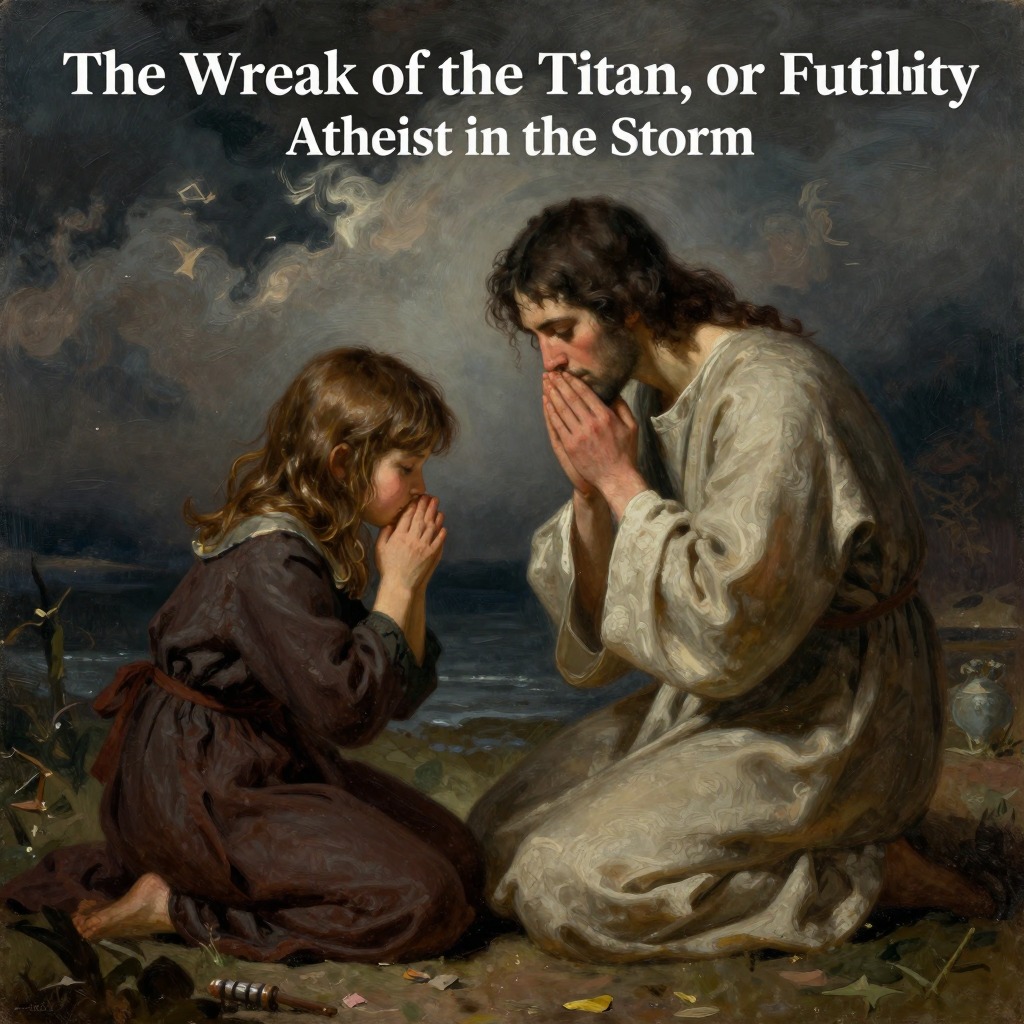
Rowland's atheism faces its most severe test during his ordeal on the iceberg with the child Myra. After the Titan sinks, he is left alone with the little girl, who is injured and crying for her mother. His rational mind offers no comfort. He contemplates the vastness of the universe, the "Christians' Heaven" and the "hell" invented by men, and concludes that "the qualities of mercy, goodness, justice, play no part in the governing scheme." He dismisses prayer as a "physiological experiment," asking whether the faithful would feel equally tranquil if they "repeated the multiplication table, or boxed the compass." Yet, in this moment of utter helplessness, his intellectual certainty begins to crack. He looks at the sleeping child and whispers, "For you, Myra," and then, in a profound reversal, he sinks to his knees and prays to the God he denies.
This prayer is not a conversion in the traditional sense. He does not renounce his atheism or embrace a personal God. Instead, he prays out of a desperate, selfless love for the child, begging for her life, for the safety of her mother, and for the strength to bring them together. Notably, he asks for nothing for himself. The narrator observes, "So much for pride." This act is a surrender of his intellectual pride, a recognition that his rationalism is insufficient in the face of such overwhelming need. The irony is immediate: as he rises from his knees, he sees the flying-jib of a bark, the Peerless, approaching. He wonders, "Is that prayer answered? Is she safe?" The narrative leaves the question open, but the timing suggests a possible, if ambiguous, response to his plea.
The Persistence of Doubt and the Shift in Priorities
Even after his rescue, Rowland's atheism does not disappear, but it is tempered by his experience. He does not become a believer, but he has been changed. His prayer was a moment of weakness, a concession to his humanity, but it did not resolve his intellectual doubts. However, his priorities have shifted. His love for the child Myra, and his desire to reunite her with her mother, have become the central focus of his life. This is evident in his refusal to testify against the Titan's owners, despite the opportunity to ruin them and gain revenge. He chooses instead to protect the child from the financial ruin that would result from the insurance not being paid. He tells Captain Barry, "I don't want to break this child." This decision, which seems to contradict his earlier desire for justice, is driven by his newfound sense of responsibility and love.
His atheism also influences his later life. After the trial, he rebuilds his life, working as a dock lounger, then a tally clerk, and finally securing a government position. He tells himself, "Now John Rowland, your future is your own. You have merely suffered in the past from a mistaken estimate of the importance of women and whisky." This statement reflects his continued reliance on self-determination and his rejection of divine providence. Yet, the narrative suggests that he is wrong. His future is not entirely his own, for he is still bound to Myra, the child, who writes to him, asking him to come and see her. The final line, "And the man went to see --- Myra," implies that his connection to her, and perhaps to the hope she represents, is more important than his philosophical convictions.
Thematic Significance: Atheism, Love, and Redemption
Rowland's atheism is not merely a personal belief; it is a lens through which the novella explores themes of love, suffering, and redemption. His unbelief is a product of his pain, a defense mechanism against a world that seems cruel and unjust. His love for Myra Gaunt, which was rejected, and his subsequent disgrace, have led him to a nihilistic worldview. Yet, it is through his love for the child, an innocent victim of the same cruel world, that he finds a purpose beyond himself. His prayer, though made to a God he does not believe in, is an act of love that transcends his intellectual doubts. It is a moment of profound humility, a recognition that some things are beyond rational explanation.
The novella does not offer a simple resolution to the question of God's existence. Rowland's prayer is not clearly answered, and his atheism remains. However, his transformation suggests that love and human connection can provide a meaning that his rationalism could not. His final act, going to see Myra, is a testament to the power of this connection. In the end, Rowland's atheism is not so much refuted as it is rendered irrelevant by the overwhelming force of his love for the child. He has found a reason to live, a future, and perhaps, a glimmer of hope that transcends his former despair.