Royal Naval College
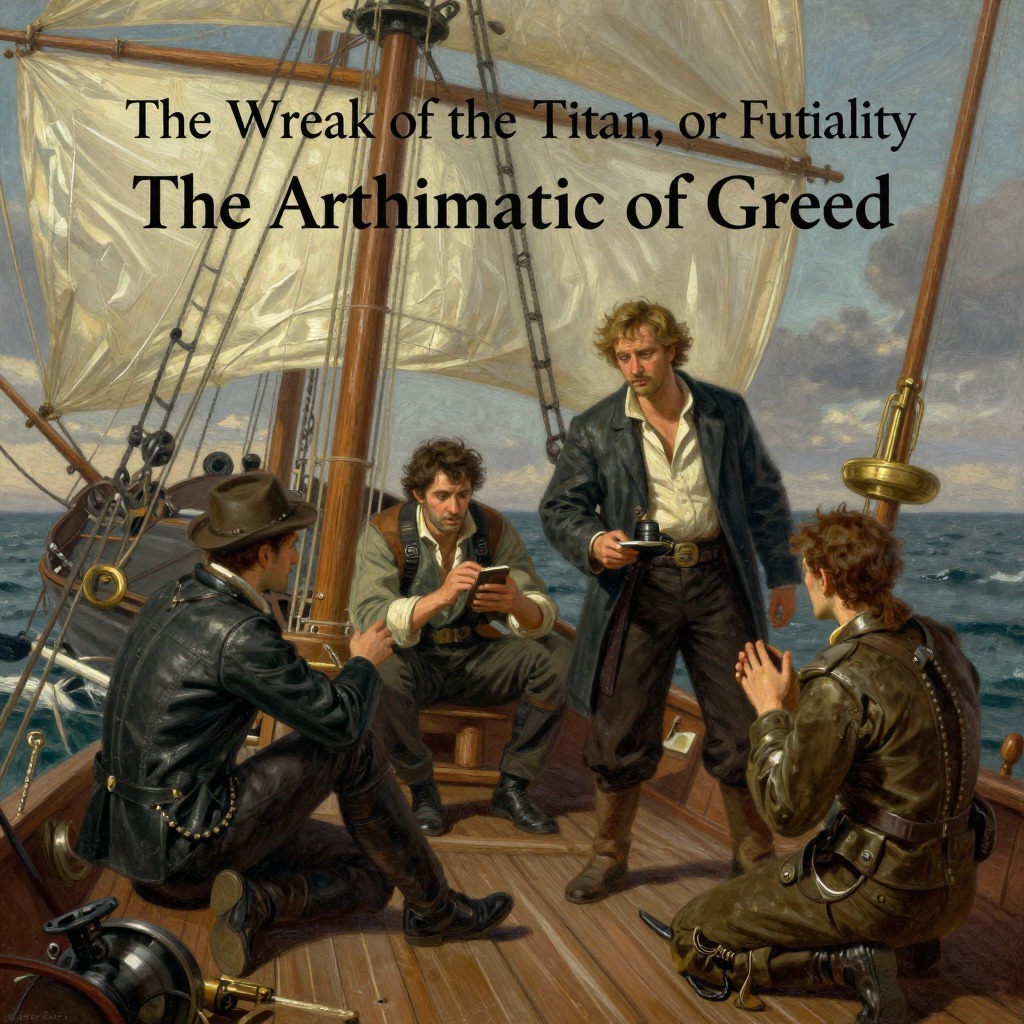
The Wreck of the Titan, or FutilityThe Royal Naval College stands in Morgan Robertson's The Wreck of the Titan as the benchmark of professional naval education, the institution whose rigorous scientific training defines the officers of the great steamship Titan. The novella opens by establishing that the Titan's bridge officers, "besides being the pick of the Royal Navy, had passed rigid examinations in all studies that pertained to the winds, tides, currents, and geography of the sea; they were not only seamen, but scientists." This standard, explicitly linked to the Royal Navy and its college, frames the ship's command as the pinnacle of maritime expertise, a class of scientifically trained professionals whose authority is both technical and social. The college thus functions as a marker of institutional prestige, the credential that separates the Titan's elite officers from the ordinary sailors who serve before the mast.
The College as a Standard of Professional Equality
The Royal Naval College becomes a crucial point of reference in the confrontation between John Rowland and the Titan's first officer, Mr. Austen. When Austen, suspicious of Rowland's competence, engages him in a conversation about navigation, he asks, "I suppose the curriculum is as complete at Annapolis as at the Royal Naval College." Rowland's reply, in which he discusses Maury's theories of currents and the calculation of ice position in fog, demonstrates that his education matches or exceeds that of the college-trained officer. Austen's muttered conclusion, "Must have a cast-iron stomach; or else the boats'n dosed the wrong man's pot," reveals that he had expected the drugged Rowland to be incoherent, but instead finds a man who can converse as an intellectual peer. The college thus serves as the yardstick by which Rowland's hidden identity is measured: despite his degraded appearance and alcoholism, his Annapolis training, explicitly compared to the Royal Naval College, marks him as an equal to the very officers who seek to discredit him.
The College and Rowland's Claim to Authority
The college's significance deepens in Rowland's confrontation with Captain Bryce in the chart-room after the collision with the Royal Age. When the captain attempts to bribe him into silence, Rowland asserts his credentials: "A graduate of Annapolis. Your equal in professional technic." This claim, which implicitly places Annapolis on par with the Royal Naval College, is what forces the captain to treat him "as man to man" rather than as a subordinate sailor. The college thus becomes a source of moral and intellectual authority that transcends Rowland's current rank. His knowledge of admiralty law, which he uses to threaten the captain with prosecution, is presented as part of the same professional training that the Royal Naval College represents. The institution, though British, is invoked to establish a transatlantic standard of naval professionalism that Rowland, despite his disgrace, still embodies.
The College and the Limits of Institutional Authority
The Royal Naval College also highlights the irony of the Titan's command structure. The officers, products of this elite education, are shown to be morally corrupt: Captain Bryce and Mr. Austen conspire to drug Rowland, conceal the collision with the Royal Age, and perjure themselves to protect the company's interests. The college's scientific rigor, which should produce men of integrity, instead produces men who use their expertise to manipulate and deceive. Rowland, the disgraced graduate of a rival institution, is the one who upholds the professional and ethical standards that the college-trained officers betray. The novella thus uses the Royal Naval College as a symbol of institutional authority that is hollow at its core, contrasting the ideal of scientific professionalism with the reality of corporate greed and moral failure. The college, like the Titan itself, represents the hubris of technological and institutional confidence that the narrative systematically dismantles.