
Bormann’s Ambition and the Regime’s Myth
The Zone of InterestThis thread follows Bormann’s pursuit of power and reveals how political ambition attaches itself to myth, bureaucracy, and private advantage.
increasing Bearing strength in each event
 decreasing
Bearing strength in each eventdecreasingA Search for Aryan Ancestry

A Search for Aryan Ancestry
A powerful man fears his lineage
Martin Bormann worries that his great-grandfather’s unknown parentage may weaken his claim to racial credentials. He pays attention to an ancestry investigation despite his senior position.
Racial doctrine turns inward
The regime’s categories threaten its own leaders as well as its victims. Bormann’s anxiety exposes the arbitrary foundations of a hierarchy presented as biological fact.
A New Theory of Cosmic Ice

A New Theory of Cosmic Ice
A pseudo-science gains political interest
Bormann asks Thomsen to assess the Ahnenerbe’s theory that Aryans originated through cosmic ice and Atlantis. Adolf Hitler’s apparent interest makes the doctrine politically useful.
Myth is treated as strategy
The question is not whether the theory is credible but whether it can support the regime’s authority. Thomsen’s investigation reveals how political leaders seek fabricated certainty.
Speer as a Rival

Speer as a Rival
Production changes the balance
Thomsen warns that Albert Speer’s rise and increased war production may threaten Bormann’s position. Bormann explains how Party officials can obstruct Speer’s access to resources.
Power is treated as inheritance
The discussion treats the succession as Bormann’s personal entitlement. The machinery of government becomes a means to secure influence rather than solve the crisis facing Germany.
The Hungarian Demand
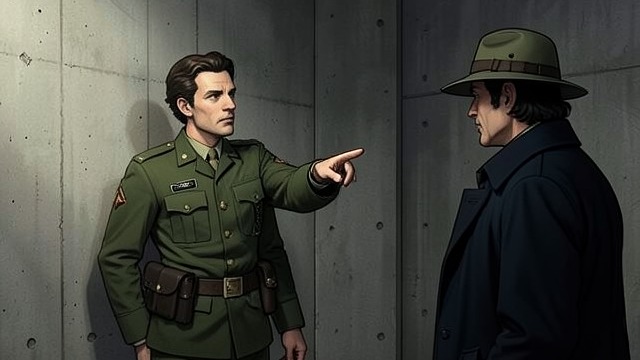
The Hungarian Demand
Pressure for persecution
Bormann demands restrictions on Jews in Hungary and insists that deportation must follow. He presents the Nazi program as a matter of national security and alliance loyalty.
Statecraft serves extermination
Diplomacy becomes a route for extending persecution beyond German-controlled territory. The meeting shows that the regime’s leaders continue pursuing mass murder while discussing international relations.
Trivial Ends at the Center

Trivial Ends at the Center
A postwar reckoning
Thomsen reflects on Bormann’s achievements and finds that the powerful official used influence for narrowly personal or absurd projects. Gerda remembers him chiefly through the laughter and authority she experienced at home.
Power leaves little moral legacy
The household recalls Bormann’s efforts on racial categories and Hungary, but these become inseparable from persecution. His private ambition survives as a small, compromised memory rather than a statesman’s accomplishment.
December 1942, during the Bormann family gathering
Late December 1942, before Thomsen returns to the camp
Winter 1942–43, during Bormann’s private discussions
Spring 1943, during Bormann’s talks with Hungarian officials
Spring 1946, in Thomsen’s conversation with Gerda
