
The Loss of Political and Moral Bearings
The Zone of InterestThis thread traces the characters’ movement through shifting ideologies and shows how political defeat fails to guarantee moral transformation.
increasing Bearing strength in each event
 decreasing
Bearing strength in each eventdecreasingThe Young Thomsen’s Politics

The Young Thomsen’s Politics
Ideologies come and go
Thomsen recalls moving among theocratic, monarchist, militarist, and Marxist positions before embracing National Socialism. He presents the shifts as a search for intellectual certainty.
Conviction proves vulnerable
His political trajectory makes him less an outsider than a participant in the era’s instability. The ease of his changes anticipates his later struggle to distinguish dissent from accommodation.
The Mitläufer’s Recognition

The Mitläufer’s Recognition
Going along becomes a self-description
Thomsen calls himself an obstructive follower who went along while trying to drag his feet. He recognizes that many Germans shared this position.
Partial resistance has limits
The phrase captures both small acts of delay and the larger fact of participation. Thomsen’s self-description does not settle whether he was courageous or merely protecting himself.
A Country of Ordinary People
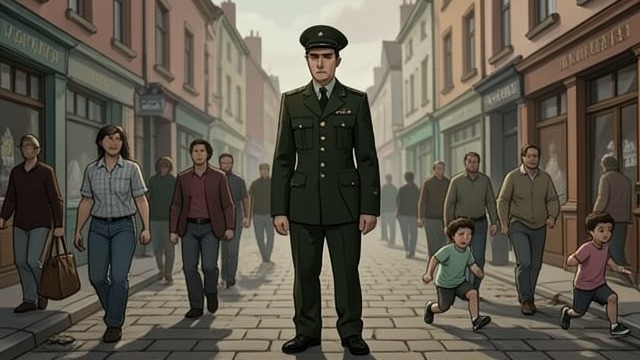
A Country of Ordinary People
Normal life returns unevenly
Thomsen sees families, veterans, vendors, and children moving through a town that has regained peace and freedom. The ordinary scene feels unfamiliar after the Third Reich and the war.
The normal hides a recent rupture
He wonders how an educated society consented to cruelty and then joined the machinery of murder. The question remains unresolved as daily life resumes around him.
Memory Without a Plausible Self

Memory Without a Plausible Self
Life continues without resolution
Thomsen works as a translator, maintains friendships, and contributes to reparations work. Yet he cannot construct a convincing inner life after his experience of the camp.
The past remains inside him
He remembers himself as divided under the regime and halved after it. The metaphor suggests that survival has not restored a whole identity.
Victims’ Justice as Work

Victims’ Justice as Work
Reparations give memory a task
Thomsen works on compensation guidelines for murdered relatives, years of slavery, physical and mental injury, and stolen property. The work connects his postwar life to people harmed by the regime.
Repair remains incomplete
The effort is important but cannot restore lost lives or erase Thomsen’s own role in the camp. His work offers a responsibility in place of the self-sufficient inner life he cannot find.
Before 1933, during Thomsen’s youth
1943, during Thomsen’s reflection on Germany’s collapse
September 1948, during Thomsen’s reflections in Rosenheim
September 1948, during Thomsen’s account of postwar life
1947–1948, before Thomsen’s visit to Rosenheim
