
Boris and Esther’s Uneasy Alliance
The Zone of InterestThis thread traces Boris’s protection of Esther, her refusal to accept the camp’s bargain, and the performance that makes her resistance visible.
increasing Bearing strength in each event
 decreasing
Bearing strength in each eventdecreasingA Rescue From the Clearance Detail
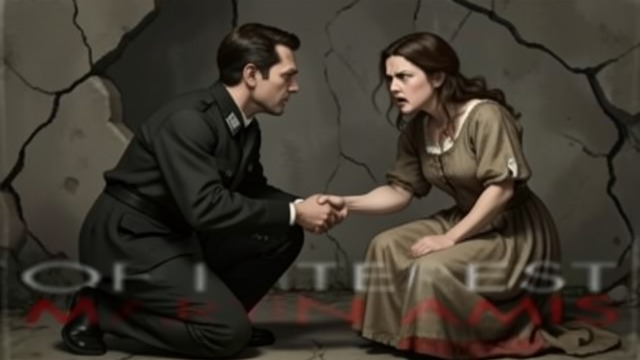
A Rescue From the Clearance Detail
Boris intervenes
Boris Eltz says he rescued Esther Kubis from rubble work and prevented her assignment to the latrine detail. Esther does not respond with gratitude; she hates him and resists his claim over her.
Protection is compromised
Boris’s intervention offers Esther a less lethal position, but he remains an officer in the system exploiting her. His care cannot be separated from his power over her circumstances.
The Dancing Memory

The Dancing Memory
An intimate origin story
Boris says Esther won his heart by dancing for his birthday. He recalls her movement as fluid and emotionally overwhelming, a memory that makes his attachment feel more vulnerable than his usual boasting.
A bond under threat
His affection does not free Esther from danger. She remains an imprisoned teenager, and Boris’s feelings coexist with the institution that can punish or kill her.
The Denunciatory Postcard

The Denunciatory Postcard
Esther rejects the approved story
Esther writes that the camp’s officials are lying murderers, thieves, and grave robbers rather than sending the reassuring account expected by censors. The postcard is intercepted and treated as political sabotage.
Boris hesitates
Boris first considers withholding food, believing confinement may teach Esther a lesson. Thomsen presses him to act, and Boris eventually secures her release through threats and bribes.
The Camp’s Star Performer

The Camp’s Star Performer
A performance is prepared
Boris arranges for Esther to take part in a ballet, where her training and talent draw the attention of Ilse Grese. He fears that Esther’s refusal to please the guards will bring punishment.
Art under coercion
Esther’s position as a celebrated performer brings privileges but no real safety. Boris’s protective hopes remain at the mercy of Ilse and the camp hierarchy.
A Dance of Survival
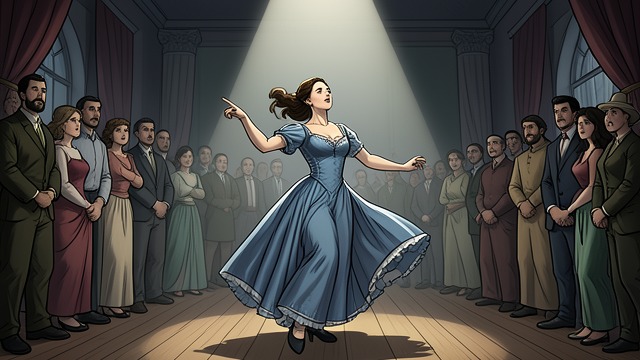
A Dance of Survival
Refusal becomes expression
Esther first performs awkwardly, making her puppet-like movements grotesque. Then the spell of the dance takes hold, and her movement becomes free and graceful before the camp audience.
Boris sees the meaning
Boris recognizes that her first movements imitate the prisoners and guards, while the final dance asserts a right to life and love. He leaves the theatre overcome, unable to treat her art as mere entertainment.
Late summer 1942, before Esther’s postcard
Before Esther is confined in Bunker 11
September 1942, after Esther is sent to Bunker 11
December 1942, before the December concert
December 1942, during the performance of Coppelia
