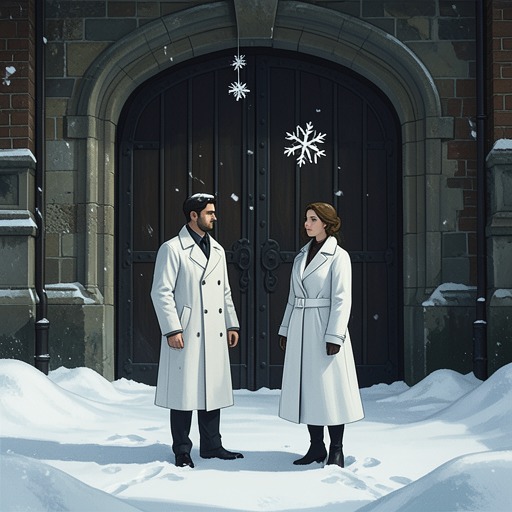
“Grey snow”
The Zone of Interest“Grey snow” gathers the book’s damaged landscape into a recurring image: the first autumn snow is ash-coloured, and its colour is associated with Dov Cohn’s eyes. The phrase links weather to death and contamination, then darkens into the later image of brown snow in a meditation on the camp’s filth and the actions that produce it.
The First Grey Snow
The image first appears as the narrator walks into the autumn snow. Its colour is given two unsettling comparisons: ash and Dov Cohn’s eyes. The snow is not introduced as a neutral seasonal detail; its colour makes the landscape resemble residue, while the reference to Dov gives that residue a human association. In the same passage, the narrator lists words used to classify and watch people, then describes being followed by a prisoner in striped clothing. Grey snow thus arrives amid surveillance and unease, an environmental image embedded in a world of human threat.
The ash comparison is reinforced elsewhere by the narrator’s account of the polluted water table in the Old Town. Pieces in the water have begun to ferment, and boiling cannot make it drinkable; the narrator warns that the smell will become unbearable. The snow is not explicitly said to have been discoloured by this water, but both images belong to a landscape in which contamination cannot be kept out of ordinary life. The weather carries the same atmosphere of material damage that the water and its smell make explicit.
Industrial and Bodily Contamination
The image gains force beside the view from the narrator’s office at Buna. Prisoners move in frantic lines under the shouting of Kapos, SS noncommissioned officers, and company foremen, while designers, engineers, and administrators from IG Farben plants step carefully past wounded, unconscious, and dead bodies. The contrast places business activity and industrial planning in the same frame as physical suffering. Against this setting, ash-coloured snow can suggest a landscape marked by violence without reducing the image to a literal report about its cause.
Smell is another route through which the book makes contamination palpable. After benzene tanks have been loaded and a receipt obtained for 1,800 zlotys, the narrator repeatedly pulls over during the drive back to sniff the air; the stench grows worse. His description turns into a dream of becoming a geyser of filth that keeps erupting and piling up. The image of grey snow belongs to this wider pattern: pollution is not a distant backdrop but a condition that presses upon bodies, movement, and perception.
From Grey to Brown
At Christmas, the narrator walks arm in arm with Gerda, wrapped in tweed hat, scarf, and shawl. When he embraces her, he imagines Hannah, noting their matching height and mass. The scene places an intimate, private displacement within the same cold landscape that the snow imagery has made ominous. The season offers no simple restoration of innocence or comfort; even an embrace is shaped by absence and substitution.
Later, the narrator wakes in the Officers’ Club after the November 9 Reich Day of Mourning luncheon. Around him lie the remains of a drunken banquet; outside, the dusk of Silesia is compared with the dawn in February as the colour of the concentration camp. In the questions that follow, he asks why the snow is made brown and likens its appearance to angelic excrement. The earlier grey image has become part of a more explicit reckoning with the camp’s filth: rats traded for bread rations, disease, the churning meadow, and pregnancies that promise death for both mother and child. The snow’s changing colour makes the environment register the consequences of what is done there.
Meaning and Recurrence
Grey snow is not simply a symbol of sadness. Its ash-like colour connects the ordinary weather to death and residue, while its association with Dov Cohn’s eyes makes the landscape answer to a human presence. The later brown snow carries the image further, tying environmental degradation to the narrator’s direct questions about the camp’s violence and the obedience that sustains it. Across these appearances, snow ceases to function as a clean seasonal contrast: it becomes a surface on which the consequences of the camp’s actions can be seen.