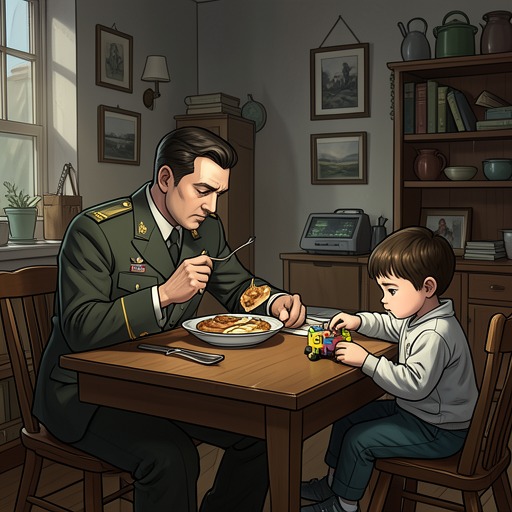
“I am a normal man with normal needs”
The Zone of Interest“I am a normal man with normal needs” is Paul Doll’s self-description and a refrain that turns his claim to ordinariness into evidence against it. He repeats the phrase while asserting sexual entitlement and political purpose, then insists that he is completely normal just as the narrative’s surrounding details make that assurance harder to accept. The words do not resolve the contradiction; their repetition makes it the point.
The Refrain and Its Setting
Doll first states that he is a normal man with normal needs after imagining that brandy will make Hannah Doll more compliant and planning to demand what he calls her spousal duty. He privately considers using Dieter Kruger’s name to overcome her resistance. In this setting, “normal needs” is not a neutral account of intimacy: the phrase recasts coercion as ordinary male entitlement, placing Doll’s self-image between his appetite and Hannah’s autonomy.
The refrain returns as Doll decides to sleep in the dressing room and approach Hannah in the morning while she is warm and somnolent. He says he will not tolerate nonsense, anticipates that they will both be in excellent spirits for a gathering at the villa, and concludes that he is completely normal—something, he complains, nobody seems to understand. The repeated assurance follows a plan to impose his will, so the performance of normality cannot erase the coercion it attempts to normalize.
The section then closes with the blunt sentence, “Paul Doll is completely normal.” Its shift from Doll’s first-person insistence to a third-person declaration makes the claim sound less like a settled fact than a refrain being displayed for judgment. The book does not need to append a verdict: the preceding details have already placed the assertion under pressure.
Normality as Political Excuse
Doll’s appeal to normality has a public counterpart in his language of political necessity. In a discussion of prisoners’ treatment, Angelus Thomsen distinguishes the practical concerns of commerce and industrial chemistry from the camp leadership’s political objective. Doll immediately claims agreement with the Reichsführer-SS and rejects pampering. His position treats a refusal of care as a reasonable administrative stance, while his invocation of political purpose makes cruelty sound like duty rather than choice.
The same logic is more explicit when Doll surveys the field at Spring Meadow. He denies feeling false sentimentality, says that thoughts of Germany and its Deliverer overcome human weakness, and frames kindness to Jews as cruelty to Germans. He then declares that right and wrong, good and bad, belong to a superseded order, leaving only positive or negative outcomes. Here, his supposed normality rests on a moral vocabulary that has been deliberately emptied: violence becomes acceptable not because it is ordinary, but because he has recast it as service to a political end.
Doll’s account of antisemitic propaganda shows a related maneuver. He objects to Der Stürmer not because its hatred is false, but because its lurid cartoons, in his view, damage antisemitism; he prefers charts, statistics, and scientific evidence. By presenting a more controlled propaganda as rational and effective, he distinguishes his own outlook from vulgar excess without rejecting the persecution it serves. The pose of moderation thus supports, rather than interrupts, his effort to see himself as a reasonable man.
The Refrain Under Strain
The book supplies a sharp counterpoint through Boris Eltz, who describes hearing that psychiatric patients were being killed to free beds for men psychologically broken by killing women and children in Poland and Russia. Boris calls his realization an “anti-eureka”: he had begun to understand that something in the state was not as it should be. His report names the human cost that Doll’s language of political objectives and positive outcomes suppresses. It places a different response to the same system beside Doll’s repeated claim to normality.
A later passage unsettles that claim from within Doll’s own narration. After the Reich Day of Mourning luncheon, he wakes in the Officers’ Club amid the wreckage of a drunken feast and asks why supposedly good work smells so bad, why the men drink so brutally, and why the meadow was made to churn and spit. He asks why conception and pregnancy promise death for both woman and child, and why the snow is turned brown. These questions do not amount to a clear renunciation of his role, but they mark a breach in the certainty that the refrain tries to maintain: the consequences he has repeatedly justified return as questions he cannot make disappear.
Meaning and Effect
The phrase works through repetition and contradiction. Each return presents Doll’s normality as something he must assert, while the circumstances around it show what his definition leaves out: Hannah’s lack of freedom, prisoners’ suffering, and the moral consequences of the camp’s violence. His confidence in political purpose and his later, unsettled questions remain side by side rather than resolving into a conversion.
As a result, “I am a normal man with normal needs” is not simply a characterization of Doll’s self-image. It exposes how the language of ordinary desire and respectable duty can shelter domination, while the reiterated claim itself becomes a measure of the distance between the man Doll says he is and the actions and system the narrative places before the reader.