Alisz Seisser
The Zone of InterestAlisz Seisser’s story exposes the violence concealed inside Paul Doll’s language of protection. First presented as the young widow of a non-commissioned officer, she returns to the camp as a prisoner after her Sinti ancestry is recognized. Doll arranges her work and confinement, visits her under the guise of concern, and treats his access to her as a private relationship. Her pregnancy and the abortion procedure he engineers reveal how little protection such attention affords her; her eventual transfer to Theresienstadt offers only an uncertain possibility of survival.
Identity and Introduction
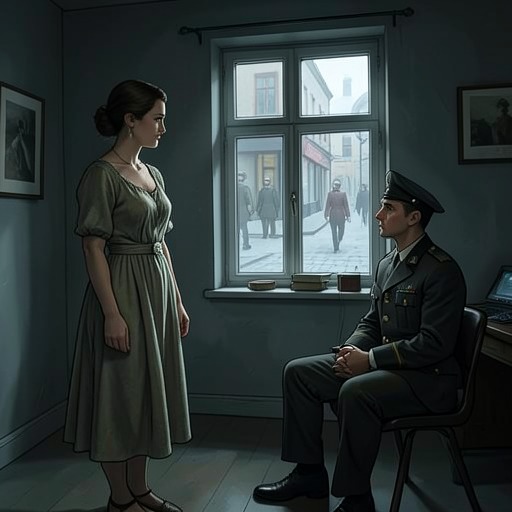
Alisz enters the narrative as a bereaved woman at a dinner attended by camp officials and their wives. Her husband, Regimental Sergeant Major Orbart Seisser, has recently died amid violence and disgrace at the camp. The gathering’s etiquette confines women largely to conversation during the soup course; afterward, their voices are expected to recede into the background. Doll turns to Alisz as his dinner companion, describing her as a young widow who is visibly ill at ease and treating her presence as an occasion to offer consolation.
The scene also establishes the unequal attention she receives. Alisz raises her black veil while sitting at the table; the narrator notices her appearance, while Boris Eltz has reportedly admired her figure and recounted her husband’s final hours. Doll’s ostensible condolences are bound up with the humiliating circumstances of Orbart’s death: he considers telling her that her husband had been under the influence of morphine during his final misadventure. The widow is thus introduced not through a history of her own making, but through bereavement, the camp’s violence, and the men’s appraising accounts of her.
From Widow to Prisoner
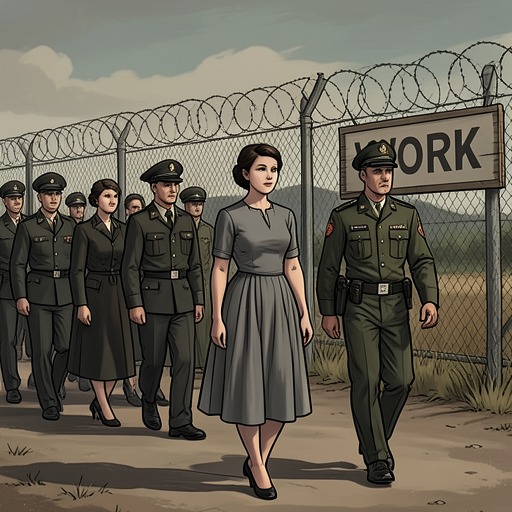
Alisz’s return from Hamburg changes her status. She had gone there intending, among other things, to pursue her pension, but a communication from the Gestapo says she is coming back as an evacuee. The administrative label marks a decisive reversal: the bereaved woman whom officials had accommodated at a dinner is now being returned to the camp within the machinery of persecution.
Her ancestry explains the change. At the camp, she tells Doll that her husband had known she had a Sinti grandmother and that this fact was already in her file. She recalls that Orbart had warned, half-jokingly, that if he died or she left him, she would be in trouble. Her explanation is direct and matter-of-fact, but Doll’s response shows the danger attached to the record: he recognizes that the authorities have classified her as a Gypsy prisoner. He notes that a family camp exists at Kat Zet II, but says its inmates are treated as internees and are not placed on labor lists; as far as he knows, Alisz is the only Sinti prisoner in the Zone. Her individual vulnerability is therefore sharpened by her isolation within the camp system.
Doll says he will continue to do what he can for her. The promise is not a release from the system that has made her vulnerable. Instead, it begins a relationship in which the commandant’s authority over her status, work, and living conditions is inseparable from his personal claims on her.
Work, Confinement, and Doll’s Attention
Alisz is employed as a veterinary nurse at the camp piggery, a modest adjunct to the Home Farm Station. Her uniform resembles the clothing worn by helpers in the prisoners’ infirmary: a white linen jacket and trousers marked with red stripes down the back. Doll approaches her at the window of her surgery, where she welcomes him as commandant. He asks after her difficulties in Hamburg and whether her pension came through, presenting himself as a concerned benefactor even as their relationship takes place under his control.
At some point Doll arranges for her to be moved to a facility in the basement of the MAB. He describes the move as making it possible for them to spend precious hours together. After his workday, which may extend past midnight, he says he regularly visits her with a small snack, often a prune or cube of cheese. He recounts their conversations about childhood and the German countryside: Alisz tells stories of summer on the Pomeranian coast, while he speaks of the Haardt Forest and his horse, Jonti. The contrast between their shared reminiscences and the reality of her confinement is stark. She is a prisoner in a space he has arranged, and even the food he brings is described as a personal gift rather than something secured by her own control.
The narrative also reveals the limits of Doll’s professed tenderness. He describes Alisz as knowing her place and retreating as soon as he glares. That description makes plain the imbalance he would otherwise recast as domestic familiarity: she is not an equal participant in a private romance, but a prisoner subject to a powerful officer’s displeasure.
Pregnancy and the Abortion Procedure
In 1943 Doll discloses that Alisz is pregnant and that he is involved in the situation. The pregnancy changes the stakes of his visits. When he next finds her crouched on a stool, her hands moving restlessly in her lap, he tells her he has spoken to a physician and assures her that the procedure will be simple and routine. Alisz objects that there are no women doctors in the camp. Doll answers that there are hundreds, because the women doctors are prisoners. When she points out that the prisoner physicians have toolkits rather than proper instruments, he insists that not all of them do.
Doll sits her beside him on the bed and tries to reassure her. Alisz thanks him for finding an answer, language that conveys both her dependence on him and the narrowness of the choices available to her. The same scene records Doll’s sexual exploitation of her: despite his stated scruples about sex with a pregnant woman, he has intercourse with her, reasoning to himself that he has already crossed a line and might as well go further. His conduct turns supposed care into another assertion of access, while he continues to present himself as the person solving the crisis.
The later procedure takes place in Alisz’s confined surroundings, with Miriam Luxemburg, a prisoner physician, preparing a portable stand and instruments on a blue cloth. Doll repeatedly defers the operation, and Luxemburg appears miffed by the delays. By the time Alisz lies on a stripped, towel-padded cot, wearing a white singlet with her legs apart and knees raised, she has a leather thong in her mouth. She has not been outdoors for a considerable period. The clinical arrangement does not make the procedure safe or voluntary: it takes place in a prison environment, under the authority of the man who has controlled her accommodation and pressed her toward it.
Illness and Uncertain Survival
Alisz contracts tuberculosis of the hip. In January 1944 she is transferred to Theresienstadt, a camp that the narrative describes as only occasionally given a Potemkin-like appearance. The account does not establish what happened to her afterward. It judges that she had a better-than-even chance of surviving the war, but leaves that survival unconfirmed.
Her ending is therefore neither a documented death nor a secure rescue. The transfer removes her from Doll’s immediate orbit, but the evidence offers no later testimony from Alisz herself and no settled account of her life after the move. That uncertainty completes a trajectory in which others repeatedly determine her status—widow, evacuee, prisoner, worker, pregnant patient—while her own words surface briefly to explain the ancestry already entered in a file and to voice concrete fears about the instruments to be used on her. Her story makes Doll’s paternal language legible as a form of power: his attention may provide a snack or alter her location, but it never cancels the coercion that defines their relationship.