Bearing witness
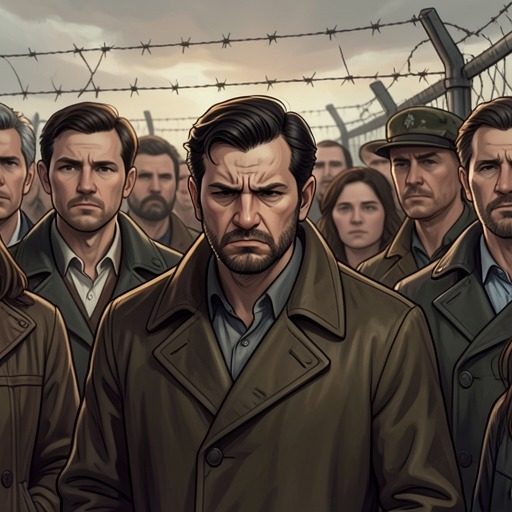
The Zone of InterestBearing witness is one of the few reasons the narrator can give for continuing to live inside the camp, but it offers no clean refuge from complicity or doubt. The Sonderkommando prisoners speak of recording what they have seen, yet their attempts to preserve testimony confront a harder question: how can a witness tell the truth about atrocity without claiming more than he knows, or turning the dead into material for a story? The novel makes witness an action under pressure, at once an obligation, a fragile collective hope, and an uncertain form of survival.
Witness as a reason to survive
The narrator sets bearing witness beside two other reasons for living: the hope of mortal vengeance and the possibility of saving or prolonging a life. The first remains imaginable but unresolved; witnessing, he says, has not yet made a killer visible in the magic looking glass. The third reason is concrete and small beside the scale of the killing. The prisoners sometimes save a youth from a transport, averaging one life per transport, though occasionally saving none or two. These are invariably male youths, and the rescue must happen as people leave the train. Once the selection lines form, the opportunity has already passed.
That narrow interval gives witness a practical counterpart. It is not only a future report to the outside world, but an effort to act before the machinery of selection closes around its victims. The narrator rejects the heroic picture of the witness as someone who escapes and informs an ignorant world. In his view, the scale of the crimes makes it impossible to believe that the world has not known for some time. Bearing witness therefore cannot be reduced to revealing a secret; it remains necessary even when the witness doubts that revelation will surprise anyone or undo what has happened.
The work of testimony also begins from a compromised position. The prisoners receive liquor, cigarettes, and food after major operations, and sleep in a bunkroom above a disused crematory. The narrator recalls his philosophical friend Adam's claim that they lack even the comfort of innocence, but refuses to accept that judgment as final: he would still plead not guilty. The tension matters to the concept. Witness is not offered as proof of purity, nor does the narrator claim that telling what happened cancels participation. It is an attempt to speak from within a situation that has already damaged the speaker's claim to moral distance.
A fragile community of witnesses
After work, a small part of the expanded Kommando gathers in the bunkroom, usually around dawn, with food, liquor, and cigarettes. The narrator estimates that about five per cent of the men, roughly forty, have neither become accustomed to the work nor gone mad. They talk earnestly and at length about questions for which, they feel, human history offers no example or precedent. Their conversations create the possibility of companionship, but the narrator carefully marks that possibility as something he wants to believe in, not something he can securely establish.
The group initially finds clarity in the word martyr: across the languages the narrator knows, he connects it to the Greek word for witness. Some of the prisoners will bear witness, they conclude, and this question seems less ambiguous than the others they face. The confidence does not last. The transition from a shared principle to the reading of one particular account reveals how quickly witness becomes difficult once it must take a specific form, with a specific voice and claims that can be challenged.
Josef's buried manuscript and the limits of testimony
Josef, a Jewish chemist from Brno, buried an eight-page manuscript written in Yiddish and black ink inside a child's galosh under the hedgerow bordering Paul Doll's garden. After disputation and a show of hands, the prisoners decide to exhume it temporarily and read it. The narrator is instinctively, perhaps superstitiously, opposed; afterward he regards the episode as one of the Lager's experiences he would least willingly relive. The document's concealment makes its purpose unmistakable: it is intended to survive its writer and reach readers. But preservation alone cannot settle whether its account is true, or whether those who read it can bear to transmit it responsibly.
As the narrator reads, he falters over an account that begins with a five-year-old girl. The men tell him to stop, order him not to rebury the manuscript, and demand that it be destroyed unread. They turn away and seek their bedding. The interruption is not simply a refusal to hear evidence: the narrator himself objects to the account's representation of children. He remembers Josef as serious and believes his intentions were good, perhaps even noble, yet judges the writing untrue and unclean. He doubts that a child of five or a boy of eight could understand the situation of the Sonder. The testimony thus provokes an ethical crisis: the impulse to preserve the record collides with the fear that the record attributes adult understanding and rhetoric to children who could not have possessed it.
One passage describes a young Polish woman speaking in the gas chamber, condemning Nazi crimes and oppression and expressing confidence that her nation's history would preserve its initiative and spirit. It then recounts the Poles kneeling in prayer, rising to sing the Polish anthem, and the Jews singing Hatikvah. The manuscript presents their different traditions as joined by a common fate. The narrator cannot comfortably accept this eloquent scene as evidence of what the children understood; nor can he treat the question as merely stylistic. He turns the crisis back upon himself, asking whether he will lie, whether he will need to deceive, and whether he will write disgustingly. Despite the group's demand that the pages be destroyed, he makes sure they are reinterred. Their fate remains suspended between concealment and preservation, while the narrator's unease over the act of reading persists.
Public memory, private memory, and the mirror
The novel contrasts this uncertain, contested testimony with Paul Doll's public commemorative speech. At a Reich Day of Mourning ceremony on November 9, Doll invokes the dates 1918, 1938, and 1923, presenting Nazi persecution as a response to supposed Jewish betrayal and describing the violence of Kristallnacht as a spontaneous popular rising. His ritual of mourning turns the past into propaganda: the speaker claims authority to narrate history while distorting the crimes that a witness would have to name. The contrast sharpens the stakes of testimony. A public account is not truthful simply because it is delivered ceremonially or before an assembled audience; its claims must be measured against what it suppresses and falsifies.
Witness also returns as a wound that cannot be summoned at will. When Thomsen explains his sour response to the apparent satisfaction around him, he does not describe the image that recurs whenever he closes his eyes: a flesh-coated skeleton pegged out on the whipping horse. His decision not to make the image more vivid in speech shows that silence can mark the pressure of traumatic memory, not its absence. The past enters his present through involuntary recurrence, while the act of narration remains incomplete.
In the postwar reflection on National Socialism, the mirror becomes a figure for the way people were revealed to themselves through their conduct. The narrator includes victims, malefactors, collaborators, witnesses, conspirators, martyrs, and minor obstructors such as himself and Hannah Doll. The Zone of Interest is defined not only by the camp's physical location but by the exposure of who people were under its conditions. This retrospect does not erase the differences among these roles; it places them within a history in which actions and failures of action became part of what could later be known.
The effort to know continues in 1948, when the narrator searches for Hannah Doll's maiden name in Rosenheim. The town has eighteen boroughs, each with its own Standesamt, and after a week of rounds he has managed to consult only three ledgers, without learning anything. His drudgery, money, and obsequiousness produce no discovery. The failed search extends the problem of testimony into peacetime: records may exist and still yield no answer, while the person being sought remains more than the surviving documents can explain. Bearing witness consequently ends neither in a complete archive nor in a settled claim of innocence. It is the persistent, self-questioning work of distinguishing what can be reported, what has been falsified, and what remains painfully beyond recovery.