Beer Hall Putsch
The Zone of InterestThe Beer Hall Putsch is recalled during Paul Doll’s November 9 memorial ceremony, where a failed 1923 revolt becomes a story of national martyrdom. The episode matters less as a straightforward account of the coup than as a demonstration of how Doll turns defeat into patriotic myth: his solemn pageant of heroic sacrifice is punctured by the narrator’s precise, almost grotesquely ordinary details about the marchers, their uniforms, and their pay.
The Putsch as a Memorial Story
Doll invokes November 9 as a day of threefold significance for the Nazi movement. He links it to the 1918 revolution and to the 1938 pogrom, presenting both through antisemitic claims that transform political defeat and state-organized violence into stories of Jewish provocation. He then announces that his true subject is November 9, 1923, and the Putsch. By placing the failed uprising inside this invented sequence of injuries and vindications, Doll makes a political reversal sound like a sacred inheritance.
His performance takes place at a memorial gathering, not in a neutral historical account. He is visibly not wholly sober, but has measured his drinking; liquor has warmed him and deepened his voice. From beneath the sloping wooden lectern he produces a large glass of colourless liquid, which gives off a faint vapour. His ceremonial manner makes the past seem present and holy, while the details surrounding the speech disclose the unstable, theatrical conditions of its telling.
The March on Munich
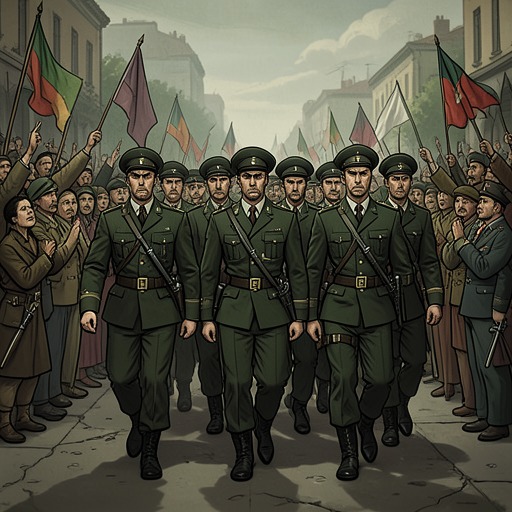
The narrator’s account reduces the grandeur of Doll’s language to a specific crowd and route. About 1,900 men gathered in and around the Bürgerbräukeller in Munich: tub-thumpers, militiamen, storekeepers, students, and other disaffected men, of different ages and backgrounds, armed and wearing ill-fitting brown uniforms. Each had been paid two billion marks, equivalent on that day to three dollars and four or five cents. At the appointed hour they emerged from the beer cellar and began moving toward the Feldherrnhalle, the first stage, in their plan, of a revolutionary march on Berlin.
Doll describes the marchers as grave yet joyful, iron-willed but carefree, moved by the crowd and inspired by Mussolini’s march on Rome. In his version they joke and sing even as they jeer at the carbines of the Republican State Police. The narrator’s description offers no comparable grandeur: an assortment of armed men, in badly fitting uniforms, set out from a cellar on a revolutionary venture. This contrast does not erase the march’s violence; it shows how the memorial speech converts a disorderly political gamble into a polished scene of collective destiny.
Gunfire and the Heroic Version
The march ends in gunfire. Doll’s account moves from a shot to a volley and then a fusillade. General Erich von Ludendorff presses forward in righteous fury; Goring is badly wounded in the leg. The future Reich leader, whom Doll calls the Deliverer, is said to have braved the bullets with two broken arms to carry a helpless child to safety. When the gun smoke clears, Doll declares, fourteen men dead: fourteen brothers and warrior-poets, leaving fourteen widows and sixty fatherless children. He makes their deaths the foundation of the hope and rebirth he claims the gathering is honouring.
These details belong to Doll’s staged retelling, and his diction steadily raises the dead from participants in a failed uprising into sacrificial heroes. The narrator’s account and Doll’s speech therefore do different work: one names the crowd, its meeting place, its numbers, and its route; the other arranges the violence into a consoling legend. The speech’s insistence on sacrifice is especially pointed because the historical outcome it commemorates is defeat, not victory.
Political Memory and the Later Narrative
The ceremony’s use of the Putsch sits beside a broader account of Nazi political violence. In a later conversation in the Tiergarten, Professor Entress argues that industrial killing was not the source of the will to exterminate: gas chambers and crematoria accelerated the process, economised its operation, and spared the killers’ nerves, but bullets and pyres would ultimately have served the same purpose. He cites the Einsatzgruppen’s killing of well over a million people by bullets. That analysis does not make the 1923 march the cause of later mass murder; it places Doll’s celebration of armed political violence within a narrative that insists on the consequences of political will, whatever the means used to enact it.
The Beer Hall Putsch’s memorial meaning is thus exposed as an act of selective remembrance. Doll dwells on the dead as proof of national virtue, while the narrative makes the audience hear both the embellishment and the historical cost obscured by such ceremonies. The speech tries to seal defeat inside a story of rebirth; the surrounding account leaves that story open to judgment.