Boris Eltz
The Zone of InterestBoris Eltz is Angelus Thomsen’s childhood friend, closest companion, and “blood brother,” as well as a Nazi officer whose fierce nationalism repeatedly places their bond under strain. Emphatic, intrepid, and handsome, he moves between affectionate intimacy, physical violence, and ideological conviction. His story culminates in his death at Kursk, but the significance of that ending lies in the contradictions already present in his life: he can recognize the war’s folly and respond deeply to Esther Kubis’s suffering, yet remains committed to a cause that makes both the camp and the battlefield possible.
Identity and a lifelong friendship
Boris and Thomsen’s connection reaches back to early childhood. Thomsen recalls them as having known each other, apparently, since they were one; their shared history runs through kindergarten, childhood, and adolescence into cycling holidays in France, England, Scotland, and Ireland, and a three-month trek from Munich to Reggio and onward to Sicily. Boris is not merely a companion from the past: he is a continuing presence against whom Thomsen measures his own choices and whose judgment he fears.
Their closeness does not mean they are gentle with one another. When they were twelve, a shouting match became a fight, and Boris’s violence struck Thomsen as passionate and self-righteous, like being run over by a combine harvester. Thomsen briefly took that ferocity for evidence that Boris had always hated him. The aftermath overturned the impression: Boris wept, stroked his shoulder, and repeatedly apologized. The episode establishes a pattern that persists into adulthood—force and tenderness coexist, and an eruption does not cancel the attachment beneath it.
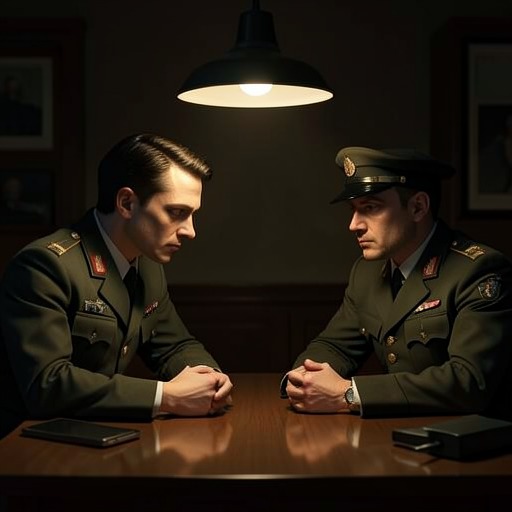
That attachment becomes difficult after the Nazi seizure of power. Thomsen says he could not bear to be near Boris in the months following 1933, when Boris was, in his account, one of only two people in Germany who viscerally wanted world war. A further period of estrangement followed the invasion of Poland and lasted through the setback outside Moscow in December 1941. Even after they resume a familiar intimacy, their friendship remains politically dangerous: Thomsen knows that if Boris discovered his secret work with Roland Bullard, Boris would draw his Luger and shoot him. Their history makes that prospect more than a simple threat between enemies; it is the lethal limit of a friendship that has survived profound disagreements but not every possible betrayal.
Officer, nationalist, and uneasy critic
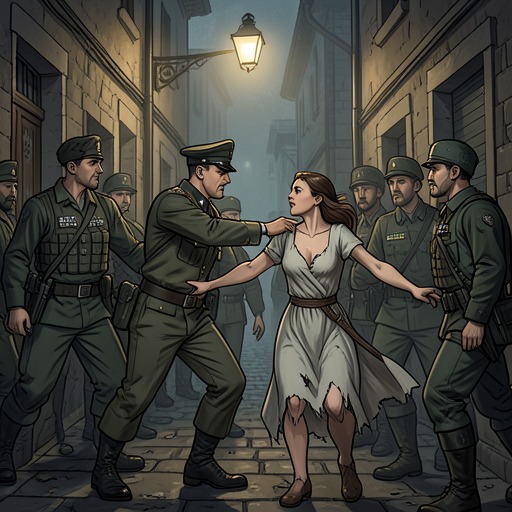
Boris’s position inside the camp brings him into direct proximity with its machinery of selection and death. After another fistfight, he is assigned a month of staggered duty on the ramp, a punishment within a punishment. The work encompasses the arrival of deportees, selection, and the drive through the birch wood to the Little Brown Bower in Kat Zet II. Boris calls selection the eeriest part and invites Thomsen to come along for the experience. His casual invitation sits uneasily beside the function of the work: he speaks of a process that sorts people for their fate as something to be observed, even while its horror is visible to him.
His politics are not static, though neither do they amount to a break with the regime. Boris remains a fanatical nationalist, loyal even when the nation he serves is Nazi Germany. At the same time, in conversation with Thomsen, he concedes that the invasion of Russia was a very silly idea. He says the Vernichtungskrieg is not to his taste, though it had seemed to be working, and boasts of France’s rapid defeat while mocking Thomsen’s earlier military predictions. The exchange captures his divided position: he can question strategic decisions and recoil from aspects of the war without relinquishing the nationalist identity that binds him to it.
Boris’s candor with Thomsen persists even when it turns personal. When he detects a meek smile on Thomsen’s face, he calls it nauseating and recognizes that some kind of breakthrough has occurred, asking why Thomsen has gone quiet. The moment shows how closely Boris watches his friend; he is alert to small changes in expression and unwilling to let silence pass as an answer. Yet he is also perceptive enough to understand that Thomsen’s hidden actions and attachments may carry consequences neither friendship nor old familiarity can control.
Esther Kubis and the limits of witnessing
Boris’s attention shifts decisively when he notices Esther Kubis. From his office, which overlooks Kalifornia, he points her out to Thomsen as exceptionally sweet. Esther belongs to the Clearance Detail, a rotating group of two or three hundred girls working among the sheds in a yard the size of a soccer field. Boris’s attraction begins inside a setting organized around imprisonment and forced labor, so that the distance between his admiration and Esther’s vulnerability is impossible to ignore.
His attachment also makes him anxious about what can happen to her. He tells Thomsen that Esther has threatened to punish him, and immediately imagines the consequence if she is judged to have failed: Ilse Grese will flog her to death. He knows that Esther has a grievance and describes her eyes as intransigent. The details reveal that Boris is not insulated from the danger around her, but his concern does not undo the power imbalance between an SS officer and a prisoner. He can fear for Esther while remaining part of the system that exposes her to that danger.
When Esther performs, Boris’s response becomes physical. As she dances, the narration describes the audience warming to her, while Thomsen struggles to bear the fluidity of her movements. Boris makes a wet snorting sound, rises, and heads for the exit bent almost double with an arm raised to his face. The next morning, after he and Thomsen have driven drunkenly toward Cracow in a Steyr 220, Boris identifies what has overwhelmed him: Esther had been imitating the enslaved prisoners and their guards. His recognition joins attraction to horror. The performance has made the camp’s relations visible in her movement, and he cannot remain in the audience as if it were merely a spectacle.
Letters, loyalty, and the road east
Boris’s letters become especially meaningful because their language is shaped by censorship. In one, dated April 19, he uses coded praise: what appears to celebrate a young teetotaller’s promotion and exemplary ethics tells Thomsen, in fact, that the Old Boozer is about to be demoted for incompetence and venality. The joke depends on the gap between what the censor is meant to read and what the two friends understand. Boris also reports seeing Hannah Doll at receptions on January 30 and March 23. He notes that she was gloomy while others were euphoric with nationalist excitement, and that a political officer rebuked her for refusing to join the prevailing mood.
The letter ends with a more intimate promise. Boris says he has been released six weeks early and is beginning his journey east with a full heart. He assures Thomsen that he will fight to the death to keep him attractive to Aryan women, and asks him to protect their contrarian friend from the High Tatras. The joke and the appeal share the same breath: Boris is still writing as a teasing brother, but he is also setting out toward a war that has already cost their friendship years of ease. His promise to Thomsen becomes tragically literal.
Death and narrative significance
The book records Boris’s death on July 12, the climactic day of the German defeat at Kursk. The battle is rendered at enormous scale—thirteen thousand tanks on a battlefield the size of Wales—before the account closes in on Boris’s individual fate. His Panther is a ball of fire when he rams it sideways into two charging Russian T-34s. He receives a posthumous military decoration.
The contrast is stark: the vast machinery of battle compresses a life-long friendship into a final image of a burning tank. Boris dies not reconciled with Thomsen’s concealed resistance, nor detached from the nationalist commitment that helped lead him east. His story therefore refuses an easy separation between personal tenderness and political culpability. The boy who wept after hurting his friend becomes the officer who serves the camp; the man shaken by Esther’s performance goes on to die fighting for Germany. Through Boris, the novel shows how intimacy can survive ideological division without absolving it, and how an individual’s capacity to feel horror does not, by itself, free him from the loyalties that sustain violence.