Buna-Werke
The Zone of InterestBuna-Werke is the immense industrial project through which the novel brings corporate ambition into direct contact with concentration-camp administration and forced labor. Conceived as a source of synthetic rubber and fuel, it is presented as a potential instrument of wartime self-sufficiency; its workers, meanwhile, are exhausted, starved, and dying faster than the factory can turn their labor into production. The project’s final failure is material as well as moral: not a kilogram of synthetic rubber or a millilitre of synthetic fuel is ever produced there.
Industrial Scale and Strategic Promise
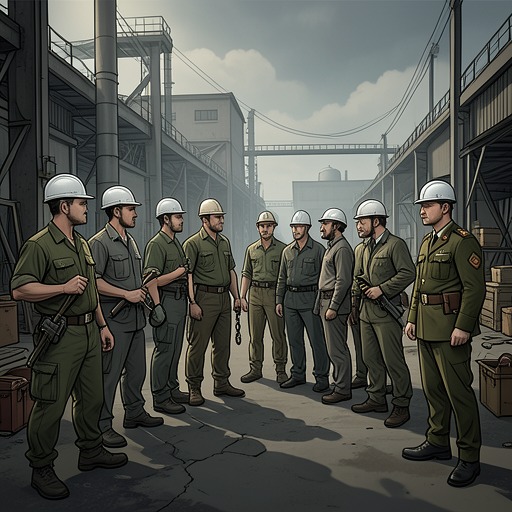
The Buna-Werke appears not as a completed factory but as a work in progress whose scale already resembles that of a city. Angelus Thomsen sees it from a distance and compares it to Magnitogorsk, a Soviet industrial city nicknamed Sparkplug. Frithuric Burckl describes a future operation that would consume more electricity than Berlin. Its intended output was not limited to rubber and fuel: the Reich leadership expected the project to advance economic self-sufficiency, which it treated as a factor capable of deciding the war.
That ambition lends the site a double character. Its vastness is evidence of industrial confidence, but the factory’s future-facing promises are repeatedly undercut by slow construction and the failure to meet production targets. In an office meeting with Burckl and Suitbert Seedig, Thomsen hears that progress in the carbide-production halls is slow and recognizes that he is losing his effort to relocate the labor force. The works are thus both a monumental plan and a place where the limits of that plan are already visible.
Buna-Werke’s importance also makes its human cost a matter of direct administrative dispute. At a meeting in the Main Administrative Building, Seedig describes prisoners rising at three in the morning, marching for ninety minutes, working until six, and returning by eight while carrying their casualties. He asks how such exhausted people can be expected to produce work. The timetable gives the factory’s industrial ambition a bodily measure: labor is organized around a long journey and a day that ends with prisoners carrying the dead or incapacitated back with them.
Forced Labor and the Factory-Camp Arrangement
The Buna-Werke’s workforce consists of concentration-camp inmates, and responsibility for them is divided between the company and camp authorities. Seedig tells Paul Doll that Farben will cover construction and running costs, while Doll is expected to provide inmates and guards and retain overall security. Burckl adds that Farben will supply food independently, avoiding the back-and-forth with the main camp that he associates with typhus. His qualification that they hope this arrangement will prevent disease leaves the proposed improvement uncertain rather than reassuring.
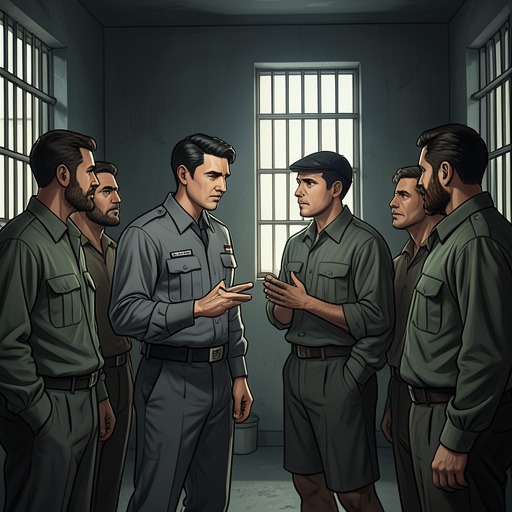
The businesslike terms of the arrangement do not conceal the conditions under which production is sought. Seedig says that prisoners are still dying at a rate of one thousand per week. When he and Burckl disagree about whether to increase rations, Burckl proposes a modest increase of twenty per cent, arguing that workers with more strength will last longer. The discussion treats survival as an input into production: improved rations are considered not as relief in themselves but as a means of extending the usable lives of the workforce.
Burckl makes that arithmetic more explicit when discussing incentives. He contrasts an adult’s estimated daily need of 2,500 calories in complete repose with 300 calories in some Polish ghettos, eight hundred in the Stammlager, and eleven hundred at Buna-Werke, if prisoners are lucky, despite their penal labor. He estimates that a heavy worker consuming eleven hundred calories loses about three kilograms a week. His appeal for an incentive therefore exposes the limits of coercive productivity: prisoners who know they are being sent to die cannot be made willing workers merely by management’s calculations.
The novel places this debate within a larger conflict of administrative priorities. Thomsen thinks of the Economic Administration Head Office pressing him to expand the labor force for munitions production while the Reich Central Security Department presses for the disposal of evacuees. The factory is one point where those competing demands meet: prisoners are needed as labor, while the same system treats their removal as a security objective. Buna-Werke’s labor policy is not an exception to the surrounding camp system but one expression of its conflict between extraction and destruction.
Production Delays and Sabotage
The factory’s difficulties are not confined to labor supply. At a Farben gathering, engineers complain about the Buna workforce’s low output and about prisoners’ heavy, unwieldy corpses, which have to be carried back to the Stammlager. Their discussion of the burden is itself an indictment of the production system: the dead remain part of the worksite’s practical problem, but are described through the obstacles they create for others.
Later, an emergency summit in the Political Department addresses sabotage at Buna-Werke. Suitbert Seedig reports that equipment has been tampered with in several ways: sand was mixed with engine grease, rivets were weakened, and pressure gauges were skewed to give false readings. Rupprecht Strunck suspects that dozens of saboteurs are involved, that someone coordinates them on the factory floor, and that there is a mole inside Farben. The meeting identifies the possibility of an internal source but does not establish who supplied information or how extensive the network is.
The saboteurs’ timing makes detection particularly difficult. They reportedly target equipment well before its first use, so a machine may jam, stall, collapse, or explode only after it has been deployed. By then, those responsible for assembling it may be hard to identify. Strunck says that the saboteurs have a calendar of first-use dates, and Thomsen immediately names Burckl. The suspicion sharpens the tension between corporate and camp interests, but the evidence presented in the meeting does not itself resolve Burckl’s role.
The works’ technical problems recur in the novel’s account of a crematorium installation. A five-retort facility designed for a capacity of two thousand per day has its rear funnel wall collapse after two weeks; after repairs, it lasts only eight days before being declared burnt out. The reported cause is loose firebricks falling into the duct between the oven and chimney and blocking the flames. Although the passage concerns the camp’s machinery rather than establishing that this facility stood inside the factory, its breakdown echoes the industrial setting’s repeated collision between ambitious capacity and faulty construction.
Failure and Aftermath
Buna-Werke’s scale and strategic promise never become successful production. Professor Peters warns Thomsen that the factory and synthetic fuel would not win the war, although they would prolong it. This judgment gives the project a grim importance beyond its output: even an incomplete or ineffective industrial scheme may help sustain the conditions in which mass killing continues. Thomsen’s connection to the works is therefore caught between its stated economic purpose and the consequences of keeping the war going.
The postwar record supplies the final measure of failure. In July 1948, thirteen IG Farben executives and managers are convicted at Nuremberg; Frithuric Burckl is not among them. Suitbert Seedig receives an eight-year sentence for slavery and mass murder, while Rupprecht Strunck, recalled from early retirement, receives seven years for plunder and spoliation, slavery, and mass murder. The different outcomes do not erase the project’s shared structure of corporate planning, camp administration, and coerced labor.
The factory’s promised products never materialize: neither synthetic rubber nor synthetic fuel is produced at Buna-Werke. That absence reverses the site’s original rhetoric of scale and necessity. A project imagined as large enough to consume more electricity than Berlin ends not as a decisive contribution to wartime self-sufficiency, but as a monument to wasted industrial ambition built through slavery and mass murder. Its failure is not separate from the prisoners’ suffering; it is the outcome of the same system that counted their bodies as a labor supply while spending them faster than production could be achieved.