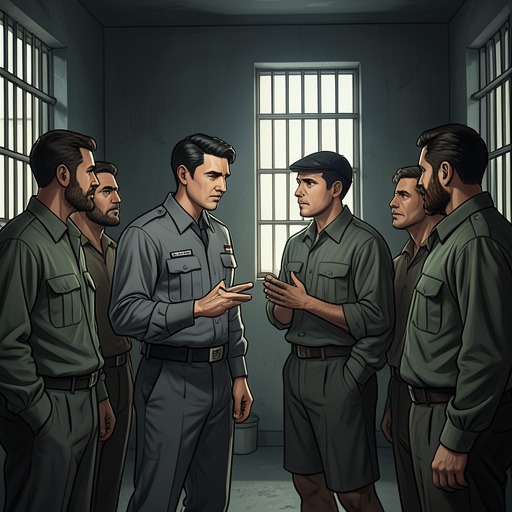
Buna-Werke sabotage campaign
The Zone of InterestThe Buna-Werke sabotage campaign exposes a hidden contest inside the machinery of forced industrial production: equipment at Buna-Werke is deliberately altered so that damage emerges only after the trail to those responsible has gone cold. The discovery prompts an emergency meeting, a search for a suspected insider at IG Farben, and the detention of an English NCO. Even after investigators identify a possible on-site coordinator, the source of the crucial calendar remains unknown.
Industrial Setting and Discovery
The sabotage comes to light amid the pressure to make the Buna-Werke productive. Suitbert Seedig describes prisoners rising at three in the morning, marching for ninety minutes to the factory, working until six, and returning at eight while carrying their casualties. He says they are exhausted before beginning and asks how any work can be obtained from them. Seedig also reports that prisoners are still dying at a rate of one thousand a week. Frithuric Burckl argues for a twenty-per-cent increase in rations so that they will have more strength and last longer. This surrounding debate makes plain the factory’s dependence on prisoner labor, even as the camp’s lethal conditions continually consume it.
The sabotage is addressed at an emergency summit in the Political Department attended by Paul Doll, Fritz Mobius, Seedig, and Rupprecht Strunck. Strunck describes an act of tampering in which sand was mixed with engine grease to damage the gears. Seedig adds that rivets had been weakened so they would pop and pressure gauges skewed to give false readings. The meeting does not establish the full scale of the damage, but Strunck suspects dozens of participants, a coordinator on the factory floor, and a source inside IG Farben.
Doll immediately supplies a name for that suspected insider: Burckl. Mobius rejects the accusation, calling Burckl a dupe rather than a traitor. The exchange marks an early limit on what the investigators actually know. They can see deliberate damage and infer coordination, but Doll’s suspicion does not amount to proof of who provided the information.
Delayed Damage and the First-Use Calendar
The distinctive feature of the sabotage is its timing. According to Seedig, the conspirators tampered only with equipment that was still a long way from first use. A machine might therefore jam, stall, collapse, or explode only after it had been put into service, when those responsible for assembling it were difficult to identify. The delay separates the act of sabotage from the moment its effects become visible and frustrates ordinary efforts to trace responsibility.
The investigators’ most important clue is a calendar recording when equipment would be used for the first time. Strunck reports that someone has supplied such a calendar to the saboteurs. It is not merely evidence that the machinery was altered: it suggests access to information about the factory’s schedule, enabling the perpetrators to choose equipment whose later failure would be harder to connect to its handling. In this way, the campaign targets both machinery and the system of accountability around it.
When Doll asks whether the apprehended culprit has been interrogated, he is told that the man has spent the previous night with Horder and has revealed nothing. Doll initially assumes the suspect is Jewish; the others tell him that the prisoner is instead an English NCO named Jenkins. The correction unsettles the assumptions embedded in Doll’s question, but it does not resolve the investigation. Jenkins is held in the crouchbox, and the officials discuss further interrogation by Michael Off and Professor Entress. The account records what the authorities plan and threaten, not a confirmed confession or a definitive account of Jenkins’s role.
The Investigation and Its Unresolved Source
The campaign’s investigation develops across two scenes. Later, Mobius reads the first page of Strunck’s report and asks whether the suspected coordinator on the factory floor has been identified. Doll says that Jenkins pointed the investigators toward him and that Strunck found the coordinator’s calendar in the tool cabin. The evidence thus advances: a detained NCO has implicated a person on the factory floor, and a calendar has been recovered from a specific workplace. The coordinator’s identity, however, is not given in the account.
The calendar’s recovery does not answer the most consequential question. Mobius asks who at IG Farben gave it to the prisoner; Doll replies that the man will not say. By then Jenkins has been in custody for six days, almost a week. Mobius responds with grim irony that six days is indeed almost a week, then returns to the unanswered question of the company source. The passage leaves the information chain incomplete: the factory-floor coordinator has been pointed out, but the person who supplied the schedule remains beyond the investigators’ reach.
The inquiry is also marked by internal secrecy. After the emergency discussion, Mobius orders Doll not to let the matter be whispered to anyone, specifically warning him not to tell Farben, Seedig, Strunck, or Prufer. The instruction sits uneasily beside the presence of Seedig and Strunck at the summit and shows that knowledge of the case is being tightly restricted as the investigation proceeds. The narrative does not explain the reason for every boundary, but it emphasizes that the inquiry itself is being managed through guarded information as well as interrogation.
Significance
The campaign’s method depends on the gap between alteration and failure. Sand in grease, weakened rivets, and falsified pressure readings turn ordinary components into delayed hazards; the first-use calendar allows those intervening at the factory to exploit the delay. The threat is therefore not represented as a single act of destruction but as a concealed sequence whose authorship becomes harder to establish with time.
That method also mirrors the larger institutional world surrounding Buna-Werke. The factory seeks work from people driven to exhaustion, while administrators debate how to preserve their labor and the camp continues to kill them. Against this background, the sabotage investigation reveals another struggle over the factory’s operation: a clandestine network is alleged to be manipulating its equipment, and the authorities respond by seeking a coordinator, a company informant, and a confession. Yet the inquiry cannot close the gap between suspicion and knowledge. A tool-cabin calendar provides a concrete lead, Jenkins remains silent, and the alleged IG Farben source is still unnamed. The campaign’s ending in the available account is thus not a resolution, but an unresolved pursuit of the information that made the sabotage possible.