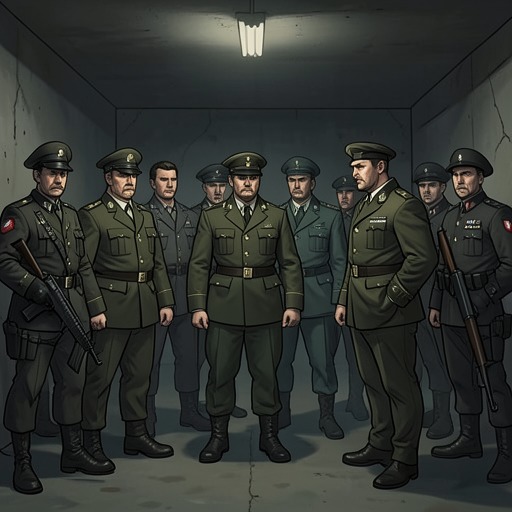
Bunker 3 massacre of Polish resistance fighters
The Zone of InterestThe Bunker 3 massacre of Polish resistance fighters was the execution of 291 Polish Home Army prisoners, most of whom were shot in the yard of Bunker 3 after being told that they would die that afternoon. The episode turns the camp’s coercive system into a direct confrontation: the prisoners appear not as the helpless, depleted figures its officers expect, but as a formidable body of men; the authorities answer that strength with a scheduled killing and threats against their families. Paul Doll’s account is at once an administrative report, a scene of intimidation, and a record of his own unease.
Background and preparation
The gathering was arranged in Bunker 3, a windowless red-brick building. The previous night, Doll had gone through Fritz Mobius’s proposed list and recognized among the names men reputed to be extraordinary workers. Some had endured a month in the coal mine at Fürstengrube, then returned to hard labour after only a few weeks carrying railway ties. Their capacity for work gave Doll serious doubts about Mobius’s proposal. He drank heavily and did not go to bed until after four in the morning.
By the time Doll took his place at the table in the basement, his condition was poor. Two agents from the Political Section were present, along with Wolfram Prufer, Mobius, and Captains Drogo Uhl and Boris Eltz. A translator from the post-censorship office was also there, but Prufer dismissed him, asserting that the Poles were experienced prisoners who understood German. Mobius said he foresaw no complications. The officers’ apparent ease did not last: as the prisoners assembled, Doll realized that, if they sensed danger and acted together, the Germans in the room might not escape alive.
The prisoners and Mobius’s announcement
The prisoners entered in columns of five, led by a single armed guard. Doll had expected the familiar sight of emaciated inmates. Instead, the men looked powerful and healthy: broad-faced, muscular, and so solidly built that their striped uniforms strained against them. They wore real shoes, and their bearing seemed almost that of a motorized combat unit. Doll felt, briefly, an ache of admiration at the thought of leading such men in battle. That involuntary response sharpened the contradiction between their visible strength and the fate prepared for them.
There were about 300 men. Mobius ordered them to stand at attention, then told them plainly that each would be shot, probably at about five that afternoon. The announcement produced no protest. Doll describes the silence as so complete that it seemed the men had stopped breathing. Mobius presented his candour as a form of respect, addressing them as soldiers because, he said, they were soldiers: members of the Home Army.
Mobius also supplied the camp’s explanation for their supposed restraint. Their Centre, he claimed, did not believe the concentration camp was an active asset because it assumed the prisoners were only skin and bones. He warned that the men should not attempt anything that afternoon. The authorities had parish registers, he said, and could seize their parents and grandparents for deportation, as well as their wives, children, nephews, and nieces. He invoked the crematorium as the threatened destination for their families. The threat extended the camp’s power beyond the prisoners themselves: resistance would be answered through punishment of people they loved.
Execution and immediate aftermath
Mobius urged the men to die like warriors and promised that the killing would remain orderly. In return for their composure, he offered them what he called German respect and a last meal consisting of a double ration of warm, foul liquid. The formal language of a bargain did not alter its terms: the prisoners were being told to cooperate with the arrangements for their own deaths. They were then taken out of the basement.
Doll’s physical reaction accompanied the scene. He tasted vomit as Mobius spoke and may have cried out. Afterward, he went to the infirmary, where Professor Zulz gave him a vitamin injection and two cubic centimetres of chlorpromazine, intended as both a sedative and an anti-emetic. The treatment did not prevent him from nearly vomiting in the recovery bay. His distress is reported alongside the officers’ procedure, but it does not interrupt or prevent it.
That night, at 10:07, Prufer came to Doll’s home to give his oral report. In the yard of Bunker 3, a small fraction of the prisoners had chosen to fight. They raised a barricade, which was quickly overrun. The rest—291 men—were shot between 5:10 and 5:45 that afternoon. Prufer described the operation as having gone smoothly. Doll records that assessment without disguising its bureaucratic calm: the mass killing is reduced to a report on how the operation proceeded.
Significance in the narrative
The scene’s central reversal is the prisoners’ appearance. The camp’s machinery depends on treating people as manageable numbers and labour capacity, yet the men assembled before Mobius are visibly strong, organized, and potentially dangerous. Their bodies contradict the camp’s assumptions about them; their brief resistance makes that contradiction physical. The execution nevertheless proceeds, with the threat against relatives helping to enforce control even before the first shots are fired.
The account also exposes violence as coordinated work. Officers gather in a basement, a senior Gestapo figure delivers the terms, guards control the prisoners’ movement, and Prufer later reports the result to the commandant. The shooting is scheduled in advance, carried out within a narrow time window, and described afterward as smooth. Doll’s nausea and alarm register a disturbance in that administrative sequence, but the outcome remains unchanged: nearly all the prisoners are killed, and the small attempt to fight is swiftly crushed.