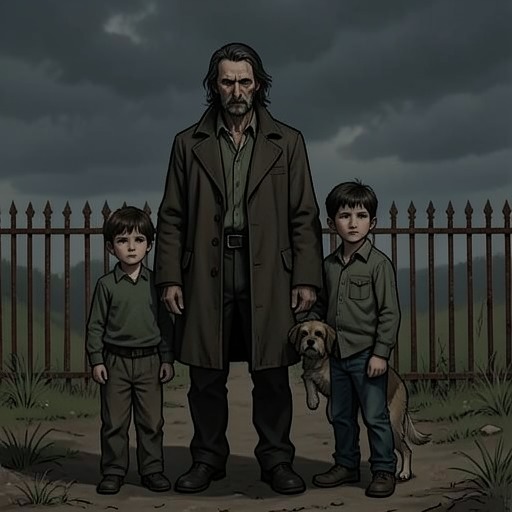
Chełmno “silent boys” massacre
The Zone of InterestThe Chełmno “silent boys” massacre was the killing of a hundred Jewish teenagers whom the SS and Orpo forced to assist with burying victims on January 21, 1942. After a day of labor in the snow, without food or water and under the lash, the boys were taken to the pits and murdered. The account makes their silence—not an absence of violence, but its terrible accompaniment—the event’s defining image.
Background and Setting
The massacre took place at Chełmno amid an ongoing operation in which three gassing vans repeatedly traveled from the Schlosslager to the Waldlager, unloaded bodies, and returned. The work of handling the dead fell to Sonderkommando prisoners. On January 21, the number of victims was so great that the SS and Orpo selected another hundred Jews to help drag the bodies to a mass grave. The narrative identifies this additional group as teenage boys.
The wider policy context described in the book reaches back to July 31, 1941, when a letter drafted by Eichmann and Heydrich was sent to Goring and returned with his signature, authorizing a “total solution.” The account describes an earlier possibility of deporting Jews to a remote, cold region, and a subsequent turn toward killing women and children as that territorial option receded and pressure mounted among officials in Poland. This context situates the massacre within an expanding policy of extermination; it does not present the boys’ murder as an isolated act.
Forced Labor and Murder
The boys were made to work from five in the morning until five in the evening. They received no food or water and labored for twelve hours naked in snow and hardened mud, under the lash, dragging bodies to the mass grave. The account gives the labor a stark duration and physical setting rather than reducing it to an abstract number of victims.
As the light thinned, Major Lange led the boys to the pits and shot them one by one. When he ran out of ammunition, he used the butt of his pistol to smash their skulls. The boys jostled to be next in line, yet none made a sound. The sequence moves from forced participation in disposing of the dead to their own systematic killing, carried out by the same machinery of violence.
Sound, Silence, and Witness
The recollection insists on what could be heard: wind in the trees, the use of whips, and the gassing vans moving between the two camps. The killing of the boys, too, was audible; the narration repeats that one could hear it even as it records their refusal or inability to cry out. The contrast makes silence neither peaceful nor consoling. It marks the extremity of what was done to them.
The phrase “the time of the silent boys” first seems to offer a bleak explanation for the scene’s cold and stillness, but the narrative immediately refuses to let the weather contain its meaning. The wind, the whips, the vans, the shots, and the blows all remain in the account. Their silence is therefore preserved not as a gap in the record but as the fact a witness must carry forward.
Policy and Narrative Significance
Elsewhere, the book’s account of the extermination policy stresses that gas chambers and crematoria accelerated killing and reduced the strain on the killers, but were not necessary to the intention to murder. Bullets and pyres, it argues, could have served the same end. At Chełmno, the gassing vans and mass grave belong to an organized process; the murder of the boys shows how that process also compelled victims to perform labor before killing them.
The massacre is narrated as a remembered event by Angelus Thomsen. Its precise date, the twelve-hour shift, and the boys’ silence anchor the scene in concrete details, resisting any account that would blur the victims into an anonymous mass. In the recurring phrase “the time of the silent boys,” memory gives the murdered teenagers a distinct place in the narrative: their silence becomes evidence of violence, not evidence that nothing happened.