Chełmno extermination operation
The Zone of InterestThe Chełmno extermination operation emerges as both an organized machinery of mass murder and a memory that cannot be made silent. The account joins the wider Nazi policy of killing European Jews to a specific atrocity on January 21, 1942, when Jewish teenage boys were forced to work in freezing conditions and then killed. The remembered silence of the boys does not soften the violence; it makes its methodical brutality harder to evade.
Policy and Escalation
The operation is set against an evolving system of Nazi decisions rather than presented as the result of a single isolated order. In a later discussion, Paul Doll dates the beginning of what he calls the crime without a name to July 31, 1941. He describes a letter drafted by Eichmann and Reinhard Heydrich, sent to Goring and returned with his signature, authorizing a total solution. His account locates that authorization at the zenith of Nazi power and connects it to preparations already under way in the east.
The policy’s course, as the narrative reconstructs it, was not simply a settled plan executed unchanged. Its leaders may initially have imagined removing Jews to remote, cold territory after a quick victory over Russia. That possibility receded as the war and the scale of Nazi territorial expansion altered the problem as officials framed it. With three million more Jews annexed, competing authorities pressed for action; by August or September, the decision had crossed a further threshold, from killing men to killing women and children as well.
The clash between economic exploitation and mass murder also appears in Doll’s reflections on administration. The Economic Administration Head Office presses him to increase the labor force for munitions production, while the Reich Central Security Department demands that more deportees be disposed of. He characterizes the latter demand through the regime’s paranoid claim that Jews constitute a fifth column. The pressure to extract labor and the pressure to kill are thus shown operating within the same system, not as opposites that cancel one another out. The account does not reduce Chełmno to a tidy administrative solution: it reveals a regime whose offices compete while enabling persecution.
The Killing Site and the Silent Boys
The episode’s defining scene is set at Chełmno, also called Kulmhof. When Doll confronts Szmul about having been there, he stresses that no Jew gets out of Kulmhof and suggests Szmul may have been kept because of his German. Asked whether he was there during the time of the silent boys, Szmul denies it. The denial is later set against the episode’s details and against the fact that this memory continues to shadow him.
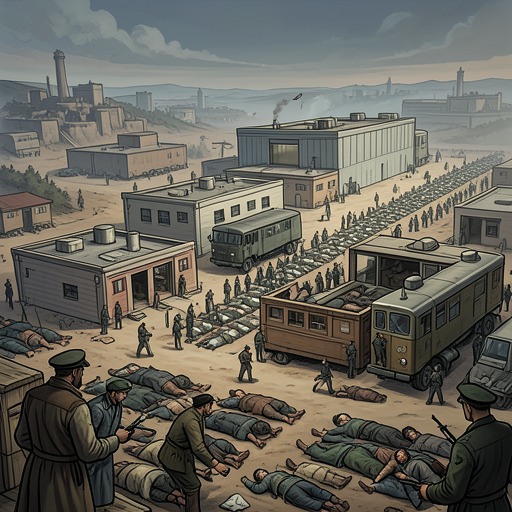
On January 21, 1942, the number of victims was so great that the SS and police selected another hundred Jews to help the Sonderkommando drag bodies to a mass grave. This additional work detail consisted of teenage boys. They received neither food nor water. For twelve hours they labored naked in snow and hardened mud under the lash. The workday stretched from five in the morning to five in the evening, while German power was enforced with whips.
The physical operation is described with a stark repetition: three gassing vans came down from the Schlosslager to the Waldlager, unloaded, and started up again. When daylight began to fade, Major Lange led the boys to the pits and shot them one by one. Near the end, he ran out of ammunition and struck their skulls with his pistol butt. The boys jostled to be next in line, but none made a sound. The narrative’s insistence that this, too, could be heard turns silence into the terrible measure of the scene: their lack of sound does not mean the absence of pain, coercion, or killing.
Technology, Scale, and Responsibility
A later conversation challenges the idea that the machinery of extermination was its essential cause. Professor Entress argues that gas chambers and crematoria were means of speeding the process, economizing, and sparing the killers’ nerves; in his account, bullets and pyres would ultimately have served the same purpose. He cites the Einsatzgruppen’s killing of well over a million people by shooting as evidence that the capacity and will to murder did not depend on a particular technology. The industrial apparatus matters, but the narrative refuses to let it stand in for the decision to kill.
That distinction makes the description of Chełmno more, not less, consequential. The vans, the repeated journeys between the two camps, the labor detail, and the mass grave belong to an organized process; none turns the perpetrators into passive cogs. Doll’s recollection of the boys’ deaths is placed beside the policy discussions and explanations that attempt to make mass murder legible as administration, expediency, or technological development. Together, they show how planning and routine could structure violence without displacing the responsibility of those who ordered and carried it out.
Memory and Narrative Significance
The time of the silent boys returns beyond the account of the killing itself. Szmul’s dream of returning home includes what he cannot bring himself to tell his wife: either the first thirty days he spent working with the Germans among the recently dead, or the time of the silent boys. He wakes as soon as the dream begins and paces because he is afraid to sleep. The event therefore persists not as a closed episode but as a memory whose disclosure he anticipates and evades.
The account’s structure connects that private burden to a broader history. Szmul’s denial when questioned, the later return of the memory, and the detailed chronology of the boys’ deaths expose the gap between what can be said and what the story nevertheless records. Chełmno is not treated merely as a name for a killing site: it is a place where mass murder depended on repeated procedures and where the silence of its victims becomes an indictment of the system that produced it.