Concentration Camp Prisoner Selection System
The Zone of InterestThe Concentration Camp Prisoner Selection System was a repeated practice of sorting prisoners, not a single procedure confined to the arrival ramp. It shaped who was assessed, where bodies were directed, and how the camp’s demands for labor and its machinery of violence operated together. The narrative makes its reach visible in the movement from a train’s arrival to selections at the gate, in the blocks, at roll call, and in the camp infirmary. Its orderly language and exacting routines never made it humane: they made coercion reproducible.
Scope and Routine
At the ramp, the authorities treated each incoming transport as a task requiring estimates, personnel, and preparation. Paul Doll expected a familiar rule of thumb: roughly 1,000 people per train, with as many as 90 percent selected Left. Yet he recognized that customary guidelines might be of little use for Special Train 105. The arrivals did not match the expected pattern of uniformed servicemen or gendarmes: first came civilian stewards wearing white armbands, followed by a little boy in a sailor suit, an elderly man in an astrakhan overcoat, and a stooped elderly woman leaning on an ebony cane. Their appearance unsettled the routine even before the other passengers disembarked.
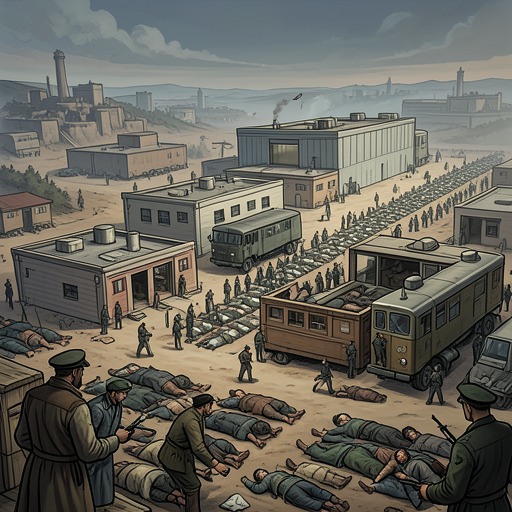
The machinery assembled for the operation shows how selection drew on the whole camp administration. Doll stood on the ramp with Wolfram Prufer, three labour managers, six physicians, disinfectors, Szmul and a twelve-man Sonderkommando team, eight Kapos, and the hosing crew. Captain Boris Eltz commanded ninety-six troops, reinforced by a unit with a heavy machine gun and two flamethrowers; Ilse Grese and her platoon were also called in. A septet of violinists from Innsbruck replaced the usual assortment of instruments. The list is not incidental: medical personnel, camp labour supervisors, prisoner functionaries, guards, and music were all folded into the apparatus around an arrival. Doll’s insistence on numbers and preparation presents the operation as a problem of exact management, while the force arrayed behind it makes its coercive nature unmistakable.
Selection and the Demand for Labour
Selections did not stop once arrivals had been processed. They occurred in the blocks and at roll call, as well as in the infirmary and on the ramp. At the gate, work commandos could face them twice in a day, leaving for work and returning. The people subjected to this recurring scrutiny were already depleted: men described as having the shape of gnawed wishbones nonetheless had to swell their chests and jog past the gate. The practice therefore reached into the ordinary movements of camp life, making continued access to work no assurance of safety.
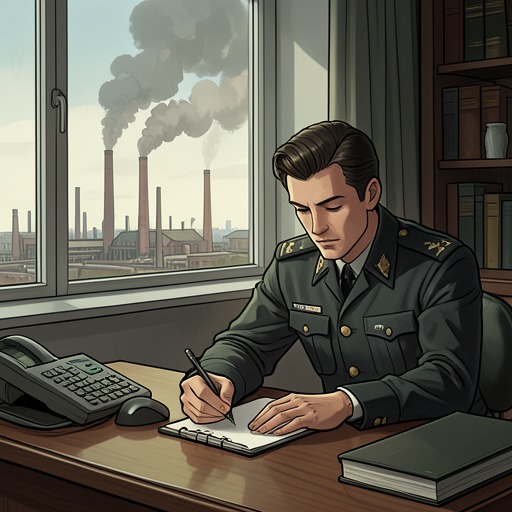
The pressure to extract labour exposes a conflict embedded in the system. Suitbert Seedig pointed out that prisoners woke at three, marched for ninety minutes to Buna, worked until six, and returned at eight carrying their casualties. He asked how useful work could be obtained from men exhausted before the shift began. At the same meeting, Seedig reported that prisoners were still dying at a rate of 1,000 a week. Frithuric Burckl said IG Farben would pay for the proposed arrangement and provide food independently of the camp, in the hope of avoiding typhus. Doll, however, focused on who would pay and questioned whether rations would increase. The exchange shows labour managers discussing food, infection, exhaustion, and deaths alongside the camp commandant, while selection continued to determine the conditions under which prisoners were kept for work or lost from it. The system’s administrative rationality did not resolve the conflict between preserving labour and consuming prisoners; it managed that conflict without displacing either objective.
Violence Behind the Sorting Process
Selection formed one part of a wider sequence that made mass killing operational. The Sonderkommando prisoners were assigned to move bodies from the shower room to the Leichenkeller, remove gold teeth with pliers and chisels, shear women’s hair, take jewellery, load bodies onto the pulley, and transfer them to the retorts. The ashes were ground and carried by truckload to the River Vistula. Before the killing, members of the team could deceive arriving people with claims that particular trades were needed or that acquaintances had gone to an agricultural station. If anyone resisted, they could be forced to an NCO. Doll describes this work as callousness and betrayal, but the detail also reveals a process in which deception, force, the handling of bodies, and disposal were connected. Selection was not an isolated decision at a table: it belonged to a chain of actions that continued after people were separated from one another.
The system also depended on command and delegated execution. When Wolfram Prufer called a directive impossible, Doll invoked the order’s origin with Gruppenfuhrer Horst Blobel and the authority of the Reichsfuhrer-SS. The scene shows orders travelling down a hierarchy while the camp’s number two disputes the feasibility of carrying them out. Elsewhere, Doll tells Szmul that the Sonderkommando prisoners’ usefulness has bought them a reprieve from death, and then describes their work in terms that expose their imposed role as both victims and participants in the killing process. Their position did not remove the coercion governing them; the threat of death remained present in the work they were forced to perform.
Breakdown, Persistence, and Accountability
A later arrival reveals how selection could break into open disorder when deportees no longer accepted the authorities’ assurances. At one transport, 800 men, women, and children had barely left the cattle cars before the scene collapsed into whimpering, screams, blows, and gunfire; Professor Zulz and his colleagues had not yet begun the selection. After ninety minutes, roughly 600 survivors had been beaten, flogged, or prodded by bayonets into Red Cross vans and ambulances. Four hours early, another train arrived carrying Jewish patients from mental homes in Utrecht, accompanied by young nurses. Among them were silver-haired twin old men who smiled at the scene and a teenager in a green canvas straitjacket who fell among the clothing. Ilse Grese pulled the girl up by her hair as onlookers applauded. The juxtaposition of the official selection process with the crowd’s violence shows a system whose apparent order could coexist with—and give way to—public cruelty.
Even the defeat of Germany did not end selection. After the German defeat in the east, a bewildered lull lasted five or six days, but selections soon operated across the ramp, infirmary, blocks, roll calls, and gate. The account contrasts the impossibility of winning against the Anglo-Saxons and Slavs with the continuing belief that there would still be time to win the war against the Jews. Doll, though less visibly drunk and more polished in his speech, was described as reaffirming the murder of all Jews as right. The persistence of selection amid defeat makes its ideological purpose clearest: it was not simply an emergency response to wartime conditions or a neutral technique for allocating labour.
The postwar record places individual camp and industrial officials within the same history of organized exploitation. Doll was captured in March 1946, tried at Nuremberg, and handed over to the Polish authorities; he was hanged outside Bunker 11 on April 16, 1947. Suitbert Seedig received an eight-year sentence for slavery and mass murder, while Rupprecht Strunck received seven years for plunder and spoliation, slavery, and mass murder. Thirteen IG Farben executives and managers were convicted, and not a kilogram of synthetic rubber or a millilitre of synthetic fuel was ever produced at Buna-Werke. These outcomes do not reduce the system to a failed labour project: they underline the distance between its meticulous allocation of people and equipment and the destruction it organized, even where its promised industrial product never materialized.