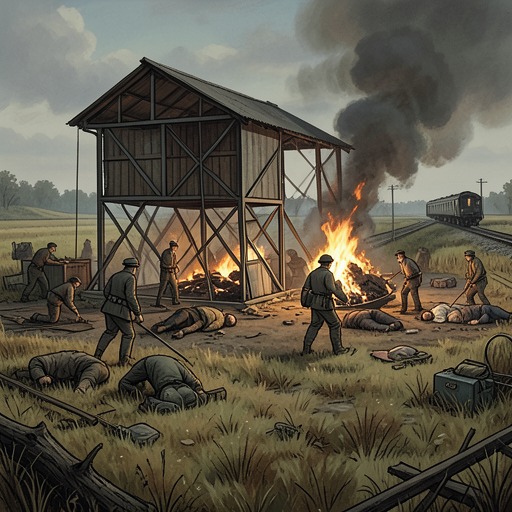
Crematorium IV
The Zone of InterestCrematorium IV is both a failing piece of camp infrastructure and a place where the machinery of mass death becomes brutally personal. Its furnaces repeatedly break down under poor materials and wartime economies, while the vault beneath it becomes the setting for Paul Doll’s coercive rehearsal of violence and his threat against Shulamith Zachariasz. The location’s significance lies in this collision: a system presented through capacity, retorts, and repair also acts directly upon individual bodies and lives.
Facility and Intended Capacity
Crematorium IV, also called Crema 4, is described through the language of industrial operation. The account lists five three-retort units and a capacity of 2,000 per twenty-four hours. Those figures suggest a facility designed to process bodies on a vast scale; they also make the subsequent failures more than routine maintenance problems. When the crematorium cannot operate, the consequences extend beyond its walls to the camp’s wider system of disposal.
The scene of repair places Szmul, the Auschwitz Sonderkommando leader, in a position of practical expertise. He attends to one of the new installations and identifies the specific cause of its failure: firebricks have come loose and fallen into the duct between oven and chimney, leaving the flames nowhere to go. Doll calls the workmanship shoddy, but Szmul points instead to poor materials and discoloured veins in the clay. The exchange exposes a gap between the commandant’s convenient diagnosis and the material evidence in front of them.
Repeated Breakdowns and the Disposal Crisis
Crematorium IV has been troublesome from the outset. Its rear funnel wall collapses after two weeks; after repairs, the installation works for only eight days before Szmul declares it burnt out. The brief interval matters: this is not a facility that fails once and is permanently abandoned, but one whose attempted return to service is short-lived. The stated capacity and the repeated breakdowns stand in stark contrast.
The other crematoria offer little relief. Doll asks whether Crematoria II and III are holding the fort, and Szmul reports that both are operating at half volume. Doll immediately connects their diminished output to the problem of incoming transports and asks what he is to tell Communications if he refuses them. He concludes that they will have to return to the pits. The exchange reveals the operational logic surrounding the building: failures do not halt the demands placed on the disposal system but redirect them elsewhere.
Elsewhere in the novel, the camp’s environmental damage is registered through a breached water table, fermenting remains, and an increasingly unbearable smell. Doll stops during a drive to keep sniffing the air as it worsens; later, his questions about the churned meadow, vermin, disease, and brown snow turn pollution into an indictment of the camp’s supposed ideals. These details establish the wider conditions in which the crematoria and pits operate, but the text does not reduce every source of contamination to Crematorium IV alone. The facility belongs to a landscape where the consequences of disposal escape neat administrative boundaries.
The Vault and Doll’s Threat
The space beneath Crematorium IV is rendered as a dank, black sepulchre, with a low ceiling, caged lights, grey gloom, and echoes. There, Doll stands with a gun in one hand and a cigar in the other, smoothing his eyebrow with his little finger. The small, controlled gesture contrasts with the violence he is about to direct. He instructs Szmul in a stabbing movement: the weapon is to fall from a sleeve into the hand, then be thrust into a sack as quickly as possible.
The rehearsal is not merely an abstract lesson in technique. Doll tells Szmul that Shulamith Zachariasz will be taken at noon on May 1 unless he countermandes the order by telephone that morning. He presents the arrangement as simple and elegant, turning the threat against Shulamith into leverage over Szmul. The crematorium vault thus becomes a place where the machinery of killing is extended into a calculated threat: Doll uses his authority over a prisoner’s loved one to compel participation in violence.
Narrative and Thematic Significance
The narrative brings Crematorium IV into view through concrete failures, technical explanations, and a sharply staged encounter. Its numbers promise efficiency, while the collapsed wall, obstructed duct, and exhausted capacity disclose a system dependent on defective materials and improvised alternatives. This does not make the breakdown a reprieve: the pressure of transports remains, and the pits reappear as the proposed fallback.
The place’s physical and narrative functions converge in the vault. Above and around it, cremation is treated as a problem of throughput; below, Doll makes violence intimate, rehearsed, and conditional. At the same time, the wider recurrence of smell, polluted ground, and brown snow makes the camp’s actions visible beyond the language of administrative necessity. Crematorium IV is therefore not only a setting for atrocity but a material point where the regime’s claims to order meet breakdown, contamination, and coercion.