Death of Szmul Zachariasz
The Zone of InterestThe death of Szmul Zachariasz is both a murder and the exposure of a coercive plot: Paul Doll has tried to use Szmul to kill or injure Hannah Doll, but Szmul refuses to become the instrument of that violence. In Hannah’s later account, Szmul faces her, reveals Doll’s intention, and dies by Doll’s gun. The staged garden encounter turns a threatened attack into a testimony, leaving Hannah with a lasting understanding of Doll and prompting her to escape with the girls.
Setting and Circumstances
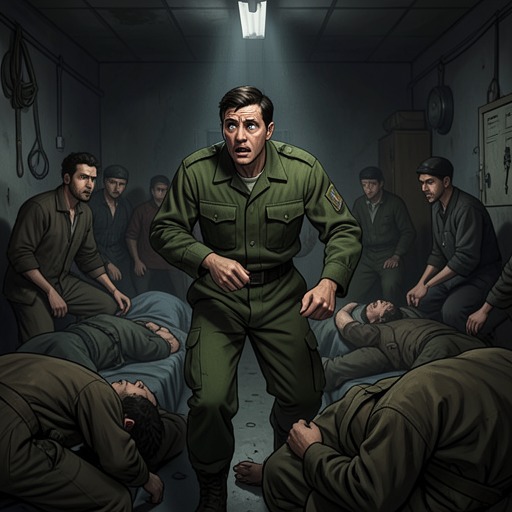
Szmul’s place in the camp’s machinery makes him, in Doll’s eyes, useful and dangerous at once. As the Sonderkommando leader, he and the prisoners under his direction are forced to handle the dead: dragging bodies from the shower room, removing hair and valuables, loading the remains into the crematory, and dispersing the ashes. These duties expose the workers to the practical details of mass killing and make them witnesses to what the camp’s euphemisms conceal. Doll calls such a prisoner a bearer of secrets, but that label does not confer power or protection. It marks the peril of knowing too much while remaining under the commandant’s control.
The larger system around Szmul depends on organized deception as well as force. On the ramp, arrivals are reassured and directed through the undressing room; within the crematory process, bodies are reduced to tasks, counted and handled as consignments. The narrative’s attention to these routines makes the private scene in the garden part of the same world, not an isolated eruption of violence. Szmul has been made to serve a process that denies the humanity of its victims; Doll now tries to turn his forced service into a weapon against Hannah.
A separate chronology later gives the death a precise place in the sequence of events: Szmul stopped living at about 6:45 on April 30, 1943, an hour after the narrator’s arrest. That bare entry supplies a date and time that the remembered scene itself does not foreground. Its clipped form contrasts with Hannah’s detailed recollection of the garden, where gestures, faces, and the order of the shots remain vivid.
Doll’s Coercive Plan
Before the killing, Doll makes the threat explicit in the dank space beneath Crematory IV. With a gun in one hand and a cigar in the other, he instructs Szmul to practise dropping a weapon from his sleeve and thrusting it into a sack. He then names a deadline: Shulamith Zachariasz is to be brought for execution at noon on May 1 unless Doll cancels the order by telephone that morning. Szmul’s wife is therefore being used as leverage, and the threatened execution is presented as a condition Doll can control.
Doll connects that threat to Hannah’s survival, telling Szmul that the only way to keep his wife alive is to kill Doll’s. The bargain is designed to force Szmul into a double betrayal: violence against Hannah and, by implication, the abandonment of Shulamith to Doll’s power. Its apparent neatness is part of the cruelty. Doll reduces two women’s lives and Szmul’s choice to an arrangement he claims he can manage with a telephone call.
The later account reveals that Szmul does not carry out the attack Doll has rehearsed with him. Instead, Doll invites Hannah into the garden to watch Roman candles, presenting the occasion through the pretext of a birthday present from Szmul. The three stand in the deepening twilight; beyond them, the Walpurgisnacht blaze and possibly a rising rocket frame the encounter. Szmul waits on the other side of the garden fence, still wearing his prisoner’s stripes. The setting offers a moment of apparent festivity, but its staged intimacy conceals the threat Doll has engineered.
The Killing
As Hannah remembers it, Szmul draws a long, narrow tool or weapon from his sleeve. The scene is uncertain and partly made to look like play; its very uncertainty reflects the contrivance of Doll’s plan. Doll kicks open the gate and urges them onward. Rather than attack Hannah, Szmul stands his ground, parts his shirt, and places the point against his own chest. He looks Hannah in the eye and tells her that Doll wanted him to do this to her.
That disclosure changes the meaning of the encounter. Szmul does not merely fail to obey Doll’s plan; he makes the plan visible to the person it was meant to harm. Hannah recalls that Szmul had rarely looked her in the eye before. His direct gaze interrupts the concealment on which Doll has relied, while his words identify the commandant—not the prisoner—as the source of the danger. Szmul’s action does not free him from Doll’s control, but it refuses the role Doll has assigned him.
Doll answers by asking what use Szmul is, then shooting him in the face. He crouches and fires again into the back of Szmul’s neck. Hannah remembers Doll turning slowly on his haunches after Szmul stops quivering and looking up at her. The sequence is brutally specific: Szmul’s refusal and disclosure are followed not by escape or reprieve, but by Doll’s immediate execution of him. The killing is not a consequence of an attack on Hannah; it is Doll’s response to Szmul’s refusal and to the truth he has spoken.
Hannah’s Recognition and Flight
Hannah remembers Doll as covered in blood and still trying to smile. The image makes recognition inseparable from revulsion: she suddenly understands him as a nightmarish little boy caught doing something plainly disgusting, yet persisting in the effort to smile. This is not simply a new fact about what Doll has done. It is a changed understanding of the person she has been watching, produced by seeing his violence at close range and hearing Szmul name his intention.
She takes the girls to Romhilde Seedig’s home and leaves as soon as she can. Her account stresses the urgency of getting away, rather than describing any further confrontation with Doll. The flight is the immediate human consequence of the scene: Szmul is dead, the threat to Hannah has become unmistakable, and the garden no longer offers even the appearance of safety.
Years later, Hannah remains troubled not only by the fact of Szmul’s death but by the manner in which Doll caused it. She identifies Doll’s prevention of Szmul’s own suicide as the worst part: rather than allowing him to die by his own hand, Doll destroys his face. She also wonders whether Doll had persuaded or pressured Szmul to hurt or kill her, and how that pressure worked. The account gives no answer to that final question. Its uncertainty preserves the distinction between what Hannah witnessed—the attempted coercion, Szmul’s refusal, and Doll’s shots—and what she can only infer about the pressure behind them.
Significance
The scene concentrates the camp’s larger logic into a private act. In the surrounding narrative, the machinery of killing is described as a means of accelerating murder, economizing effort, and sparing the nerves of the killers; bullets and pyres, too, would have served the same lethal purpose. Against that system, the garden’s candles and birthday pretext do not soften the violence. They show how ordinary forms of invitation and celebration can be made to conceal an execution and an attempted murder.
Szmul’s final act also complicates his enforced role within the killing apparatus. He has been compelled to perform the camp’s work, and Doll treats that coerced position as evidence that he can be made to do anything. Yet in the decisive encounter Szmul turns toward Hannah rather than against her, discloses the threat, and refuses Doll’s intended use of him. The narrative does not make this refusal undo the violence or deliver him from it. Instead, his brief act of truth-telling leaves Hannah with the knowledge that changes her course, while Doll’s attempt to control the story ends in a killing that exposes his own responsibility.