Doll's injury and Bohdan's death
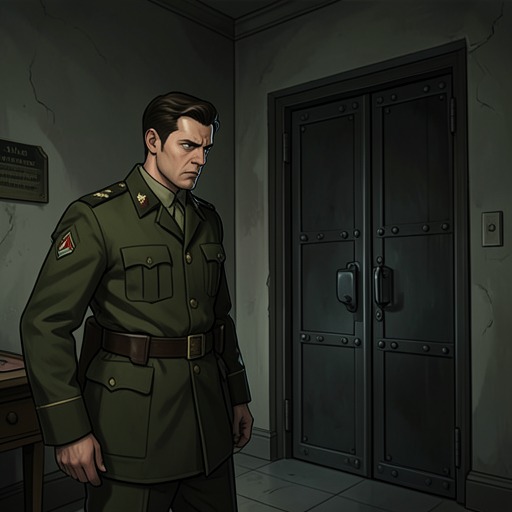
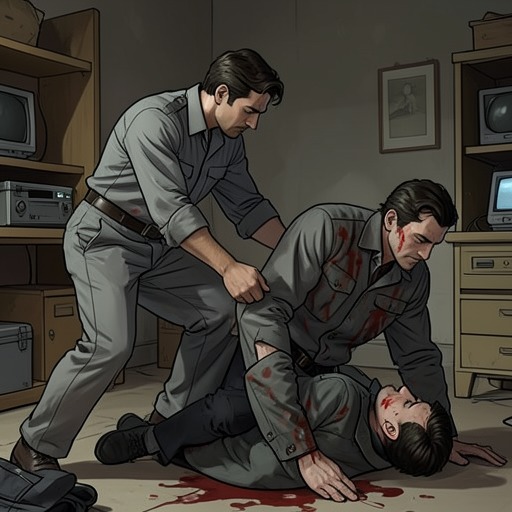
The Zone of InterestPaul Doll's injury and Bohdan Szozeck's death expose how a fabricated account of violence becomes lethal inside the camp. Doll attributed his black eyes to Bohdan, helping to set in motion the order that killed him; Hannah Doll later disclosed that she had struck her husband, while Dov Cohn's account revealed that Bohdan had actually helped Doll after seeing him fall. The event is therefore both a murder and a story about the power of a lie: Bohdan's kindness becomes entangled with the weakness he witnessed, and Doll converts that exposure into grounds for punishment.
The injury and the cover story
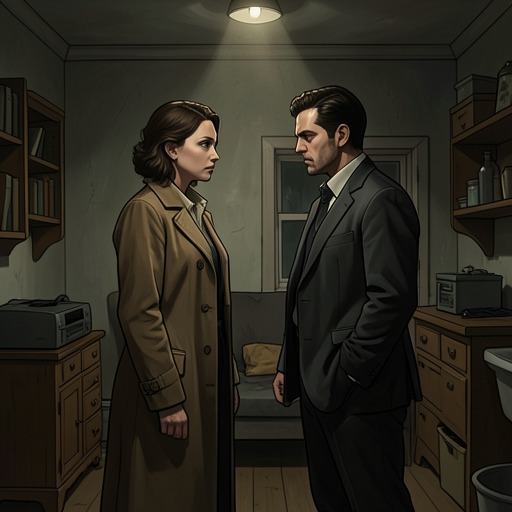
The chain of events begins with an altercation between Paul Doll and Hannah Doll. Angelus Thomsen later reconstructs the likely sequence: Hannah struck Doll in the face, and as the bruises darkened over the course of the day Doll needed an explanation for his disfigurement. At some point Bohdan attracted his attention, perhaps through clumsiness. Doll then invented a story involving a shovel and passed it, together with instructions, to Wolfram Prufer; Prufer's adjutant notified the Punishment Commando. Thomsen presents this as the likeliest sequence rather than as something he witnessed, and initially identifies Torquil's fate as the remaining mystery.
The false attribution surfaces in Thomsen's conversation with Hannah. He tells her, smiling, that Bohdan is dead and relays the version he has received from Boris Eltz: a mishap with a garden tool, followed by Doll's order to Wolfram Prufer and the dispatch of the Punishment Commando. Thomsen withholds the gas from his account, but recognizes that Hannah understands what happened. When he repeats the claim that Bohdan gave Doll his black eyes, Hannah corrects him: she, not Bohdan, struck Doll. Her mirthless smile widens and tightens as she speaks. The revelation does more than identify the original blow; it exposes how Doll's injury was made into a pretext for directing punishment at someone else.
Bohdan's last morning
Dov Cohn's testimony supplies the scene behind the competing stories. On Bohdan's last morning, Bohdan went to the Ka Be to have the dressing changed on his infected knee, then arrived at the Doll villa garden later than usual, at about half past nine. He was in the conservatory when Paul Doll reeled out through the glass doors of the breakfast room, one hand pressed to his face and still wearing his pyjamas. Bohdan initially took Doll for a prisoner: a new arrival, or Zugang, with a still-fat stomach and clean clothes, who seemed drunk, mad, or disoriented.
Doll saw the tortoise moving across the lawn, picked up a shovel, and brought its flat blade down hard on the animal's shell. He then fell backward onto the gravel. His pyjama bottoms had come undone and tripped him. The detail of the fall complicates any picture of Bohdan as the aggressor: in the account Dov gives, Doll is the one who strikes, and his victim is the tortoise. Bohdan did not exploit Doll's helplessness. He went out, helped him up, settled him on a stool in the shade, and fetched him a bottle of water. Doll waved him away.
Bohdan had already walked from the Stammlager to say goodbye to Dov and warn him not to look for him at the villa. He then went back, waiting for the punishment he expected. Dov knew why: Bohdan had been there when Doll showed weakness and had seen the Kommandant cry. That private observation, not an assault on Doll, is the knowledge that Bohdan believed had sealed his fate. The contrast is stark: Bohdan's response to Doll's vulnerability was practical care, while Doll's response to being seen vulnerable was to turn an invented accusation into an order backed by camp authority.
The killing and its aftermath
Thomsen and Hannah preserve their smiles while he recounts what Boris told him, but the performance of ordinary conversation cannot disguise the killing. Hannah asks whether Bohdan went to Stutthof; Thomsen answers that he went nowhere. She also asks about the tortoise. Thomsen calls its destruction Bohdan's parting gesture, while acknowledging that this is effectively her husband's version, filtered through several intermediaries. Her question and his qualification keep the account unsettled: the story Doll circulated is not the same as the sequence reconstructed from Dov's testimony.
The account of Bohdan's death includes the order to Wolfram Prufer and the dispatch of the Punishment Commando. Thomsen says nothing to Hannah about the gas, though he knows that she understands. The omission is significant because the polite, smiling exchange is itself a form of concealment: the violence is present, but it cannot be spoken plainly in that conversation. Elsewhere, Bohdan's expectation of death is echoed by Boris's memory of him sitting by a door, marking time and giving away his possessions. The scattered accounts converge on a man who knew the danger was coming and behaved as though there would be no return.
The camp as a system of consequence
Thomsen's reconstruction places the personal deception within a deliberately replicated camp landscape. On the same Friday, he walks through Kat Zet III, built and financed by IG Farben on the model of Kat Zet I and Kat Zet II. Its searchlights, watchtowers, barbed wire, high-tension fencing, sirens, gallows, guards, punishment cells, whipping post, mortuary, and other facilities reproduce the apparatus of confinement. In such a setting, Doll's fabricated story does not remain a private lie. It moves through a chain of command and becomes an instrument of organized violence.
Doll's own justifications elsewhere make that machinery harder to mistake for mere procedure. He insists that he is a normal man with normal feelings, then says that kindness to a Jew would be cruelty to Germany and replaces ordinary distinctions between right and wrong with calculations of positive and negative outcomes. His angry declaration that there will be no pampering belongs to the same moral logic: cruelty is presented as discipline, while the victim's suffering disappears behind the language of duty and political purpose. His account of Bohdan's supposed attack performs that logic on an intimate scale, transforming Doll's own injury into an excuse to punish another person.
The event also resonates with Doll's later questions about the camp's stench, the churned meadow, brown snow, and the drunkenness of those who carry out its work. On the Reich Day of Mourning he wonders why, if their actions are good, they smell so bad, and observes that the language of obedience contains the corpse. That later reckoning does not undo what happened to Bohdan. It does, however, sharpen the event's central contradiction: a regime that claims to serve Germany produces death through routine orders, while its functionaries keep speaking as if positive outcomes could erase the human cost.