Dov Cohn
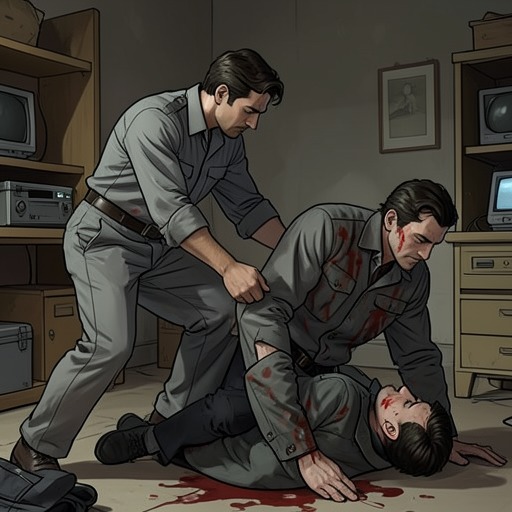
The Zone of InterestDov Cohn is a fifteen-year-old German Jewish prisoner at Kat Zet III, a survivor left alone after the deportation and selection of his family. Known as Bohdan Szozeck’s “Pikkolo,” he is both the young person in the older prisoner’s care and a witness to a moment of weakness in the Commandant. His brief encounters with the narrator bring into focus the novel’s contrast between a child’s vulnerability and the grave knowledge that survival has made him carry.
Identity and Place in the Camp
Dov is introduced through his connection to Bohdan, the Polish gardener in the Doll family’s garden. Hannah describes the pair as “very close.” The relationship is given a camp-specific name when the narrator learns that Bohdan has a “Pikkolo,” Hannah’s designation for a young companion or charge whom an older prisoner looks after. The term is ambiguous: unlike “Piepl,” which has a definite sexual meaning, “Pikkolo” can describe companionship and care. The distinction matters because it keeps the bond from being reduced to a label; the account presents Dov as someone Bohdan looks out for, without supplying a more exact definition of their relationship.
Dov is sometimes seen in the Dolls’ garden, including during the narrator’s first visit. Hannah identifies Bohdan as a former professor of zoology in Cracow, now working as a gardener, and the contrast between that former life and his present circumstances gives their closeness additional weight. Dov, meanwhile, is registered in Block 4(vi) at Kat Zet III. The camp is still under construction, with only a colony of builders quartered there, but its planned organization reproduces Kat Zet I and Kat Zet II, including their fencing, watchtowers, punishment cells, and mortuary. Dov’s location is thus a specific block within a developing camp system, not a refuge outside it.
Deportation and Loss
When the narrator asks how he came to be there, Dov tells his history in a firm voice that sometimes leaps an octave. In the autumn of 1941, he and his family were flushed out of a Jews’ House in Dresden. They spent a month in Theresienstadt camp before being sent on the second transport. On arrival, a leftward selection took his mother, four younger sisters, three grandparents, two aunts, and eight younger cousins. His father and two uncles survived for about three months, digging drainage ditches; after that, Dov was alone.
The telling is called unexceptional, but its sequence makes the scale of the loss concrete: removal from home, a month in a holding camp, selection from the transport, and then the gradual disappearance of the male relatives who initially survived. The precise count of those taken with his mother and the brief interval before his father and uncles died keep his story from dissolving into general statements about wartime suffering. Dov recounts this history without the narrative presenting it as an appeal for sympathy. Its restraint sharpens the contrast between the ordinary firmness of his voice and the enormity of what he has survived.
Care, Exchange, and Witness
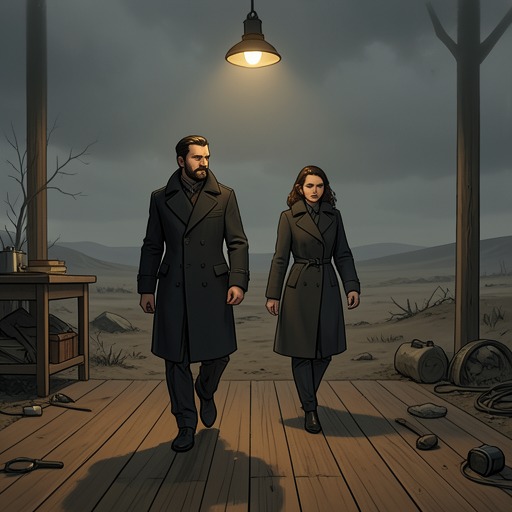
The narrator approaches Dov to ask about Bohdan Szozeck and assures him that no harm will come to him, whether or not he helps. Before Dov gives his account, the narrator offers him five American cigarettes and tells him to save them. The exchange occurs under the lamps at night; the cigarettes are measured against the bread rations they might be worth, making the offer a material inducement as well as a small gesture of care. Later, as they walk back toward Dov’s block, the narrator gives him the remaining cigarettes and ten US dollars, again telling him to put them somewhere safe.
A Hershey bar changes the pace of the questioning. Dov carefully frees it from its cellophane and gives the chocolate a reverent lick. The narrator watches him linger over it, imagining that he could make it last a week by consuming it with his tongue. The scene gives Dov a moment of pleasure without pretending that the gift can repair what has happened to him. His eyes, described as having once seemed made for innocence but now enlarged by experience, carry the same contrast: the child remains visible, but so does what he has been compelled to know.
Asked who looks out for him, Dov reluctantly identifies Stumpfegger. Asked why, he explains that Stumpfegger was present when the Commandant showed weakness and saw him cry. This is the clearest account of the value Dov places on the connection: Stumpfegger’s claim to look after him is tied to having witnessed a breach in the Commandant’s authority. Dov’s statement is concise, but it reveals that a moment of emotion at the top of the camp’s hierarchy has entered the understanding of a boy living under it.
Narrative Significance
Dov’s story links the domestic garden, the camp register, and the night-time walk back to his block. He belongs to the garden through Bohdan, to the camp through his assigned location, and to the narrator’s inquiry through the account he chooses to give. These settings do not offer different versions of safety: even the garden is within the world of imprisonment, while the narrator’s cigarettes, chocolate, and money can provide only limited, immediate help.
The character is defined less by a developed course of action than by the relationships and testimony that survive around him. Bohdan’s care gives him a companion; Stumpfegger’s reported care is attached to witnessing the Commandant’s vulnerability; and the narrator’s questions elicit the history of a family erased in stages. Dov does not become a symbol instead of a person: the named relatives, the block number, the chocolate wrapper, and the careful saving of cigarettes keep his experience particular. At the same time, his presence makes the camp’s violence legible through what it has left behind: a fifteen-year-old without his family, still being looked after by others, and already carrying knowledge that adults in authority would prefer to control.