Einsatzgruppen
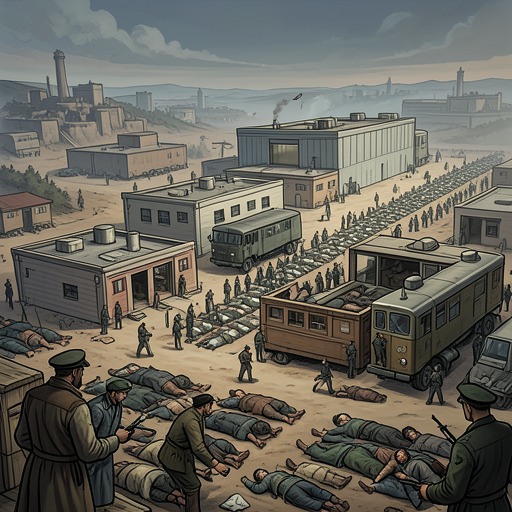
The Zone of InterestEinsatzgruppen are presented as mobile killing units whose shootings reveal the human will at the center of mass murder. In a conversation with Angelus Thomsen, Konrad Peters says they had already killed well over a million people with bullets; their example challenges the idea that the machinery of extermination, however consequential, was what made the crime possible.
Role in the Killing Process
Peters invokes Einsatzgruppen as evidence that mass murder did not depend on the gas chambers and crematories. He describes those technologies as means of accelerating the killings, economizing on resources, and sparing the killers’ nerves. Bullets and pyres, he argues, would also have enabled the perpetrators to kill on an enormous scale. The organization’s significance in this account lies in what its method demonstrates: industrialized facilities could shape the process, but they were not a precondition for extermination.
Scale and Method
The figure Peters gives is already well over a million people killed by bullets. He asks Thomsen to imagine millions of women and children being killed in the same way. The hypothetical widens the implication of the figure: shooting was not merely an earlier or smaller-scale form of violence, but a method that could have been extended to the full killing of civilian populations. Peters returns to the killers’ capacity and intention rather than treating the choice of weapon or facility as the decisive explanation.
Policy Context and Escalation
The novel places the shootings within a broader account of how the extermination policy developed. In Peters’s chronology, a letter dated July 31, 1941, drafted by Adolf Eichmann and Reinhard Heydrich and returned with Goring’s signature, conveyed Hitler’s wish for a total solution and the authority to begin. Peters describes an earlier possibility of deporting Jews to a remote, cold region after a rapid victory over Russia. That territorial option, he says, receded as officials in Poland faced the addition of three million Jews and argued that they could not manage the numbers. By August or September, the shift was toward killing not only men, already being murdered, but also women and children. This account supplies policy context for the Einsatzgruppen’s shootings without reducing the organization’s actions to a single order or treating the policy’s development as detached from pressures within the occupied territories.
Narrative and Moral Significance
Peters’s discussion turns the organization into a challenge to explanations that locate the horror primarily in modern machinery. The gas chambers and crematories matter as instruments of speed, economy, and the management of the killers’ nerves; the shootings demonstrate that the intent to kill could operate without them. His repeated insistence that the perpetrators had the will places responsibility on human choices, even as the novel traces those choices through authorizations, administrative pressure, and escalating policy. The contrast makes the Einsatzgruppen’s method more than a historical aside: it exposes how technological form can change while the purpose and scale of violence remain.