Endlösung extermination policy
The Zone of InterestThe Endlösung extermination policy is depicted as both an authorized project and a process of escalating decisions: a high-level mandate gives permission to begin, while pressure on the ground narrows the supposed alternatives until the murder of women and children becomes policy. The novel follows that development from a letter sent in 1941 to the disorder of a later transport arrival, insisting that bureaucratic language and industrial methods must not obscure the human decision at their centre.
Authorization and the turning point
In a conversation with Thomsen, Konrad Peters identifies July 31, 1941, as a beginning point for the crime without a name. The letter drafted by Eichmann and Reinhard Heydrich was sent to Goring and returned with his signature. As Peters interprets it, Adolf Hitler’s expressed wish for a total solution was translated into authority to begin: manpower had been assembled in the east, and the officials responsible were told they had the authorization to proceed. The letter therefore functions in the account not as an exhaustive blueprint, but as a decisive administrative permission.
Peters places this authorization at the zenith of Nazi power. His dating and explanation give the policy a political chronology: it was not simply an eruption of violence without institutional direction, nor does his account reduce its development to one document. The signature, the assembled personnel, and the instruction to begin establish central responsibility; what followed also depended on how officials and administrators acted as the circumstances changed.
From territorial schemes to mass murder
Peters describes an earlier imagined alternative in which Jews might be dumped in a cold, barren region beyond the Urals, perhaps in the Arctic Circle, after a quick victory over Russia. In this account, that was extermination by exposure and deprivation rather than an escape from the intent to destroy. The territorial scheme depended on military victory and on a distant destination that could supposedly absorb the people the regime had marked for removal.
The plan became harder to sustain as officials in Poland faced the consequences of annexing another three million Jews. Peters describes pressure from below among plenipotentiaries who could not manage the numbers, while the territorial answer receded. By August or September, he says, the question had moved toward another escalation: killing not only men, as had already been happening for months, but women and children as well. The account thus links the policy’s radicalization to a collision between an existing exterminatory purpose, expansion of the population under Nazi control, and the failure of proposed territorial solutions. Administrative pressure helps explain the turn, but does not excuse or erase the decisions that made it possible.
Labor, deportation, and competing offices
The policy’s logic is also exposed through a camp official’s account of being pulled between two institutions. The Economic Administration Head Office presses him to increase the labour force for the munitions industries; the Reich Central Security Department presses for the disposal of as many evacuees as possible. He frames this conflict as a choice between competing demands, and repeats the regime’s claim that Jews constitute a fifth column. His language makes the machinery of persecution audible: people are counted as workers to be extracted or as a security problem to be removed.
A teletype proposing that all able-bodied mothers be worked to exhaustion in the boot factory at Chełmek brings that contradiction into sharp focus. The official objects that its advocates have not considered how anyone could separate mothers from their children at the ramp. The practical objection does not challenge the persecution itself; it reveals how labor exploitation and deportation collide at the point of implementation. Within the passage, the demand to swell the workforce and the demand to dispose of evacuees coexist, leaving administrators to manage the consequences of policies that treat human beings as both usable labour and disposable population.
Deportation loses its cover
Later, the novel shows how the deception surrounding transports begins to fail. The official insists that he has not become worse at deceiving evacuees; rather, people in the communities from which they are taken have learned to draw conclusions from the fact that Nobody Has Ever Come Back. The loss of surprise is more than an operational inconvenience. It marks the failure of the euphemisms that had helped make deportation appear to be resettlement, as the intended victims infer what the authorities continue to conceal.
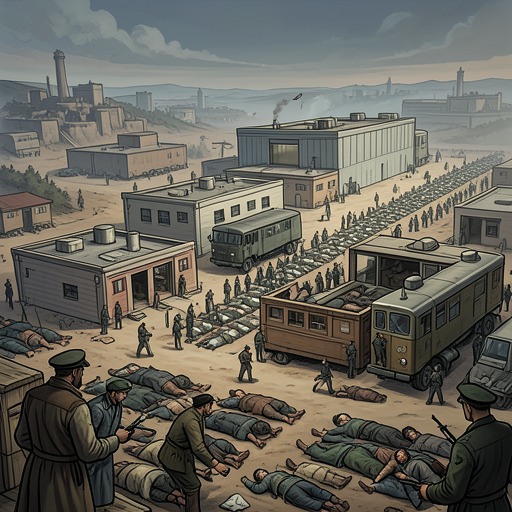
One afternoon, a transport’s first draft collapses almost as soon as its passengers leave the cattle cars. Before Professor Zulz and his colleagues have begun the selection, 800 men, women, and children are moving through the slush. The arrival turns rapidly from a confused whimper to screams, blows, and a gunshot. Ninety minutes later, roughly 600 survivors have been beaten, flogged, or prodded with bayonets into Red Cross vans and ambulances. The official stands on the platform wondering how long the cleanup will take. His concern with restoring order and clearing the site reduces a scene of human suffering to an administrative mess.
Four hours ahead of schedule, Sonderzug 319 arrives. It carries Jewish patients from mental hospitals in Utrecht, accompanied by their young nurses. The official initially mistakes the transport for one connected to the euthanasia programme, then notes that these are Jews rather than Germans. The passengers move relatively calmly along a siding already strewn with corpses, blood, and sodden bags, while horrifying laughter joins the familiar sounds of violence. Two silver-haired twins look on with apparent satisfaction; a lanky teenager in a green canvas straitjacket trips and falls, and Ilse Grese hauls her up by the hair. The bystanders applaud. The episode places the policy’s abstractions beside a particular, degrading spectacle: people categorized as defective are delivered into a system that has already made violence and humiliation part of its ordinary operation.
Methods and the meaning of the machinery
Peters cautions Thomsen against treating gas chambers and crematories as the essence of the crime. He calls them epiphenomena: methods that accelerated killing, economized effort, and spared the killers’ nerves. In his account, bullets and pyres could have accomplished the destruction because the perpetrators had the will to carry it out. The distinction is crucial to the policy’s meaning in the novel. Industrial facilities magnify the speed and organization of murder, but they do not supply its intention.
Peters points to the Einsatzgruppen, which he says had already killed well over a million people with bullets. He imagines the same method extended to millions of women and children, underscoring that the existence of gas chambers was not what made mass murder possible. His argument neither diminishes the significance of the killing apparatus nor treats technology as an autonomous cause. Instead, it locates responsibility in the political purpose and human choices that could employ different means toward the same end. Across authorization, administrative conflict, and the brutal handling of transports, the novel presents the Endlösung extermination policy as a system whose euphemisms and machinery can change while its destructive intent persists.