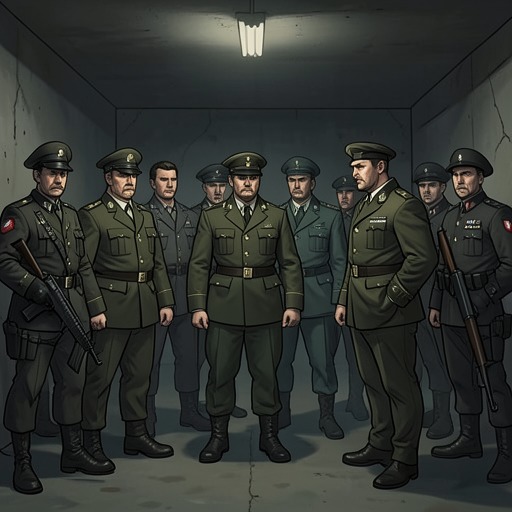
Execution of Polish Home Army prisoners at Bunker 3
The Zone of InterestThe Execution of Polish Home Army prisoners at Bunker 3 is presented as an organized massacre whose administrative calm cannot conceal its purpose. At a briefing in the camp’s windowless basement, the prisoners are told that every one of them will be shot that afternoon. The account then follows the threat into its execution: a small group fights back, while 291 men are shot between 17:10 and 17:45. Their final soup, postcards, patriotic songs, and cries of “Long live Poland” stand against the machinery of intimidation that has already made the killings a matter of schedule.
Background and Assembly
The immediate setting is Bunker 3, a red-brick, windowless building. The day’s proceedings begin at 06:28, after Paul Doll has spent a troubled night drinking heavily and has taken a sedative in the early morning. He arrives feeling unwell and sees the meeting through a first-person account marked by physical disorientation. Present with him are Wolfram Prufer, Fritz Mobius, two agents from the Political Section, and Captains Drogo Uhl and Boris Eltz. A translator is dismissed on the claim that the Polish prisoners, described as “old numbers,” understand German well enough.
The prisoners enter in columns of five, led by a single armed guard. Their appearance unsettles Doll’s expectations: they are about 300 men, muscular and well-fed enough to fill out their striped uniforms, some wearing real shoes. The narrator compares their bearing to that of a crack military unit and briefly imagines leading them in battle. Their strength matters not just as a striking contrast to the camp’s usual image of prisoners as emaciated, but because the assembled men are identified as members of the Polish Home Army. They are not an anonymous labor group; they belong to a resistance movement whose capacity to act is precisely what the officers seek to contain.
The Threat and Its Terms
Mobius announces that each prisoner will be shot, probably at about five that afternoon. The statement is delivered openly, without the false promise of release. He explains that the men have held back because they cannot persuade their center in Warsaw that the camp is an active asset: the camp authorities assume that prisoners are merely “bags of bones,” whereas the men before them contradict that assumption. The speech turns their military usefulness into the stated reason for their danger. Their strength is acknowledged, then made part of the case for killing them.
The warning extends beyond the prisoners themselves. The officers claim to possess parish registers and threaten to send the men’s parents and grandparents to cattle wagons, as well as their wives, children, nephews, and nieces to the crematoria. This threat places the prisoners’ families inside the coercive structure of the camp: the men are made to understand that resistance could expose relatives to deportation and death. Mobius’s proposed terms for the final hours are equally controlled. The prisoners are told to die with Polish pride and courage, while the Germans promise respect and a double ration of warm, foul soup. The language of respect does not soften the sentence; it recasts an already decided execution as an orderly exchange between soldiers.
The Killings
The prisoners are dismissed after the briefing. At 22:07 that night, Prufer reports the outcome to Doll. A small fraction of the Polish contingent chose to fight, forming a barricade that was quickly overrun. The remainder—291 men—were shot uneventfully between 17:10 and 17:45. The compressed timespan makes the massacre legible as an operation carried out to plan: the interval between the afternoon sentence and the shooting is filled not by any reconsideration but by preparation for the killing.
Prufer describes the prisoners’ final hours in details that make their conduct harder to assimilate to the officers’ orderly account. They ate their soup and spent an hour or two writing postcards. When the time came, many sang patriotic songs, and nearly all shouted something like “Long live Poland” as their final words. The men’s last expressions do not reverse their vulnerability or alter the result; instead, they preserve a form of collective identity that the threats and execution are meant to crush. Doll responds to the Polish cry as an oddity, while Prufer’s report makes clear that the prisoners met the killing with deliberation and solidarity.
The aftermath also strains the appearance of procedural smoothness. Prufer says the bodies had to be moved before the prisoners’ comrades returned from work. The carts were covered, but the officers could not conceal the blood. The returning men saw it, and the yard became tense. Mobius thinks another batch may be necessary, meaning the operation may have to be repeated. The attempt to hide the massacre thus produces a further practical problem for the camp authorities, and the possibility of repeating it is presented as an administrative response rather than as a moral reckoning.
Narrative and Historical Significance
The episode places an explicit death sentence inside the camp’s ordinary systems of command: armed escort, officers’ conference, prisoner classification, threats based on family records, timed shooting, and the removal of bodies. The scale and timing are reported with the same precision as a work schedule. That precision does not make the event impersonal; it shows how violence is organized so that responsibility can pass through roles and procedures while the outcome remains unmistakable.
The prisoners’ identity as Home Army members also connects the massacre to the wider conflict beyond the camp. Mobius says that their resistance center in Warsaw cannot be convinced that the camp is an active asset, while the officers answer that potential with execution and reprisals against relatives. The account does not make the prisoners’ resistance successful: a small group is overrun, and 291 are shot. What survives in the telling is instead the contrast between the perpetrators’ effort to control time, bodies, and information and the prisoners’ final acts of writing, singing, and speaking for Poland. The blood that cannot be covered marks the limit of that control.