Final Solution
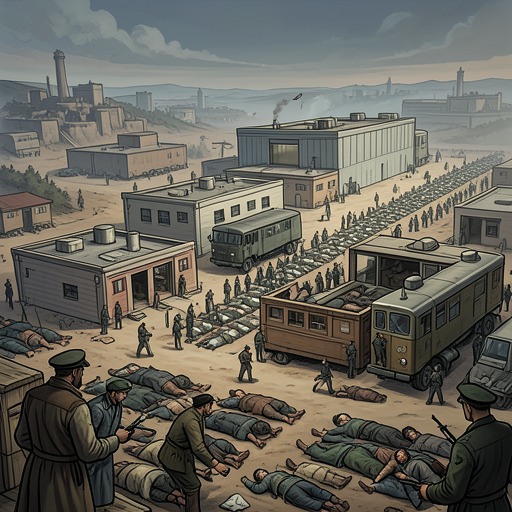
The Zone of InterestThe Final Solution is the Nazi policy of exterminating Europe’s Jews. In the novel, it is neither reduced to a single order nor treated as a policy that simply emerged by accident: the account joins a central authorization to local pressures, institutional conflicts, and decisions that expanded the intended victims from men to women and children. Its starkest claim is that modern machinery accelerated killing and spared the killers’ nerves, but was never its source. The decisive force was the will to kill.
Authorization and Radicalization
In a conversation in the Tiergarten, Angelus Thomsen asks Konrad Peters to put the crime into perspective. Peters locates its beginning on July 31, 1941, when a letter drafted by Eichmann and Reinhard Heydrich was sent to Goring and returned with his signature. As Peters explains it, the letter conveyed Adolf Hitler’s wish for a total solution and authorized action after manpower had been assembled in the east. The scene gives the policy a paper trail and a chain of authority, while making clear that administrative language is not a neutral description of what that authorization meant.
Peters does not describe the first contemplated course as immediate, comprehensive extermination. The regime may initially have expected to expel Jews to a cold, barren region beyond the Urals or in the Arctic Circle after a rapid victory over Russia, allowing them to die through exposure and deprivation. That territorial scheme depended on a victory that did not arrive. At the same time, pressure mounted among officials in Poland, where annexations had increased the number of Jews under Nazi control and local authorities claimed they could not manage them. As the proposed territorial solution receded during August and September, the policy moved further toward direct murder.
The crucial escalation, in Peters’s account, was the extension of killing from men, who had already been murdered for months, to women and children. This sequence resists a simple choice between a fully specified plan enacted unchanged from above and a process made up only of spontaneous local initiatives. The scene identifies a high-level authorization and Hitler’s expressed wish, but also shows policy hardening amid administrative pressure and competing officials. The narrative presents those forces as mutually reinforcing rather than as excuses that dissolve individual responsibility.
Who Was Marked for Death
The policy’s reach is exposed through the grotesque rationales offered for killing different groups. In Peters’s account, children are supposedly dangerous because they might grow up and seek revenge; women below forty-five are treated as potential mothers; older women are included through the logic of killing them while the operation is underway. These explanations make the supposed practical reasoning visible as a device for extending murder across age and sex, not as a meaningful distinction between threats and non-threats.
The narrative also sets extermination beside the Nazi system’s competing demands for labor. At the camp, the Economic Administration Head Office presses for increased labor strength for the munitions industries, while the Reich Central Security Department presses for the removal of as many evacuees as possible. Angelus Thomsen’s weary reflection on these opposed imperatives shows how people can be treated at once as exploitable workers and as a population to be eliminated. The conflict does not make the system humane: it exposes the administrative calculation through which lives are alternately used, discarded, or subjected to both forms of violence.
The same coercive environment reaches beyond the camp. In Litzmannstadt, a control office nominally tasked with combating black-marketeering and profiteering in the Jewish residential district is described as having grown out of the Jewish Order Police and as answering to the Gestapo. The office’s transformation into a body run by informers, pimps, and other underworld figures exemplifies how persecution can criminalize a subject population and open access to its hoarded wealth. This is not presented as the whole extermination policy, but as part of the surrounding machinery of dispossession and domination.
Methods, Machinery, and Will
Peters directly challenges the idea that the industrial character of the killing explains its underlying purpose. Gas chambers and crematoria, he argues, were means to accelerate the process, economize on resources, and spare the nerves of the killers. They were consequential instruments, but not the origin or necessary condition of the policy: bullets and pyres could also have killed the victims. He cites the Einsatzgruppen, which had already murdered well over a million people by shooting, as evidence that mass killing did not depend on the later image of an automated process. The machinery changes the speed and administration of murder; it does not account for the decision to murder.
The novel connects that will to a wider culture in which cruelty is treated as a virtue and rewarded with preferment and power. Peters places mass murder alongside forced abortions, sterilizations, and euthanasia, identifying a pervasive appetite for death rather than an isolated excess of one institution. He describes the conjunction as at once modern and ancient: the advanced Buna-Werke represents the promise of futuristic industry, while the violence surrounding it reaches back to a more primitive brutality. The contrast is pointed by the fact that the plant produced no synthetic rubber or synthetic fuel, even as forced labor and mass murder formed part of the system built around it.
The camp’s material conditions give this argument a sensory and moral dimension. In an earlier reflection, Paul Doll asks why an undertaking claimed to be good smells so appallingly bad: why the meadow churns, why vermin and disease flourish, and why the snow turns brown. Those questions do not identify the whole policy by themselves, but they puncture its euphemisms with the physical consequences of killing and disposal. The stink, contaminated surroundings, and altered snow make violence impossible to keep at the level of offices, orders, or abstraction.
Defeat, Continuation, and Responsibility
The policy’s movement through time is marked by the gap between military defeat and the persistence of murderous intent. As 1943 approaches, Paul Doll celebrates the apparent prospect of victory at Stalingrad and endorses the reported plan to deport the women and children and shoot the men remaining there. His triumphal language turns the proposed destruction of a population into a supposed tribute to German sacrifice. Later, after defeat in the east, the camp briefly experiences the bewilderment of people confronting the possibility that the war may be lost and that crimes legalized by the state remain crimes elsewhere. That interval lasts only five or six days. The narrator’s conclusion is bleak: Germany may lose against the Anglo-Saxons and the Slavs, yet still have time to win its war against the Jews. Doll, rather than retreating from murder, becomes newly convinced of its righteousness.
Konrad Peters later tells Angelus Thomsen that the extermination will be prosecuted, and perhaps completed, in the convulsion of defeat. His statement denies any comforting assumption that military collapse will automatically stop the killing; the regime’s awareness that it has lost does not erase its capacity or intention to continue. Peters also asks who will benefit from a Europe emptied of Jews if the Reich itself is about to disappear. The question exposes the self-defeating character of the project without implying that its perpetrators required a rational or durable benefit in order to pursue it.
The novel’s retrospective view refuses to let bureaucratic distance stand in for innocence. After the war, Angelus Thomsen recalls the doubled self he felt in the camp and his postwar sense of being halved, as Germans were expected to become reformed characters after the war of annihilation and the extermination policy. That inward division is not offered as an acquittal; it registers how a system of participation and obedience can deform the people who serve it without making their actions disappear. The policy’s history, as the novel frames it, therefore runs from authorization and administrative escalation through killing and continued intent under defeat to an unsettled reckoning with responsibility.