Fritz Mobius
The Zone of InterestFritz Mobius is a senior Gestapo figure in the Political Department whose influence rests on political intelligence, institutional access, and a talent for making coercion sound like practical administration. He can read a room, work a prisoner, investigate a sabotage report, and warn a camp commandant that his position is precarious. The narrative also gives him a place in the chain of explanation for mass murder: he recounts how extermination policy hardened through authorization and mounting pressure, while insisting that industrial killing was a means rather than the source of the perpetrators’ will. His own conduct, by contrast, is not presented as a simple portrait of physical brutality. At a nightlong interrogation he shouts with unmistakable fury but uses no force; later, he dies of a heart attack during another interrogation.
Position and Political Method
Mobius belongs to the Political Department and is identified as a consummate Gestapo operator. The combination matters: his authority is not shown chiefly through a formal description of rank, but through his ability to manage information and people inside an institution where political custody, interrogation, and camp administration intersect. In one case, Esther Kubis is in Gestapo custody as a political criminal. Mobius is away on leave, and the narrator describes him as non-venal. With him unavailable, Boris Eltz turns instead to Michael Off, hoping that Off will be cheaper than Jurgen Horder. Mobius’s absence therefore has practical consequences: even a reputation for incorruptibility becomes part of the calculations others make around a prisoner’s case.
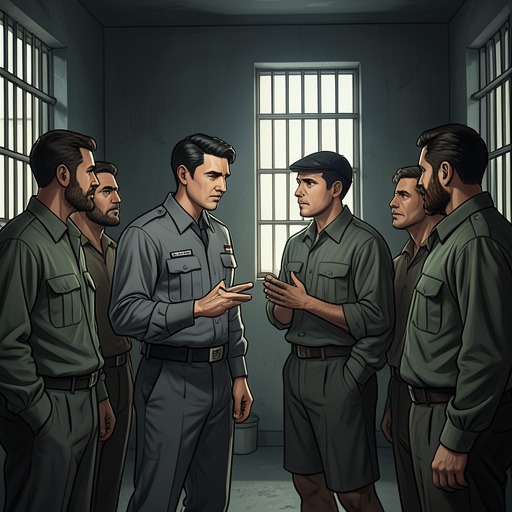
His dealings with Polish prisoners show how he converts political pressure into a performance of recognition. He argues that something must be done about the Poles, then addresses a group of Home Army prisoners as soldiers. His tactic is to tell them that their resistance has not persuaded their Centre that the camp can be an active asset; in the Centre’s view, they are merely bags of bones. The speech acknowledges the prisoners’ capacity while turning that acknowledgement toward an instrumental purpose. The narrator recognizes the tactic in advance, expecting Mobius to use subterfuge and play his audience. Mobius’s skill lies not in concealing that he is manipulating them, but in making the manipulation sound like frank military respect.
The narrative also catches him in ordinary professional exchanges: he opens one encounter with a courteous invitation to sit and explain how he can help. Elsewhere, he discusses a ballet’s choreography by Saint-Leon and music by Delibes with Suitbert Seedig, then turns to Paul Doll and remarks that the Kommandant does not look well. Such transitions place cultural conversation and camp business in the same institutional world. A woman’s absence from the experimental thés dansants and from a cocktail party Mobius gives in the Political Department is another small indication of the social occasions attached to his office, though the account does not identify her in that passage.
Crisis, Investigation, and Conflict with Doll
Mobius is among the officials summoned to an emergency summit in the Political Department over a crisis at Buna-Werke. Suitbert Seedig and Rupprecht Strunck are also present. The episode situates him among administrators responding to a threat to the camp’s industrial operations, and establishes that he is involved in the political side of the response rather than standing outside it. The evidence does not make him the sole decision-maker; instead, it shows him working within a circle of officials and using reports to pursue responsibility.
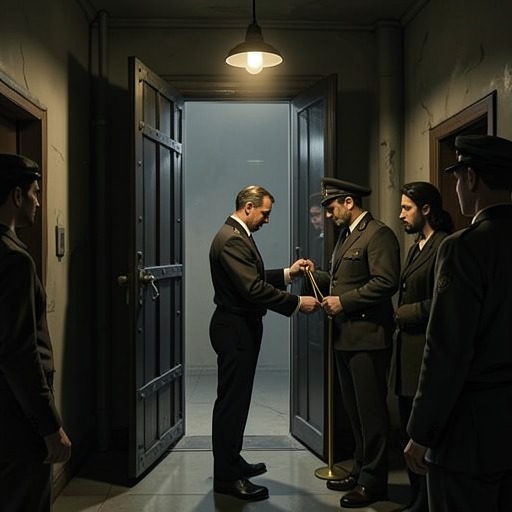
During an investigation associated with Rupprecht Strunck’s report, Mobius reads the first page and asks whether the named man is the coordinator on the floor. He then focuses on a calendar marking first use and asks who at IG Farben supplied it. The questions are compact but revealing: he is tracing both operational responsibility and the source of information. Soon afterward, a bolted door is opened, revealing Michael Off half asleep on a stool and Roland Bullard lying in the dirt with a severe head wound. The account does not clearly establish who inflicted that injury, so it cannot be assigned to Mobius; its presence instead fixes the investigation within a coercive environment in which information gathering and bodily harm are close together.
His confrontation with Doll makes the pressure on the camp commandant explicit. Mobius tells Doll that his position is hanging by a thread and points to Hannah Doll’s apparent pleasure at every snippet of bad news. He threatens to report the situation to Prinz Albrecht Strasse if things do not change soon, then reduces the issue to a demand that Doll control his wife. The threat joins institutional oversight to private life: Mobius treats Hannah’s conduct as evidence bearing on Doll’s fitness to command. Earlier, in a conversation with Angelus Thomsen, he asks whether Hannah has left him, bringing the marriage into a more personal exchange. Across these moments, Mobius’s attention to Hannah is framed less as independent concern for her than as a way to assess Doll and exert pressure on him.
Explaining the Extermination Policy
In a discussion with Thomsen, Mobius offers a historical account of the policy of mass murder. He locates a decisive authorization at the end of July 1941: a letter drafted by Eichmann and Reinhard Heydrich, sent to Goring, and returned with his signature. In Mobius’s summary, the document gave authority for a total solution, while reflecting the Fuhrer’s wish. He presents this not as a detached archival account but as an explanation of how decisions at the top entered an already expanding machinery in the east.
His account also emphasizes pressure from below. He suggests that the original territorial scheme may have involved sending Jews to a remote, cold region beyond the Urals and into the Arctic Circle after a quick victory over Russia. As that prospect receded, annexation added three million Jews in Poland to the population the authorities claimed they could not manage. Mobius describes a contest in extremism among plenipotentiaries in Poland and identifies the subsequent widening of murder to women and children as a further turn in the process. His explanation therefore combines central authorization with institutional and local pressure; the account presents his interpretation, rather than certifying every element as an omniscient historical judgment.
Mobius distinguishes the purpose of the killing from its technology. He tells Thomsen that gas chambers and crematories were epiphenomena: they sped up the process, economized, and spared the killers’ nerves, but were not necessary to the perpetrators’ intention. Bullets and pyres, he argues, would ultimately have accomplished the same end because the killers had the will. The statement is chilling partly because it strips technological modernity of explanatory power. In his telling, the machinery altered the speed and experience of killing, not the underlying readiness to do it.
Interrogations and Death
Mobius’s own practice is marked by a contrast between verbal fury and physical restraint. During the first six hours of a nightlong interrogation, he shouts vociferously, but the narrator stresses that the anger is neither simulated nor an act, and that Mobius uses no force. When the shift changes at midnight, Doll looks in and strikes the prisoner a few times before Michael Off takes over until dawn and does somewhat more of the same. The prisoner appears not to be meant to bear visible marks. The distinction does not make Mobius’s role benign: he remains an interrogator within a system of coercion, and his sustained shouting is described as an expression of anger. But the scene differentiates his method from the physical blows delivered by Doll and Off.
The narrative later records that Fritz Mobius suffers a fatal heart attack toward the end of a nightlong interrogation on June 1. No year is specified in that statement. His death comes in the setting that has defined much of his work: an interrogation conducted through the night, in the Political Department’s orbit. The ending gives no account of a conversion or repudiation. Instead, the officer who had read reports, manipulated prisoners, pressured Doll, and interpreted the escalation of extermination dies while the machinery of interrogation is still in motion.
Narrative Significance
Mobius is drawn through several linked forms of authority: the tactician who anticipates resistance, the official who follows a report toward its sources, the political superior who threatens Doll, and the speaker who narrates extermination as a process shaped by both authorization and escalating pressure. His polished, adaptable manner is not a refuge from the violence around him. It is one of the means by which that violence is administered, explained, and made to appear operationally manageable.
At the same time, the novel does not make him interchangeable with every other official. His characterization depends on distinctions of method and temperament: he is described as non-venal, quick to recognize a subterfuge, and capable of extreme anger without using force in the interrogation witnessed by the narrator. These details do not erase his institutional complicity. Rather, they sharpen the portrait of a system in which personal style can vary while political custody, coercive investigation, and mass murder remain connected. His explanation of the extermination process makes that connection especially stark: the devices may change, but, in his own account, the will to kill precedes and outlasts them.