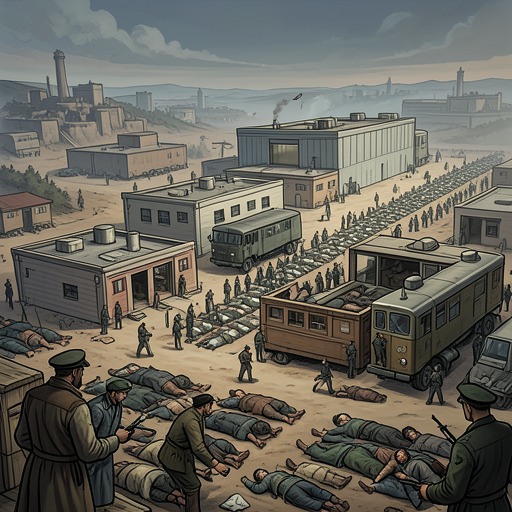
Göring’s Authorization of July 31, 1941
The Zone of InterestGöring’s Authorization of July 31, 1941, is presented as a written grant of authority at a decisive point in the development of the Nazi mass murder of Europe’s Jews. In Paul Doll’s account, the document links a request drafted by Eichmann and Heydrich to Göring’s signature and to Hitler’s stated wish for a total solution. The narrative treats the authorization as a critical step in a process that escalated through competing institutional pressures, while insisting that the machinery and methods of killing did not create the perpetrators’ willingness to kill.
The Document and Its Authority
Doll dates the beginning of what he calls the crime without a name to July 31, 1941, when a letter drafted by Eichmann and Heydrich was sent to Göring and returned with his signature. As Doll recounts it, Hitler’s wish for a total solution supplied the political premise; the letter conferred authority to begin. Its significance in the narrative lies in the passage from a leader’s expressed intention to a written authorization carried through administrative channels.
The account also preserves a distinction between authorization and a fully specified method. In Doll’s reconstruction, officials in the east had been assembling manpower during the preceding month, while some leaders may still have envisaged removing Jews to a cold, barren region beyond the Urals and into the Arctic. That imagined territorial solution depended on a rapid victory over Russia. The letter therefore appears not as a detailed operational plan, but as a consequential delegation amid options that had not yet all disappeared.
Escalation and the Expanding Target
Doll describes a further shift in August and September, as the territorial alternative receded and pressure grew among competing authorities in Poland. The narrative connects this pressure to the annexation of an additional three million Jews and to officials’ claims that existing arrangements could not cope with the numbers. Under that strain, he says, the policy crossed a moral threshold: killing expanded beyond men, who had already been murdered for months, to include women and children. The authorization is thus situated within an escalating process, not presented as an isolated paper that by itself explains every subsequent decision.
Doll’s account identifies the inclusion of women and children as a crucial change in the scope of the killing. In a later exchange with Konrad Peters, the supposed rationales for killing children and different groups of women are exposed as a succession of justifications, not as mitigating explanations. The administrative language of authority and necessity sits against the human consequence of a policy that made whole families targets.
Administration, Labor, and Disposal
Elsewhere, Doll describes himself as caught between the Economic Administration Head Office, which pressed him to increase labor for the munitions industries, and the Reich Central Security Department, which demanded the disposal of as many evacuees as possible. His account of those competing demands shows how labor exploitation and mass killing could operate as simultaneous administrative priorities. The authorization belongs to a system in which agencies pressed different objectives downward, leaving local officials to navigate, implement, and sometimes intensify policy.
That chain of command also appears in Doll’s dealings with his subordinates. When an order came from Horst Blobel, Doll presented it as an order from the Reichsführer-SS and demanded obedience from his camp official. The scene does not identify that particular order as the July authorization; rather, it shows the routine transmission of authority through ranks and the way a superior’s command could be invoked to compel action. Responsibility, in this account, moves through the bureaucracy without disappearing into it.
Means, Responsibility, and Aftermath
In Doll’s conversation with Peters, industrial killing is described as a means of accelerating the process, economizing resources, and sparing the killers’ nerves. Peters argues that gas chambers and crematoria were not the source of the murderous intent: bullets and pyres could have carried out the killing, because the perpetrators had the will to do it. The distinction sharpens the authorization’s significance. A written grant of authority could help organize and extend the crime, but neither machinery nor administrative form accounts for the decision to murder.
The novel sets this history beside the postwar fate of officials and industrial managers. Doll was captured in March 1946, tried at Nuremberg, and delivered to the Polish authorities; in his final statement, he acknowledged grave sin against humanity. Thirteen IG Farben executives and managers were convicted at Nuremberg in July 1948, including Suitbert Seedig, who received an eight-year sentence for slavery and mass murder. These outcomes do not make the authorization a substitute for individual responsibility. Instead, they reinforce the narrative’s concern with how a crime carried through signatures, commands, and institutions remained attributable to the people who authorized, administered, and executed it.