Geheimnisträger (Bearer of Secrets) Status
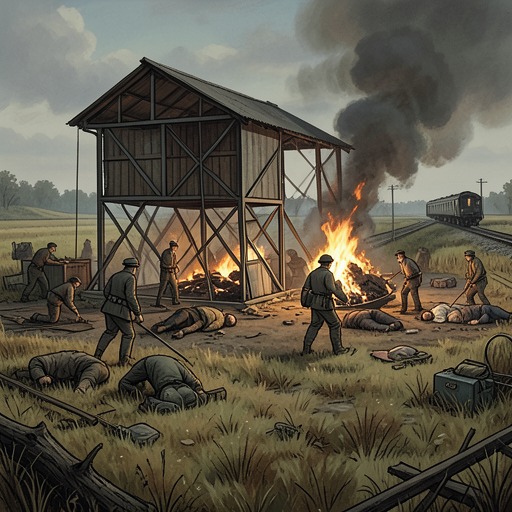
The Zone of InterestGeheimnisträger (Bearer of Secrets) Status describes the prisoners who know what happens inside the camp’s killing system because they are forced to work within it. For them, knowledge is neither a route to protection nor a position of power: it makes them necessary for a time and marks them for death. The cycle is written into their work, as each group must cremate the group before it. The term therefore binds witness to coercion, complicity under duress to a fate the system repeatedly enforces.
Meaning and Conditions
The book links the German term Geheimnisträger to the prisoners’ knowledge of the camp’s concealed operations. Their task brings them face to face with the process of killing and with the bodies it produces. They become witnesses not by choosing a public role but by being made to work where the secret is enacted. The knowledge cannot be separated from the violence that makes it possible.
The narrator estimates that a prisoner in this position can expect to survive no more than two or three months. The reason lies in the structure of the work: the prisoners’ first assignment is to cremate their predecessors, and the same fate awaits them. A few refuse to continue despite knowing the likely consequence. Their refusal does not alter the system’s design; it makes visible the narrowing choice imposed on everyone caught within it.
The exception of Szmul sharpens the contrast between a temporary role and an unusually long survival. The narrator regards him as the longest-serving undertaker in the concentration-camp system and notes that even guards accord him a measure of respect. His standing does not make him safe. Szmul knows what happens to bearers of secrets, and his exceptional duration only makes the underlying rule more stark.
Work, Indispensability, and the Perpetrator’s Gaze
Paul Doll describes Szmul as living a charmed life because he has made himself indispensable, and compares that usefulness to the factories used as his analogy. He sees the prisoner as afraid to die but capable of killing, and concludes that such a person has his uses. The remark exposes the camp’s brutal calculation: a prisoner’s specialized knowledge and labor can preserve him temporarily, while the same work confirms that he has been drawn into the machinery of death.
Doll’s judgment is not an account of freedom or consent. It is the gaze of a commandant treating a prisoner’s forced function as a useful tactic. The narrator, watching Doll leave, turns the label over: what secrets do these prisoners bear, when the surrounding world already refuses to look directly at them? The question unsettles the apparent power of secrecy. The prisoners know what has been done, but their knowledge does not give them control over its disclosure or their own survival.
The wider bureaucracy offers a related context for the secret they bear. The narrator describes pressure to increase labor for the munitions industries alongside pressure to dispose of as many deportees as possible. In a later discussion, Professor Entress’s account traces a shift from imagined deportation to remote, long-term killing toward the killing of women and children as policy radicalized in the east. He stresses that gas chambers and crematoria made killing quicker and more economical and spared the killers’ nerves; they were not the source of the will to kill. Against that background, the prisoners’ secret is not simply knowledge of a hidden room or procedure. It is knowledge of an organized process whose methods could change without changing its lethal purpose.
Testimony and the Attempt to Remember
The book connects bearing secrets with bearing witness. The narrator reflects that the word for martyr derives from the Greek word for witness, then immediately qualifies the apparent clarity of that connection. For the prisoners, testimony is not an uncomplicated moral position: speaking, remembering, and surviving are all shaped by danger and by the circumstances of forced labor.
Josef, a Czech Jew from Brno who is already dead, writes his testimony and buries it in a child’s galosh beneath the hedge bordering Doll’s garden. After disputation and a vote, the prisoners decide to dig it up temporarily and read it. The narrator is instinctively, perhaps superstitiously, opposed, and later regards the episode as one he would least wish to relive. That reluctance gives the act of reading its weight: retrieving evidence is necessary, but it brings the group again into contact with what the testimony records.
The manuscript consists of eight pages, written in Yiddish in black ink. Its physical form matters: a small, concealed document hidden in a child’s shoe becomes a means of carrying an account beyond the conditions that produced it. Yet preservation is precarious, and the narrator’s stumbling attempt to read the opening underscores the distance between a witness’s written record and the group’s ability to absorb it. The text does not make their position safe or resolve their disagreements; it makes the suppressed experience present among them.
A Shared Knowledge Without Safety
The prisoners’ common condition does not guarantee companionship. When armed men arrive to take a chosen group away, those leaving may offer a nod, a word, or a wave; sometimes they depart with their eyes on the floor and no gesture at all. Later, when the narrator says Kaddish for the dead, he observes that the departing men have already been forgotten. The sequence sets the intimacy of shared knowledge against the system’s repeated erasure of the people who carry it.
The narrator calls the attachment that incapacitates the prisoners a form of mortal love. That phrase does not turn their enforced work into willing collaboration. Instead, it registers the painful human ties that persist among people who know how little time they may have and who cannot protect one another from the cycle. Their shared status is thus at once collective and isolating: each knows the fate awaiting the group, while each departure threatens to make the dead disappear from memory.
Narrative Significance
Geheimnisträger (Bearer of Secrets) Status makes witness inseparable from the conditions of witnessing. The prisoners’ knowledge is produced by a system that exploits their labor, exposes them to its crimes, and periodically kills them to contain those who know too much. Their testimony challenges that containment, but the book refuses to suggest that knowledge alone brings justice, solidarity, or escape.
The motif also sharpens the distinction between institutional secrecy and human memory. The killings may be concealed behind euphemism and administrative language, while the prisoners encounter their physical consequences directly. Josef’s buried pages, the prisoners’ contested decision to exhume them, and the recitation of Kaddish all form fragile acts of remembrance inside a structure designed to replace one group of witnesses with another. To bear the secret is to be endangered by it; to preserve testimony is to resist the further disappearance of those who bore it.