German invasion of the Soviet Union
The Zone of InterestThe German invasion of the Soviet Union appears not as a self-contained military episode but as the point where Nazi confidence, imperial ambition, and mass murder converge. Recalled by Angelus Thomsen and reconsidered by Boris Eltz, the campaign changes in retrospect from an apparently winning gamble into a war whose violence could not secure victory—and whose eastward expansion coincided with decisions to kill Jewish women and children as well as men.
Origins and Assumptions
Boris describes the decision to invade as an extension of the confidence that followed France’s defeat. He recalls that he had supported the invasion at the time, swept up in the belief that no one could refuse Adolf Hitler after the rapid victory in France. The generals, in Boris’s account, regarded an attack on Russia as potentially insane, but the French campaign had made Hitler seem like a leader whose instincts would again prevail. Boris’s retrospective judgment does not excuse his earlier enthusiasm: he explicitly includes himself among those who endorsed the decision.
The invasion was also joined, in Boris’s account, to Nazi antisemitism. He describes the leadership’s willingness to pursue Hitler’s “fever dream about the Jews” alongside the military campaign. The juxtaposition makes the eastern war more than a bid for territory: conquest and racial persecution travel together in the political imagination that Boris remembers. His later disgust at the decision therefore marks a change in judgment, not a claim that he had opposed its aims from the beginning.
A Campaign Recast as a War of Annihilation
Boris’s assessment turns on a distinction between a conventional military campaign and a war of pillage and murder. At first, he says, the violence seemed effective; until around late September, the invasion still looked viable to him. He acknowledges that he had believed a war of annihilation was “doing the trick,” a phrase that exposes how success could be measured through mass death. Yet his confidence had depended on treating murder as a means capable of overcoming the realities of a vast country and its population.
He gives the scale of that miscalculation in stark arithmetic. Even if Germany killed five million people, took five million prisoners, and starved another thirty million, he argues, 125 million would still remain. Destroying Leningrad and Moscow would not end resistance: he anticipates an insurgency extending along the Urals and asks how Siberia, described as the size of eight Europes, could be pacified. The figures do not turn his argument into a humane rejection of mass violence; they reveal the strategic limits he eventually sees in the attempt to subdue a population through it.
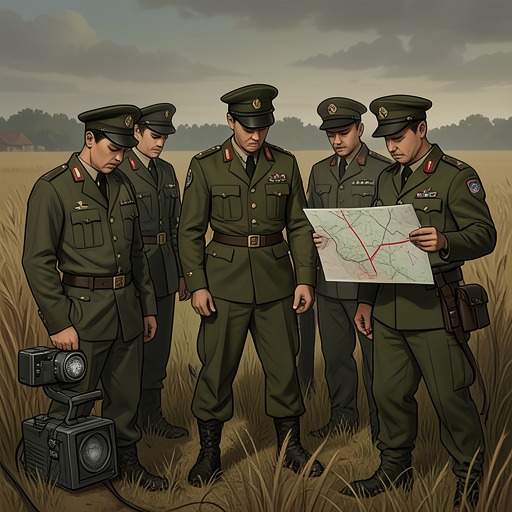
Boris contrasts the invasion with an older, conventional cabinet war against a dying regime. This campaign, he argues, was different because every Russian might fight, including women and children. He locates his own change of mind in the course of the advance: until October and the events at Kiev, he had believed that murder and massacre could accomplish what ordinary military force could not. He then admits that he had thought “night” was winning. His language registers a collapse of certainty: the violence had seemed not merely permissible to him but capable of delivering an outcome, until the campaign made that belief untenable.
Military Reversal and Belated Recognition
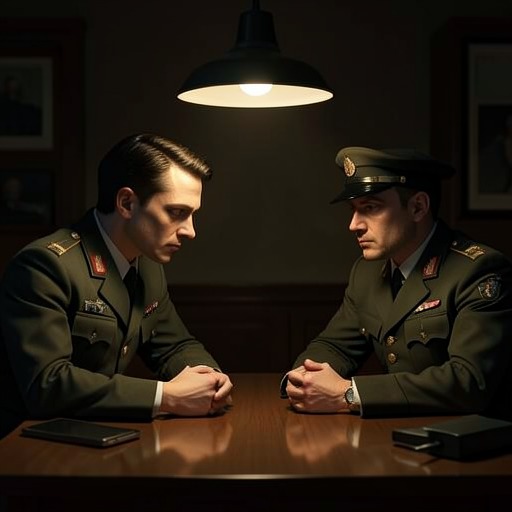
The invasion’s failure becomes legible in the conversation through Boris’s reassessment of the war’s prospects. He insists that victory against Russia was impossible, and argues that declaring war on America after the campaign had bogged down compounded the regime’s errors. He points to the possibility of a Russian insurgency even if major cities were razed, and to the inability of an occupying force to pacify the immense territory beyond them. These are Boris’s judgments, presented in a private conversation rather than as a detached account of military operations; their force comes partly from the fact that he had once been an advocate of the invasion.
Angelus initially answers with the absence of a second front, the possibility of a break between the Allies and Moscow, and Germany’s hoped-for “wonder weapons.” Boris counters that the opposing side also has German scientists. The exchange preserves the distance between recognition and acceptance: even while Boris says Germany has lost, Angelus reaches for reasons the outcome might still be reversed. The invasion’s decisive consequence in this conversation is thus also a shift in what the characters can admit about the war.
Invasion and the Radicalization of Mass Murder
The novel places the invasion alongside a developing policy of extermination without reducing that policy to a single battlefield decision. In a later account to Thomsen, Konrad Peters traces what he calls the crime without a name to an authorization dated July 31, 1941, when Nazi power was at its height. He describes a letter drafted by Adolf Eichmann and Reinhard Heydrich, sent to Hermann Göring and returned with Göring’s signature, granting authority to pursue a total solution. This account places a high-level authorization within the period of the war in the east, while making clear that the process continued through further decisions and pressures.
Peters describes an initial possibility of deporting Jews to a cold, barren region beyond the Urals and into the Arctic Circle, where they would die through exposure and deprivation. As a quick victory over Russia receded, he says, territorial removal appeared less feasible. At the same time, officials in Poland faced pressure after the annexation of millions more Jews and struggled to manage the numbers. Peters identifies August and September as a further turn: the killing of men, already under way for months, was extended to women and children. The invasion’s stalled progress and the shrinking prospect of removing Jews eastward form part of this account of escalating policy, rather than a claim that military reversal alone explains the genocide.
Peters also rejects the idea that the industrial machinery of killing was essential to the perpetrators’ intention. Gas chambers and crematoria, he argues, made mass murder faster, more economical, and less damaging to the killers’ nerves; they were methods, not the source of the will to kill. He points to the Einsatzgruppen and their killings by bullets to insist that murder could have continued by other means. In the novel’s treatment, the invasion is therefore bound to extermination not because one technology or one order created the violence, but because the campaign’s expansion, administrative pressures, and changing territorial calculations accompany a widening determination to murder. Boris’s belated recognition of military failure and Peters’s account of policy formation expose two connected limits of the regime’s vision: conquest cannot make a vast population disappear, and the failure of one method does not extinguish the intent to kill.