Germany
The Zone of InterestGermany in the novel is more than a national setting: it is the state whose institutions organize persecution, the homeland to which its officials remain attached, and the society whose industrial and administrative routines continue alongside mass death. The narrative repeatedly sets ordinary structures of work, family, and public ceremony against the violence they enable, until the country’s insistence on normal life becomes part of the indictment.
State, Administration, and Complicity
The state appears not as a single, smoothly coordinated authority but as a system whose departments impose competing demands. Paul Doll describes pressure from the Economic Administration Head Office to enlarge the labor force for munitions production, while the Reich Central Security Department urges the disposal of evacuees. In one bureaucratic proposal, able-bodied mothers would be worked in a boot factory at Chełmek; Doll’s objection is not to the coercion itself but to the practical impossibility of separating mothers from their children at the ramp. His calculations expose a regime trying to make exploitation and deportation function as compatible administrative tasks.
The novel also places complicity below the level of explicit policy. Konrad Peters and Thomsen are described as “obstruktive Mitlaufer”: people who went along while dragging their feet and resisting in small, ineffective ways. Thomsen’s reflection enlarges this category from two officials to hundreds of thousands, perhaps millions. The admission refuses a clean division between committed perpetrators and innocent bystanders: obstruction may register a difference in degree, but it does not erase participation.
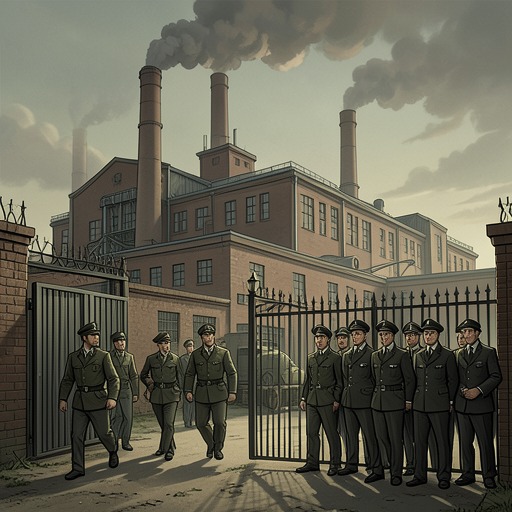
That contradiction is visible in the industrial world. At Buna, Thomsen watches striped prisoners driven through frantic labor, alongside Kapos, SS noncommissioned officers, and company foremen enforcing the work. Yet his attention settles on designers, engineers, and administrators from IG Farben plants in Frankfurt, Leverkusen, and Ludwigshafen, picking their way past wounded, unconscious, and dead bodies with leather-bound notebooks and retractable measuring tapes. The instruments of professional inspection remain precise amid human wreckage. Germany’s industrial capacity is shown not as a separate sphere from camp violence, but as a system operating beside it and drawing on its coerced labor.
The Homeland and the Camp System
The novel connects Germany’s internal life to the camp system without pretending that every camp scene occurs within the country’s borders. Its officials carry the state’s rival priorities into occupied territory; its companies inspect production there; and its political language gives violence administrative and ideological cover. Germany is therefore present in the narrative both as a place and as the authority projected outward through occupation, labor policy, and deportation.
The physical consequences of that authority are registered in pollution and smell. Doll describes water rendered undrinkable even after repeated boiling, a breached water table, and fermenting matter; the worsening stench cannot be corrected by complaint. During a drive, he repeatedly pulls over to sniff the air, finding that conditions grow worse. Later, he asks why the meadow was made to churn and spit, why flies and vermin multiply, why conception promises death for mother and child, and why the snow has turned brown. These details locate the regime’s crimes in material processes—water, bodies, smoke, waste, and contaminated ground—rather than leaving them at the level of ideology. They belong to the camp landscape under German power, not to a claim that the camps themselves stood inside Germany.
The counterpoint is the homeland’s ordinary social and domestic life. At Christmas, Thomsen walks arm in arm with Gerda, dressed in tweed hat, scarf, and shawl. When he embraces her, he imagines Hannah, whose height and mass resemble Gerda’s; Gerda notices that he is thinking of someone else. A familiar family gesture thus carries the emotional consequences of a life divided between Germany’s elite household world and the violence of the camp. The scene does not resolve that division: Thomsen embraces Gerda again while acknowledging the absent woman in his thoughts.
Public Memory and Private Recognition
A November 9 memorial ceremony shows how Germany’s public rituals reshape history into political myth. Doll, not wholly sober but temporarily steadied by liquor, addresses an audience before fourteen wreaths and fourteen makeshift urns made from tar-blackened flowerpots. He presents November 9, 1918, as a Jewish betrayal of the fatherland and describes the 1938 pogrom as a spontaneous popular response to provocation. The ceremony turns a date associated with multiple historical ruptures into a carefully staged story of grievance and national virtue. Its darkened sky, smoking vessels, and Doll’s bulky typescript make the performance look less like an assured act of remembrance than an unstable attempt to command meaning.
Thomsen’s own recognition comes less as a public declaration than as a series of questions he can no longer suppress. After waking in the Officers’ Club amid the wreckage of a drunken commemorative luncheon, he asks why supposedly good work smells so foul, why the meadow was made to churn, and why obedience has led the living to resemble the dead. The repeated image of brown snow joins the camp’s physical contamination to the moral contamination of the state. His questions undermine the official language of loyalty and ideal obedience without converting doubt into innocence: the speaker remains implicated in the system he is beginning to see.
Defeat and the Reckoning with Policy
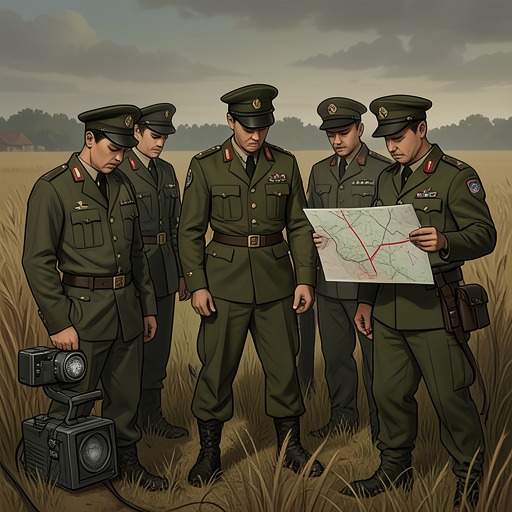
Germany’s military prospects and its exterminatory policy are linked by the novel’s shifting accounts of knowledge. Thomsen and Boris discuss the war on multiple fronts and the decision to declare war on the United States; their exchange treats defeat as a foreseeable consequence of political and military choices, not an unforeseeable accident. Doll, by contrast, can still declare approaching victory as autumn becomes winter and the Battle of Stalingrad appears, in his account, destined to end in German triumph. His confidence is undercut by the narrative’s wider chronology and by what follows: after the German defeat in the east, the camp experiences a bewildered lull lasting five or six days. Some finally grasp that crimes legalized by the state remain crimes elsewhere. The pause is brief, and selections continue across the ramp, infirmary, blocks, roll call, and camp gate.
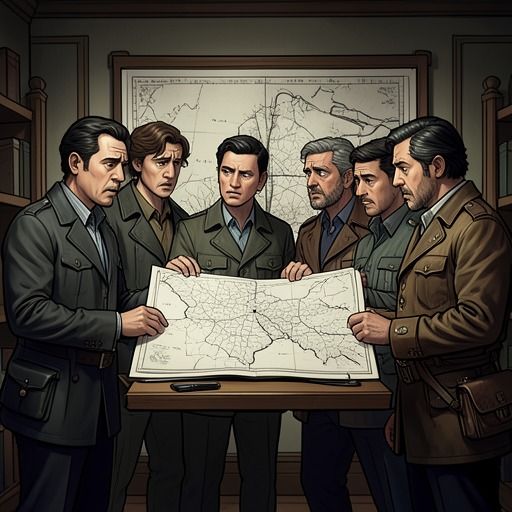
A later conversation with Peters places policy formation against this record of denial. Thomsen identifies July 31, 1941, as the point at which a letter drafted by Eichmann and Heydrich and signed by Göring authorized a “total solution.” Peters’s account also describes a possible earlier territorial scheme—deportation to a cold, barren region—and the escalating pressure produced by the annexation of millions of Jews and the inability of authorities in Poland to manage the numbers. By August or September, the proposed territorial answer had receded and the killing had expanded from men to women and children. The episode presents central authorization and local radicalization together: a high-level mandate gives the policy force, while administrative pressure and competition among officials help determine its increasingly murderous form.
Peters rejects the idea that the industrial apparatus of gas chambers and crematoria created the underlying crime. They accelerated killing, economized effort, and spared the killers’ nerves, he argues; bullets and pyres would have served the same purpose because the perpetrators possessed the will to kill. He points to the Einsatzgruppen’s mass shootings as evidence that extermination did not depend on a uniquely modern technology. Thomsen, meanwhile, tells Peters that he has been exposed as a desk murderer and that his efforts have been for nothing; Peters replies that the stakes remain enormous because Buna and synthetic fuel may prolong the war. Germany’s defeat does not make the machinery harmless, and recognition does not release those who helped operate it. The country’s decisive significance lies in this conjunction: policy, industry, public myth, and everyday compliance persist as connected parts of a single historical landscape.