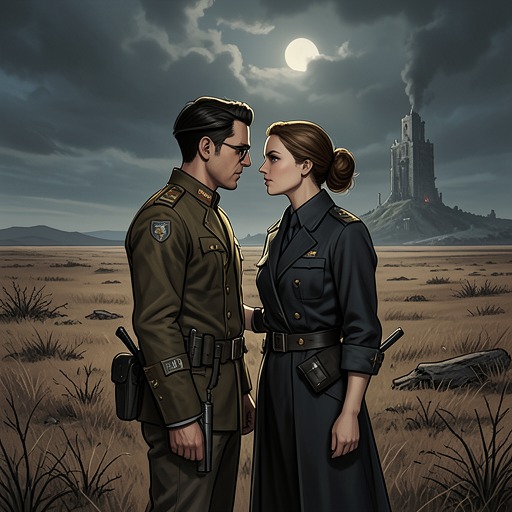
Hannah Doll and Golo Thomsen meet in the shelter pavilion
The Zone of InterestThe meeting between Hannah Doll and Angelus Thomsen takes place in an unfinished shelter beside the hedge marking the Zonal boundary. Its decisive turn is intimate but not conclusive: after watching Hannah sleep, Thomsen embraces her, yet they do not kiss; when she begins to speak of Dieter Kruger, he recognizes that he is involved in something whose course cannot simply be abandoned. The scene makes a beginning out of stillness, grief, and an unfinished structure, without resolving what Hannah’s disclosure will mean.
The Unfinished Shelter
Thomsen comes upon the pavilion almost by chance. Someone has begun building it just before the Zonal boundary and then run short of time and timber. The result is neither a finished public building nor a secure enclosure: a planked back, two side walls of unequal length, and only half a roof. Its resemblance to a rural bus-stop shelter makes it a place for waiting, but here the waiting is private and precarious. The hedge marks a boundary nearby; the open windows and incomplete roof provide no firm separation from the world around them.
Inside, the details are spare: there are no panes in the windows, only a flat wooden bench. Hannah is in the corner with a blue oilskin spread over her lap, asleep so deeply that Thomsen describes her as dead to the world. The oilskin is a specific, practical object in an otherwise bare setting; the scene does not explain why she has it or what has brought her there. Instead, the pavilion’s exposed, unfinished character gives the encounter its form. It offers shelter without suggesting safety, and a pause without making clear what can follow it.
Watching Hannah Sleep
The hour Thomsen spends beside Hannah is remarkably still, but the stillness is made up of minute changes. Her frowns come and go, each registering a different trace of puzzlement or pain. Her nostrils flare three or four times with what he reads as subliminal yawns; a tear gathers, drops, and melts into her cheek; once, a childish hiccup shakes her. These movements do not amount to a conversation or an explanation. They make her sleeping body the scene’s evidence of life before she can speak for herself.
Thomsen attends closely to the rhythm of her breath, calling it an iterated proof of her existence. His language makes the observation more than passive waiting: in a landscape and historical setting marked by death, each breath insists on the presence of a living person. But this attention does not give him access to Hannah’s thoughts. Her changing expressions remain unreadable, and the hour’s intimacy depends on that limit. He can watch her breathe and see a tear fall; he cannot yet know what she will say when she wakes.
Recognition, Words, and Restraint
When Hannah opens her eyes, she looks at Thomsen with so little loss of composure that he feels already established in her dream. The impression is his, not a confirmed account of what she has dreamed. Her first words, in German, ask what they are doing there with the unimaginable ghouls. Thomsen presents the question as steady and sincere rather than rhetorical. It breaks the hour’s bodily quiet with a direct confrontation with the dead around them, while leaving the referent of her question broad: the scene does not specify a particular corpse or identify the ghouls more narrowly.
Hannah stands and they embrace. They do not kiss—not even when she begins to cry and, as Thomsen understands the moment, they may both desire a kiss. He makes the withheld kiss explicit, then recognizes that he is already involved. The restraint matters because the embrace is not treated as a complete declaration or a settled relationship. Physical closeness has begun; a boundary remains. The scene holds attraction and hesitation together without assigning the hesitation a motive beyond what Thomsen can observe.
Dieter Kruger and the Unfinished Beginning
Eventually Hannah begins with the name Dieter Kruger. The account stops at the opening of her disclosure: it does not recount what she says about him or explain his place in her past. That interruption leaves the name carrying weight without turning it into a resolved revelation. Thomsen’s response is not to claim knowledge of what comes next. He understands that whatever has begun between them will have to go forward, even though its meaning and course are not yet clear.
The ending returns to questions of direction: where now, and where to? They are not answered before the narrative moves on. The unfinished pavilion, Hannah’s incomplete opening, and Thomsen’s unresolved questions converge in an ending that marks a threshold rather than a destination. The encounter establishes a new emotional commitment while keeping its terms uncertain. It begins with the sight of Hannah asleep, passes through her waking recognition and their embrace, and leaves both characters facing what has not yet been said.