Hannah Doll—Angelus Thomsen
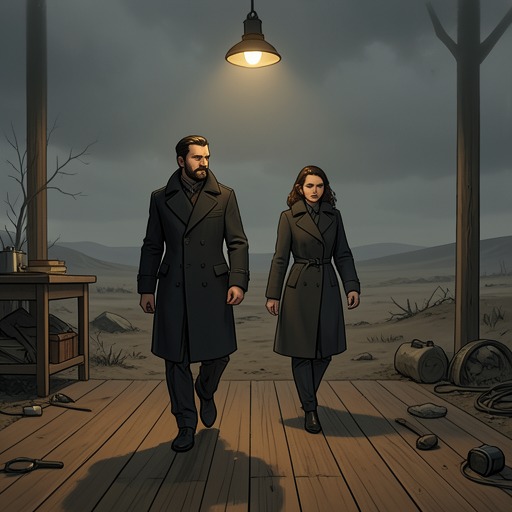
The Zone of InterestHannah Doll—Angelus Thomsen is a secret love shaped by surveillance, the threat of Paul Doll’s violence, and the impossibility of ordinary contact. In a letter passed to Hannah at the riding school, Thomsen tries to protect her by recasting their earlier meetings as an inquiry into Dieter Kruger’s whereabouts; at the same time, he confesses that watching her sleep changed his sense of himself and made him hope for a future beyond the present. Their attachment finds its clearest practical expression not in another meeting, but in a proposed five-minute walk in Hannah’s garden, a signal Thomsen can watch for from a building on the hill.
A Relationship Under Threat
Thomsen’s letter begins with news of another disappearance: Dov Cohn has been transferred, he writes, six weeks after the event. He had believed Dov well equipped to survive, and the news unsettles him. This is more than an isolated report: the letter establishes a world in which people can vanish and information arrives late, giving the lovers’ own communications an immediate sense of risk.
Hannah has told Thomsen about the circumstances of her marriage. In response, he says he no longer feels obliged to show even minimal respect to her husband as the father of Paulette and Sybil. He describes Paul Doll as worsening and recalls that Doll was prepared to eliminate three people, including a child, over a single compromise of his prestige—an act Thomsen characterizes as kindness. The details of Hannah’s account are not given, but its effect on Thomsen is explicit: he believes she is exposed to danger in a way he is not. He says his uncle provides him with a measure of protection, while Hannah has none.
That imbalance makes their attachment more than a private affair. Thomsen’s concern is not simply that their relationship might be discovered; he fears that discovery could give Doll a reason to strike at Hannah. He warns that, as things stand, Doll has no reason to do so, but that Hannah’s own plan for the home front could change the situation. Thomsen recognizes her resolve and leaves the decision to her, while making clear that he sees the danger.
A Cover Story for Their Meetings
Thomsen proposes that they retroactively normalize their past dealings. His plan depends on Hannah’s certainty that Doll no longer knows the status or whereabouts of Dieter Kruger. He instructs her to remember a version of events that makes their contact appear to have had a practical purpose rather than a romantic one.
In this account, Hannah’s first letter, delivered to Thomsen by Humilia, asked him for a service and said she could be found on Fridays at the Summer Huts. When they met there, he agreed—reluctantly, according to the story—to make inquiries about Dieter Kruger, since the task distracted him from his work at Buna-Werke. Thomsen’s insistence that she memorize this sequence shows the degree to which their past must now be managed as evidence. Their meetings are not erased; they are given a safer explanation.
The second communication, the letter Hannah is holding, is to function as his report. Thomsen believes Doll knows about the first letter and may know about the second, because they were observed. If Doll questions Hannah, she should admit freely that she contacted Thomsen, then refuse to tell her husband what Thomsen discovered. Thomsen says that he will now inquire about Dieter Kruger, and expects that Doll will do the same. The cover story therefore rests on a narrow distinction: Hannah may acknowledge the correspondence, but she must not disclose its supposed result.
Intimacy, Distance, and the Letter
The letter is both an instrument of concealment and a declaration of feeling. Thomsen says they can no longer meet privately, that any future meeting must be communal, and that there must be no more letters. The same communication that scripts what Hannah should say to Doll thus becomes their last permitted private exchange, making its practical instructions carry the emotional weight of a farewell.
Thomsen recalls watching Hannah sleep in a gazebo or half-made pavilion for sixty or seventy minutes. He describes the experience as a change in the sources of his being: what he had waived or surrendered became visible to him, along with his disgust at how diminished he had allowed his heart to become. When Hannah opened her eyes, he felt something like hope. His account locates the beginning of that hope not in a declaration or a promise, but in the quiet interval of watching her sleep.
He connects this altered attention to the artist’s habit of starting again from first principles, seeing familiar things as newly strange. That inward renewal is set beside an image of bald, oversized stick figures returning in lines of five to slavery while a band plays. The contrast binds the intimacy of the letter to the coercive world around it: Thomsen’s renewed capacity to notice and feel exists alongside a scene of people being driven back into bondage.
His confession becomes explicitly physical but remains framed as longing rather than an account of an encounter. He says that everything Hannah does and says warms and touches him, and that he finds her beauty difficult to take in. He describes kissing her in dreams, then insists that the woman he kisses belongs neither to the present nor to the place they inhabit: she lives in the future and elsewhere. The poem he calls The Exiles gives that distance a name. Exile is not only separation from a possible shared life; Thomsen extends it to the sane, suggesting that those who recognize their world’s reality are already inwardly estranged from it.
A Signal Instead of a Meeting
With letters and private meetings ruled out, Thomsen proposes a small recurring sign. Once a week—Tuesday at four, for example—Hannah should take a five-minute turn in her garden. He will watch from the building on the hill and understand that she is well, and that she is walking there for him. The arrangement cannot restore their privacy or remove the danger; it replaces direct contact with a brief act that can be seen from a distance.
The proposed walk gives their separation a rhythm and a purpose. Hannah would not need to send a message or approach him: her presence in the garden would confirm her safety, while Thomsen’s watching would make the gesture personal. Their connection is reduced to a fleeting sight, but the reduction is also protective. At the point when ordinary communication becomes too dangerous, care takes the form of observation and a signal whose meaning they share.
Hope and an Uncertain Future
Thomsen describes the months ahead as a great void, estimating that he may have one, two, or perhaps three months left in the Reich. The letter does not resolve what will happen to either of them. Instead, it places his attachment inside a future he can imagine but cannot secure: Hannah belongs to that elsewhere, while the weekly garden walk offers only a way to know, for a moment, that she remains alive and reachable by sight.
His final reflection imagines a future in which the National Socialists will seem as exotic and improbable as prehistoric meat-eaters. He calls them non-human and non-mammalian, contrasting them with mammals’ warm blood and live young. Set beside his dream of intimacy and his concern for Hannah’s safety, the image makes their private bond an insistence on vulnerable, living human connection in a world organized around violence. Yet the letter offers no assurance that love will overcome that world. Its most definite promise is smaller: if Hannah walks in the garden, Thomsen will see her.