Hannah Schmidt
The Zone of InterestHannah Schmidt is the name under which Hannah Doll reappears in the postwar narrative, and the change of name accompanies a decisive shift in perspective: the woman Paul Doll fears and tries to interpret becomes a witness who recounts her own escape and acknowledges her past feelings for Angelus Thomsen. Her story links the coercive domestic world of the Doll household to the political imprisonment that followed, while revealing a private attachment that neither she nor Thomsen had been able to resolve during the war.
Identity and Narrative Perspective
Before the postwar meeting, Hannah is largely visible through Paul Doll’s account. He admits to being afraid of her, describing the sensation of being alone with her as a vacuum in his solar plexus, like a globe of hard air. The admission is striking partly because it interrupts the authority he otherwise claims within the household: he can name the fear, but does not understand Hannah on her own terms. His description turns her changed appearance into evidence for his own anxieties, calling her a more experienced pleaser of men and reading calculation in her eyes. This is not a neutral portrait. It exposes Doll’s possessiveness and the way he construes his wife’s sexuality as a threat to his standing.
That perspective makes Hannah’s later voice consequential. In 1948, when Thomsen asks for her maiden name, she answers that it is Schmidt and adds that knowing it would not have helped him much. The reply both establishes her identity and underscores the distance between the woman he once knew and the person he has been trying to find. Her account does not merely fill a gap in Thomsen’s knowledge: it replaces Doll’s speculative reading with Hannah’s own description of what she saw, decided, and endured.
Under Suspicion in the Doll Household
Hannah’s name appears in a conversation between Fritz Mobius and Paul Doll about a group of women Mobius calls a cabal. He lists Norberte Uhl, Suzi Erkel, and Hannah Doll, then characterizes their supposed offenses as defeatism, frivolity, and listening to enemy radio. Mobius says he has already spoken to the men associated with the other women and has also spoken to Doll. The passage therefore places Hannah within an atmosphere of surveillance and accusation: ordinary speech and association can be recast as political disloyalty, and the warning reaches her through a conversation that centers on male authorities.
Doll’s treatment of Hannah at home further shows how control and intimacy coexist in his conduct. He calls her into the garden and tells her that Szmul wants to give her a present and worships her. The invitation makes the garden a staged encounter, with Doll deciding how the gift and its giver will be presented. Read alongside his confession that he fears Hannah, the scene suggests a relationship in which his efforts to direct her do not remove his apprehension of her. His words place her in the middle of other people’s desires while concealing how much he himself needs to control the scene.
Escape and Testimony
Years later, Hannah recalls the moment when Doll was covered in blood and still trying to smile. She says that Szmul looked her in the eye, something he had never done despite her seeing him almost every day. The change in his gaze matters: it marks a break in the familiar pattern between them at the instant of violence. Hannah remembers that she was surprised by the cigarette in her hand, drew on it, and dropped it. The ordinary gesture sits beside the shocking sight of Doll, making her recollection precise without turning it into a composed or heroic set piece.
In that moment, Hannah says she understood who Doll had been all along. She compares him to a nightmarish little boy caught doing something plainly disgusting, still trying to smile. The image describes her recognition of his character through the contradiction between what he has done and the smile he maintains. It is her interpretation, offered after the fact, rather than an account that excuses or softens his actions.
Her response was immediate and practical: she got the girls, took them to Romhilde Seedig’s, and left as soon as they could. The account identifies both her responsibility for the girls and the concrete steps by which she removed them from the household. Hannah then tells Thomsen that she went through camps before prison and spent eighteen months in the political wing at Stadelheim. She calls prison bliss compared with camp, a comparison that makes the severity of her experience plain without supplying details she chooses to defer. Her offer to tell him more another time remains conditional; she adds that there may not be another time.
Hannah and Thomsen
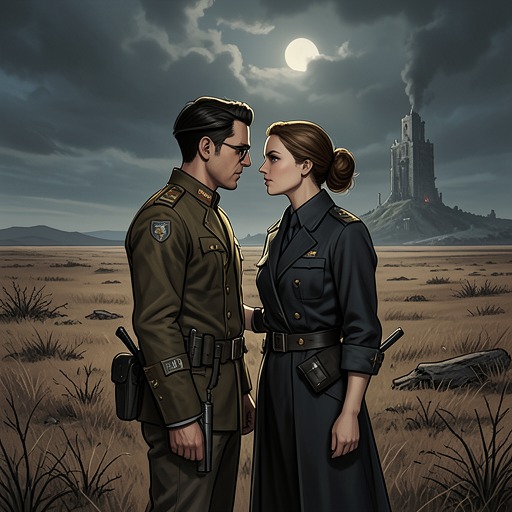
At their postwar meeting, Thomsen asks whether he had imagined Hannah’s feelings for him. Her answer confirms that she had felt something: she recalls that his embrace in the pavilion seemed right, that she went out into the garden for him willingly, and that she thought about him often. The exchange gives retrospective meaning to their earlier closeness, but does not recast it as an uncomplicated romance. Their connection existed under dangerous circumstances, and the letter Thomsen sent her had to be destroyed.
Hannah says she wished she had not needed to destroy that letter. She also tracked down the poem he had quoted, The Exiles, and begins to recall its lines. The two details make visible what survived the separation: not the letter itself, which she could not keep, but her regret and the effort she made to find the poem. The passage presents memory as an imperfect substitute for a forbidden or lost object, while letting Hannah disclose that Thomsen’s words remained with her.
Change and Significance
Hannah’s trajectory is revealed through a contrast between imposed descriptions and her own acts of narration. Doll interprets her appearance and sexuality through his fear; Mobius places her among women suspected of defeatism; Hannah, when she finally recounts events, speaks instead about Szmul’s gaze, Doll’s bloodied smile, the girls she took with her, and the imprisonment that followed. These concrete details do not erase the danger surrounding her, but they establish her as someone who observes, judges, and acts within it.
The reunion with Thomsen offers recognition, not a simple restoration of what the war interrupted. Hannah confirms their mutual feeling while also describing escape, captivity, and the loss of the letter. Her maiden name, Schmidt, is therefore more than a biographical detail: it marks the postwar encounter as a meeting with a woman whose history Thomsen did not know and could not have recovered from a name alone. By giving Hannah the final account of her departure from Doll and the words that remained from Thomsen, the narrative shifts her from the object of other people’s suspicions and desires into a witness with a history of her own.