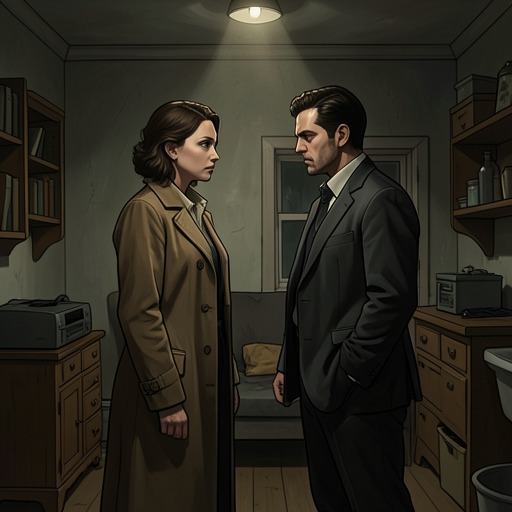
Hannah tells Doll that Germany has lost the war
The Zone of InterestHannah tells Doll that Germany has lost the war in a scene where military defeat, private betrayal, and the prospect of punishment converge. As she listens to an enemy broadcast, she speaks plainly about unconditional surrender and the crimes for which Doll may be held responsible. He calls doubt a crime; she answers that the crimes are real, and that the war is already lost. His thoughts then turn to the planned killing of Szmul, exposing how quickly he returns from the threat of judgment to the machinery of violence.
The broadcast and the revelation
Doll returns to the villa with a heavy heart, increasingly convinced that Hannah has betrayed him with Angelus Thomsen. The belief is presented as Doll’s own suspicion, not as independent confirmation: he thinks Thomsen has made Hannah pregnant, and resents that she appears to have kept the relationship from him. The scene places this private grievance beside a more consequential secret about the war. When Doll enters, Hannah is lying across the bed while an enemy radio broadcast speaks in formal German about the defeat of fascism.
Doll asks who is speaking. Hannah identifies the voice as Friedrich Paulus. The identification matters because Doll associates Paulus with defeat: in an earlier exchange, he had rejected a claim that Paulus had died as a warrior, insisting instead that Paulus was in Moscow. Now the broadcast provides a voice for the loss that Doll refuses to acknowledge. He brings up Dieter Kruger’s death and asks why Hannah is so radiant. Her answer is direct: Germany has lost the war.
The revelation is not simply that Hannah has heard a report. She is willing to accept what it means. She tells Doll that the Allies will accept only unconditional surrender, rejecting his effort to describe defeat as an armistice or truce. The exchange makes the contrast between them immediate: Hannah treats the news as a fact with consequences, while Doll tries to preserve a language in which Germany has not truly been beaten.
A dispute about guilt and punishment
Doll responds by accusing Hannah of committing a crime: doubting victory. His threat invokes the regime’s power to punish speech as disloyalty, even as the defeat announced on the radio makes that power appear precarious. Hannah asks whether he himself doubts victory. Doll insists there is no possibility of defeat, recasting surrender as a matter of terms that Germany might still negotiate. Her answer leaves no room for that evasion: the Allies will demand unconditional surrender.
The argument then changes its terms. Hannah asks what will happen to Doll when his actions are seen. He treats the prospect as a question of war crimes, but she rejects that framing. In her account, the central issue is not a crime committed within a legitimate war; it is crime without the protective abstraction of war itself. Her distinction strips away the euphemism that might make his conduct seem like an unfortunate part of military necessity. She predicts that he will be hanged and that she will be free.
The scene’s domestic intimacy sharpens rather than softens the confrontation. Hannah speaks from the bed, at ease in a moment when Doll is trying to reassert authority through the language of criminal punishment. Her composed certainty reverses their apparent positions: the commandant can threaten her, but she can name the defeat he cannot face and anticipate the reckoning he fears. Doll answers that she will be free after he is dead, but does not seriously rebut her account of what he has done.
From defeat to the next act of violence
The revelation produces no turn toward remorse or reconsideration. Doll says nothing further to Hannah; his attention shifts instead to what he calls the Kreative Vernichtung of Szmul, the Sonderkommando commander. The abrupt transition is the scene’s decisive consequence. The news that Germany has lost, and Hannah’s insistence that Doll’s conduct will be judged as crime, do not interrupt his capacity to plan further violence. His mind converts the pressure of exposure into a renewed focus on a prisoner he intends to destroy.
That turn also connects the exchange to the institutional world Doll inhabits. Elsewhere, he describes himself as caught between the Economic Administration Head Office’s demand for labor and the security authorities’ demand to dispose of evacuees. He relays orders from Gruppenführer Horst Blobel as orders backed by the Reichsführer-SS. Such passages show a command structure that can displace responsibility upward or sideways, but Hannah’s challenge insists on the personal acts concealed by that structure. In the villa, Doll does not answer her by describing his place in the chain of command. He turns toward Szmul.
The scene’s later irony
Hannah’s prediction gains force from Doll’s eventual fate. He is captured in March 1946, tried at Nuremberg, and handed over to the Polish authorities. In his final statement, he writes that he has come to the bitter realization that he sinned gravely against humanity. He is hanged outside Bunker 11 in Kat Zet I on April 16, 1947. The later outcome does not make Hannah’s words a formal judgment, but it gives the scene a sharp retrospective shape: the man who threatens punishment for doubt is himself eventually tried and executed.
The conversation also resists treating defeat as the moment that creates Doll’s guilt. Hannah’s insistence that these are crimes, not merely wartime offenses, refuses to let the end of the war serve as the origin or explanation of what he has done. The broadcast announces a political and military outcome; her response turns that outcome toward accountability. Doll’s immediate return to the planned destruction of Szmul then denies the scene an easy moral conversion. He has heard that the regime is losing and that his own freedom may end, yet the next thought remains an act of violence.