Hedwig
The Zone of InterestHedwig is presented as both an agent of Esther Kubis’s persecution and a participant in the ballet organized around her. Her role shifts from helping stage the performance to playing Dr. Coppelius, the magician who attempts to bring Esther’s marionette to life; when Esther’s movement turns into an extended spectacle of awkwardness and collapse, Hedwig finally stops acting and looks to her mentor, Ilse Grese.
Role in Esther’s Persecution
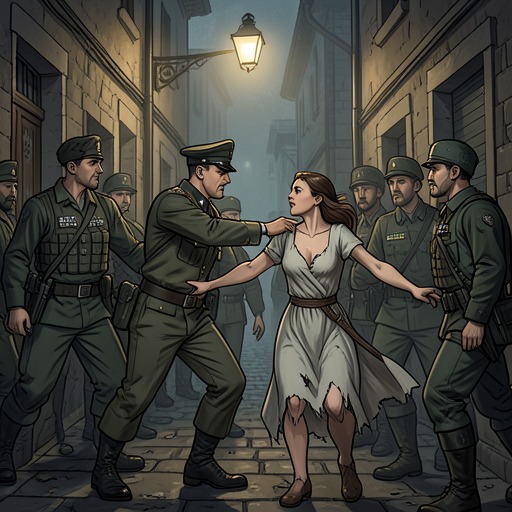
Hedwig is identified as one of the people persecuting Esther alongside Ilse Grese. The account connects this hostility to Boris Eltz’s history with Ilse: after a sordid quarrel with her in bed, Boris says that Esther is now being persecuted not only by Ilse but by Hedwig as well. The narrative labels Hedwig Ilse’s “little bumgirl,” presenting her as aligned with Ilse in the abuse Esther faces, though it does not further explain the relationship or Hedwig’s motives.
That alignment carries into the performance. In the camp space where Esther and several other female prisoners are gathered, Ilse watches in full overseer’s uniform, with a whip at her belt, while Esther and the others organize what appears to be a slow waltz. Hedwig is among the group. The scene places her within an entertainment organized under Ilse’s authority, where Esther’s artistic role is inseparable from her vulnerability to the people supervising her.
The Coppelia Performance
During a performance of Coppelia, Hedwig takes the part of old Dr. Coppelius, wearing a frockcoat and grey peruke. Esther sits rigidly in a tutu, spangled white tights, and bright pink slippers, reading a book upside down until Coppelius corrects her. She appears sightless and still among dolls and dummies, as the magician begins trying to animate her with sweeping gestures.
The attempted animation becomes a prolonged, grotesque sequence. Esther twitches, jumps up, throws aside the book, and moves with compulsive shrugs, noisy steps, and repeated falls backward into Hedwig’s waiting arms. Hedwig’s role is therefore physical as well as theatrical: she receives Esther when she falls while continuing to play the magician in the scene. The performance makes Esther appear at once like an awkward mechanism and a living person struggling to move.
The Moment Hedwig Stops
As the sequence continues, Hedwig makes one final set of finger movements, then gives up acting. She puts her hands on her hips and turns toward Ilse, seated in the front row and tipping forward in her seat. Esther continues alone as Coppelia, still moving frantically, until the ballet’s charm takes hold and her performance changes into a more fluid, apparently liberated dance.
Hedwig’s withdrawal marks a sharp break in the stage action: the magician stops trying to animate the figure just as Esther’s movement begins to transform. The scene does not establish whether Hedwig’s surrender is deliberate or simply a response to the length and strain of the performance. It does, however, place her beside the collapse of the role she has been playing, while Esther’s dance proceeds beyond her control.