Humilia
The Zone of InterestHumilia is Hannah Doll’s maid and a Jehovah’s Witness whose brief appearances reveal a conflict between religious conviction and the intimate costs of captivity. She cares deeply for Hannah’s two daughters, yet her refusal to renounce her faith means she remains separated from her own twelve-year-old son, who is in state care. Her later deliveries of a message and an envelope, followed by an appearance in which she says her conscience is troubled, give her a small but consequential presence in the story.
Identity and Introduction
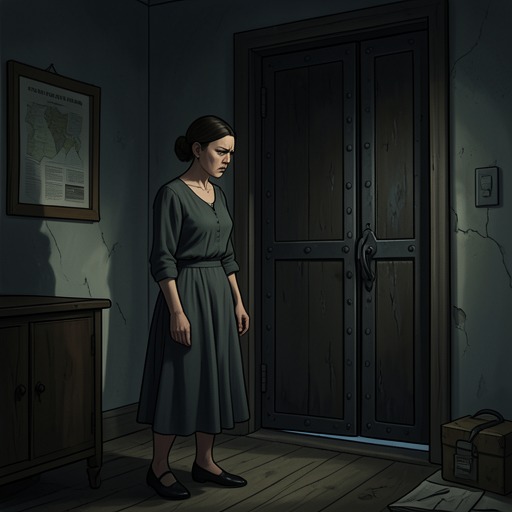
Humilia first appears on the steps of the Doll Villa, where the visiting narrator encounters her while seeking the master of the house. Paul Doll is elsewhere, on the ramp with doctors, Boris Eltz, and others awaiting Special Train 105. The narrator describes Humilia as an unsettling figure in thickly knitted woollens: a jerkin and skirt, set off by bright silver shoe buckles. Her arrival is thus placed beside the machinery of the camp, though her own role in that moment is domestic and personal.
The narrator’s description emphasizes ambiguity. Humilia’s face seems indeterminate as to both sex and age, and her cress-like hair forms a solid quiff above rimless glasses. Hannah, who identifies her as a Witness, calls her face religious; the narrator agrees, while his description dwells on a self-sufficiency that he finds unsettling. Later, Humilia is seen in a floor-length nightgown, moving quickly through the grounds. The changes in clothing—from knitted daywear to nightgown—mark distinct appearances, while the narrator’s attention to her speed and appearance makes her a striking presence in an otherwise brief role.
Faith, Work, and Family
Hannah explains the practical terms of Humilia’s situation: signing a document would make her free to leave and retrieve her son, a twelve-year-old boy in state care. Humilia does not sign. The decision is especially difficult because she is devoted to Hannah’s two daughters, and because the freedom on offer is connected to giving up her religious commitment. Her predicament is not presented as a choice between faith and indifference to family: the boy’s separation is concrete, while her attachment to the girls is also evident. The story leaves the conflict unresolved rather than supplying an explanation that would make her decision easy to comprehend.
The conversation also exposes the difference between Hannah’s and the narrator’s understanding of Humilia’s refusal. Hannah insists on her devotion to the girls and points to the son she cannot reclaim; the narrator responds by recalling what he has heard about Witnesses and suffering. He withholds the particular story from Hannah, but his reaction shows how readily Humilia’s conviction is interpreted from outside rather than understood on its own terms. Her refusal remains a fact with painful consequences, not a belief the other characters can comfortably explain away.
Messages and Conscience
Humilia later approaches the narrator at night and hands him a blue envelope from Madam before quickly walking away. The scene is brief and gives no account of what the envelope contains, but it establishes Humilia as a trusted messenger within the Doll household. The sudden delivery contrasts with her earlier presentation as a domestic figure: she now carries something between people, without explanation or delay.
In another encounter, Humilia enters Paul Doll’s room looking penitent and stricken. When he asks whether she has something to convey, she tells him that her conscience is upset. The evidence does not disclose what has troubled her or what follows from the admission. That limit matters: her words introduce an inward conflict without resolving it, and the scene places her conscience in direct relation to Doll’s authority. She appears neither as a fully explained rebel nor as a compliant servant whose inner life is irrelevant.
Narrative Role
Humilia’s limited appearances link domestic life to the coercive world around it. The daughters she loves, the son she cannot recover, the document she will not sign, and the blue envelope she carries are all concrete details of a life shaped by other people’s power. The story offers no complete account of her history or final fate. Instead, it lets the unresolved tension in her choice—and her later statement of troubled conscience—give weight to a character who might otherwise pass unnoticed in the household.