IG Farben Trial
The Zone of InterestThe IG Farben Trial marks a postwar reckoning with the company’s executives and managers, but its significance in the narrative reaches beyond the courtroom: the convictions are set against the exploitation and mass death embedded in the industrial world they served, and against the striking failure of the Buna-Werke to produce a kilogram of synthetic rubber or a millilitre of synthetic fuel.
The industrial setting
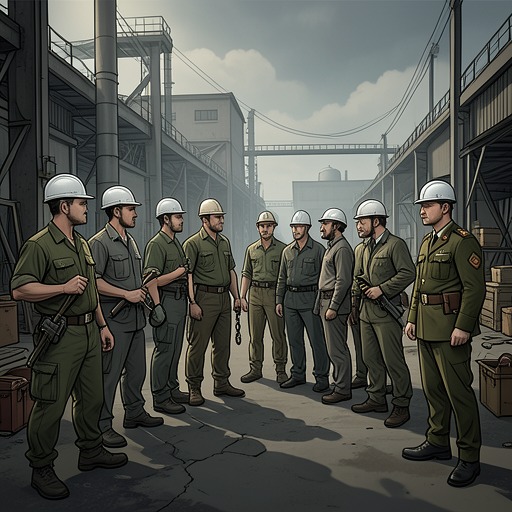
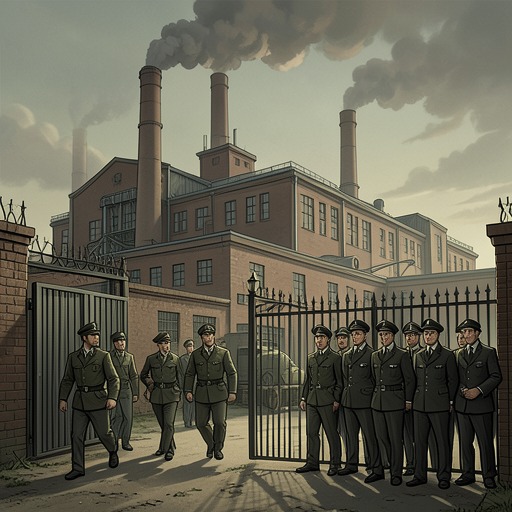
The novel places industrial enterprise within the camp’s machinery of forced labor. At the Buna site, prisoners move in frantic lines under the screams of Kapos, SS noncommissioned officers, and company foremen. Among them, plant designers, engineers, and administrators from IG Farben facilities in Frankfurt, Leverkusen, and Ludwigshafen pick their way past wounded, unconscious, and dead bodies, carrying leather-bound notebooks and retractable measuring tapes. The contrast makes corporate presence concrete: technical inspection and business routine continue amid the physical consequences of the system that supplies labor.
The violence also leaves material traces beyond the worksite. The camp commander describes water rendered undrinkable, with fermenting matter and a breached water table making the stench worse. On a drive back, he repeatedly stops to smell the air and finds it worsening. These episodes do not establish what was presented in court; they show the wider world against which the later corporate convictions acquire meaning, where industrial and camp operations coexist with contamination, bodily degradation, and death.
The convictions and sentences
In July 1948, thirteen IG Farben executives and managers were convicted at Nuremberg; Frithuric Burckl was not among them. Suitbert Seedig received an eight-year prison sentence for slavery and mass murder. Rupprecht Strunck, recalled from early retirement, received seven years for plunder and spoliation, slavery, and mass murder. The narrative identifies these individuals and the crimes attached to their sentences without supplying a fuller account of the proceedings or claiming that every conviction rested on the same findings.
The sentencing gives the industrial story a legal aftermath, but not a neat resolution. The named penalties register personal consequences for company figures, while the surrounding account has already shown people in business suits moving through a workplace marked by injured and dead prisoners. The contrast places official accountability beside the ordinary administrative and technical routines through which the industrial project was pursued.
A failed project and its human cost
The trial’s sharpest material counterpoint is the Buna-Werke’s failure: not a kilogram of synthetic rubber and not a millilitre of synthetic fuel was ever produced there. This fact turns the project’s outcome into more than a measure of industrial inefficiency. In the same narrative that records forced labor and mass murder, the plant’s unfulfilled production goal makes the scale of human cost impossible to mistake for successful manufacture.
The novel also presents the camp’s pollution and stench as part of the violence’s lived environment. The water is undrinkable, its contents have begun to ferment, and the smell grows more oppressive. Elsewhere, the camp commander asks why the snow is turned brown and why the meadow was made to churn and spit. Such images do not serve as trial testimony in the account; they broaden the moral frame around the verdicts by showing the physical world that the camp system leaves behind.
Narrative significance
The IG Farben Trial appears near the end of a chain of consequences that extends from camp administration and industrial collaboration into postwar punishment. Its concise listing of convictions and sentences gives names and durations to legal accountability; the final production figure, by contrast, reduces the promised industrial achievement to absolute failure. Together, these details resist a view of the Buna enterprise as merely an unfinished factory project. The labor and deaths surrounding it, and the convictions that follow, remain part of the same account.