Kalifornia
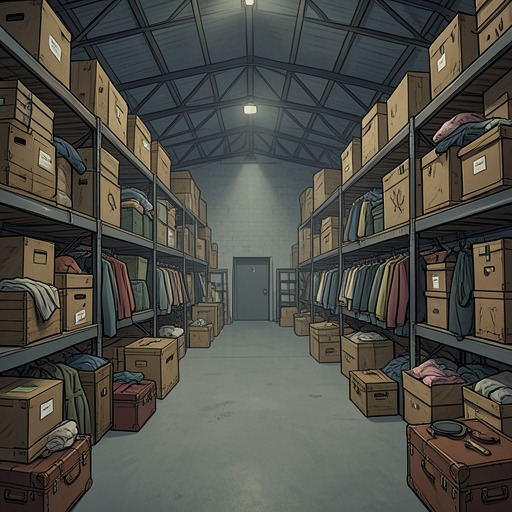
The Zone of InterestKalifornia is a large, shed-cluttered yard within the Zone of Interest, observed from Boris Eltz’s ground-floor office and connected to the camp’s machinery of arrival, sorting, and forced labor. Its immense heaps of possessions turn the aftermath of deportation into a landscape: personal effects are gathered and handled as goods, while the people from whom they came are subjected to selection and violence.
Setting and Material Landscape
From Boris Eltz’s office, Kalifornia appears to stretch across an area the size of a soccer field. The Clearance Detail works there: a rotating pool of two or three hundred girls occupied in a yard crowded with sheds. The space is not presented as a neutral storehouse. Its scale and organization place it within the camp’s labor system, where prisoners are made to process the belongings left by those arriving.
The yard’s inventory forms a vast, disorderly catalogue. Rucksacks, kitbags, suitcases, and trunks bear labels that evoke journeys through distant cities and border posts. Blankets rise in a stack said to be as tall as a three-storey building; nearby lie pots and pans, clothing, watches, spectacles, wigs, dentures, hearing aids, surgical boots, and spinal supports. Children’s shoes and prams complete the view. The objects preserve the ordinary uses and individual histories of their owners, but at Kalifornia they appear in heaps, stripped of those contexts and absorbed into a system of collection.
The Ramp and the Machinery of Arrival
Kalifornia is closely associated with the camp ramp and the operations assembled to receive transports. Before the arrival of Special Train 105, Paul Doll arranged a large force: Wolfram Prufer, three labor managers, six physicians, disinfectors, Szmul and a twelve-man team, eight Kapos, a hosing crew, ninety-six troops under Boris Eltz, an additional eight-man heavy-machine-gun unit, two flamethrowers, Ilse Grese with her platoon, and a seven-member group of violinists. The formidable scale of the deployment stands in stark contrast to the passengers who emerge from the train: among the first are a boy in a sailor suit, an elderly man, and a bent elderly woman leaning on a cane.
The scene is framed by an established selection rule: a train of a thousand people is treated as a standard load, and Doll expects as many as ninety percent to be selected Left. Yet he doubts that customary guidelines will be much help with this arrival. The calculation makes the ramp legible as an administrative process, while the first passengers—recognizable individuals rather than an abstract number—break through that arithmetic. Kalifornia’s role in the reception of deportees thus joins the logistics of selection to the visible presence of the people subjected to it.
Labor, Theft, and Camp Violence
The yard is also a place where the camp’s arrangements create opportunities for survival and exploitation. Sergeant Seisser goes to Kalifornia to steal enough money to pay for his medication before returning to his post at the southern edge of the Women’s Camp. As he approaches the Potato Store, two prisoners break from their ranks and run for the perimeter, an act described as a form of suicide and as astonishingly rare. Seisser opens fire; the force of the weapon and, as the account suggests, the drug in his system send him staggering backward while he continues to shoot, until he collapses against the electrified fence. The episode links the theft of money in Kalifornia to the armed control of prisoners beyond it, showing how closely ordinary camp transactions sit beside lethal violence.
The heaps of possessions belong to a wider system of forced handling and disposal. Elsewhere in the camp’s killing and cremation process, Sonderkommando prisoners drag bodies from the shower room to the Leichenkeller, remove gold teeth and women’s hair, strip away jewelry, and send bodies to the retorts; ashes are ground and carried away by truck. That sequence should not be mistaken for the sorting of goods at Kalifornia, but it reveals the larger circuit in which the yard participates: objects and bodies alike are made subject to organized procedures of extraction and removal.
Contamination and Significance
Kalifornia’s material order is accompanied by a spreading physical disorder. After a delegation in the Old Town complains that water is undrinkable even after repeated boiling, Doll explains that the water table has been breached and that decomposing matter has begun to ferment. He anticipates an overwhelming stench. On a later drive, after benzene tanks have been loaded and a receipt obtained, he repeatedly pulls over to sniff the air and finds that the smell is worse than he has ever known. The narration’s emphasis on odor makes the camp’s consequences impossible to confine to the clean categories of inventory, labor, and administration.
Doll’s own questions gather the location’s moral and environmental implications into a larger reckoning: he asks why the meadow churns, why flies and vermin thrive, why disease and death attend pregnancy, and why the snow turns brown. Kalifornia’s heaps are one visible register of the same system. The yard makes the scale of dispossession tangible, while the stench and contaminated landscape disclose consequences that bureaucratic routines cannot keep at a distance.