Little Brown Bower
The Zone of InterestThe Little Brown Bower is a killing site in Kat Zet II, reached from the ramp by a drive through the birch wood. Its path, garden details, changing room and chamber give murder an outwardly orderly setting; the apparent resemblance to a place of shelter or washing is part of the horror. In scenes narrated by Paul Doll, the Bower’s routines begin to falter as arriving people recognize the danger, and its carefully maintained appearance can no longer contain what happens there.
Setting and Approach
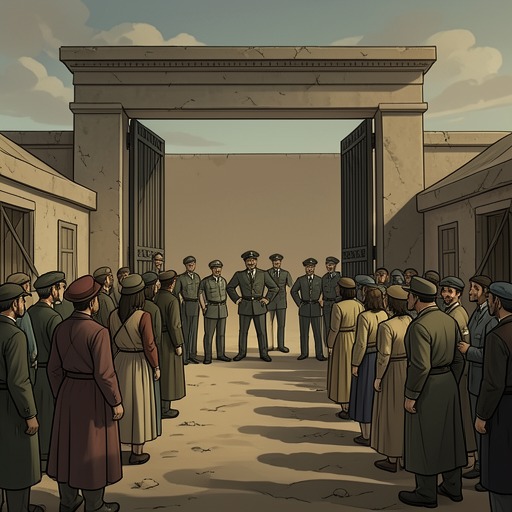
The Bower lies at the end of a route that begins with the train’s detrainment and selection on the ramp, then continues through the birch wood. Boris Eltz describes a month of this ramp duty as punishment within a punishment, imposed after yet another fistfight. His account makes the Bower part of a larger sequence: arrival, selection, passage through the trees, and the destination beyond them. He calls the selection the eeriest part and invites Paul Doll to come along for the experience, turning a routine of mass death into the language of an excursion.
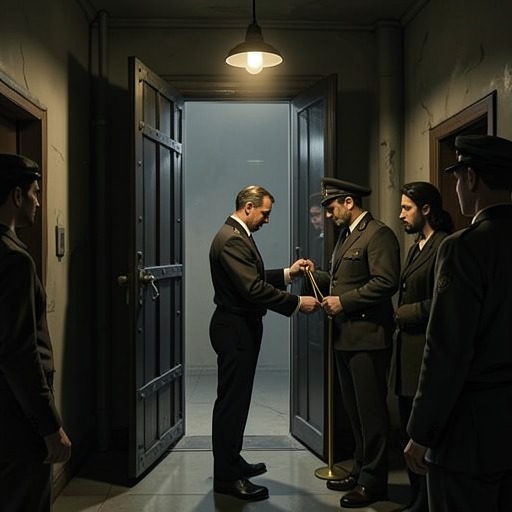
The approach is not presented as an isolated detail. The birch wood and the Bower’s grounds create a transitional space between the public business of the ramp and the enclosed place where the killing is completed. Doll describes peeling birchbark, a picket fence, potted geraniums and marigolds, an undressing room, and finally the chamber. The domestic garden plants and modest fence sit beside doors that have been screwed shut. When Wolfram Prufer gives the signal, Doll turns on his heel with a flourish, registering the process as choreography as well as procedure. The controlled gesture and the locked doors belong to the same scene.
Procedure and Disguise
The Bower’s function is exposed most plainly in a later description of its interior. The undressing area has hooks and benches, along with signs in all the languages of Europe. Beyond it, the chamber has been hosed down and restored to its imitation of a shower room, complete with nozzles but without drains set into the floor. The fittings imitate a familiar place of washing while withholding the practical feature that would make it one. The contrast is not merely between an innocent appearance and a hidden purpose: the signs, benches and nozzles organize the victims’ movement through the site.
In another scene, Doll waits in the empty changing room while the arrival of transport from Hamburg is delayed because the Zyklon B handlers are incapacitated by drugs or alcohol and must be replaced. A note from the camp commandant gives a precise accounting of the incoming train: twenty wagons, about ninety people in each, two additional wagons from a stop at Warsaw, and approximately 1,980 people in total. After ten percent are counted as fit for work, the estimate leaves about 1,782 to be killed. The arithmetic reaches Doll as an administrative message, even as the empty room waits for those it describes. When the people arrive, the Sonderkommando prisoners move among them.
The Bower Under Strain
The orderly sequence does not always hold. Doll describes an afternoon when the first group collapsed into panic almost as soon as its members had left the cattle cars. Eight hundred men, women and children were caught in a scene of confusion before Professor Baldemar Zulz and his medical staff had begun selection. A whimper grew into a scream; blows, a body striking, and a gunshot followed. After ninety minutes, roughly six hundred survivors had been driven by beating, flogging and bayonets into Red Cross vans and ambulances. The account connects the Bower’s system to the violence around the transports: the procedures meant to sort and direct people have to contend with a crowd no longer deceived by the expected routine.
A second train, Sonderzug 319, arrived four hours early. It carried Jewish patients from mental homes in Utrecht, accompanied by young nurses. They processed along a siding already marked by blood, bodies and sodden bags; laughter joined the familiar sounds of the killing ground. Two silver-curled twin old men smiled as if walking to a village fête. Nearby, a teenager in a green canvas straitjacket fell and injured her chin. People watched, then applauded when Ilse Grese pulled her up by the hair. Later, Doll fears dreaming of the twins grinning in the Bower. The contrast between their apparent pleasure and the surrounding violence refuses any comforting division between an orderly audience and the suffering it witnesses.
A Fragile Performance
The Bower’s most unsettling scenes turn on the difficulty of sustaining the deception. On one occasion, people undress calmly while the Sonderkommando prisoners move through the crowd. Doll briefly persuades himself that they really will be cleansed, reclothed, fed and given warm beds. His momentary belief is not evidence of a changed purpose: it is a fragile performance of care, broken when a young naked woman approaches him, raises her hands, shrugs and gives her age as eighteen. The brief encounter makes an individual presence interrupt the language of a transport and its processing.
Elsewhere, Doll’s own body betrays the pressure of his role. When a four- or five-year-old girl takes hold of his ungloved left hand in the Bower, his first impulse is to recoil with a snarl. He suppresses it, with great effort and unease, and continues standing where duty requires. The small physical contact does not halt the killing; its consequence is instead registered in the effort needed to resume his place within it.
The Bower’s repeated imitation of ordinary care thus becomes less convincing as the novel’s scenes accumulate. At first, the route through the trees, the planted flowers and the staged shower room can be read as elements of a managed routine. Yet the locked chamber doors, the missing drains, the breakdown of selection, the frightened or bewildered arrivals and Doll’s strained reactions expose the violence beneath that surface. The Bower is not only a destination in the camp’s process of murder; it is the setting in which the perpetrators’ administrative performance repeatedly collides with the human beings it is designed to deceive and destroy.