Litzmannstadt(Łódź)
The Zone of InterestLitzmannstadt(Łódź) appears as a place from which deportees are sent and where Nazi violence can still be inflicted on people who have not yet reached the camp. Its narrative significance sharpens when a letter links the city to the ghetto’s director, and Paul Doll uses a planned killing there to threaten Szmul through the fate of Shulamith.
Deportation and the First Transport
The city enters the narrative through a question about the first transport out of Litzmannstadt(Łódź). Asked why he had been on it, Szmul answers that it was for undesirables and that he himself had been classified as one. His reply gives the transport a history of selection before the prisoners arrive at the camp: the label has already been applied, and Szmul’s presence among the deported is evidence of that prior designation.
The exchange takes place after the first train has been dealt with. Szmul is sitting on a suitcase under the direct glare of an untended arc light, eating cheese; Doll approaches from behind and asks about the transport. The ordinary details of food and luggage sit uneasily beside the question of how the people on the train were classified. Litzmannstadt(Łódź) is thus present not as a panoramic cityscape but as the origin point of a system whose consequences continue on the ramp.
The Ghetto Director and the Letter
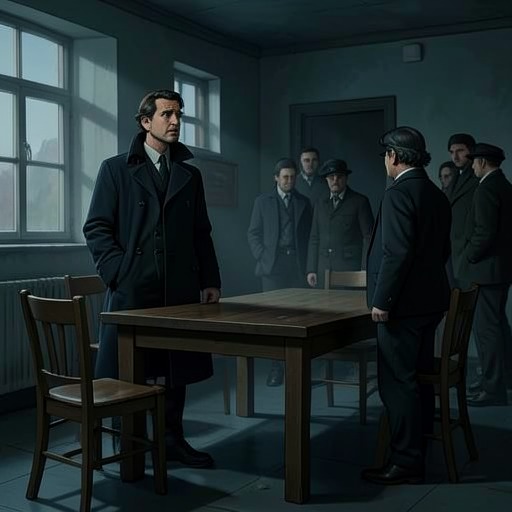
A letter received that morning from Litzmannstadt(Łódź) gives the city a specific political figure. Doll produces it and points out the stamp, which carries the director’s portrait. He describes the director as a ghetto king and notes that he travels in a wheeled carriage drawn by a slight horse. The letter and its image make authority in the ghetto legible to Doll, who turns the portrait and its details into a subject of conversation with Szmul.
The scene offers no account of the director’s policies or of the letter’s full contents. What it does establish is that communication from the ghetto reaches Doll, and that its leadership is represented through an official portrait, a title, and a conspicuous mode of transport. Litzmannstadt(Łódź) is therefore not only a destination or point of departure: it is also a place with an identifiable administration, whose symbols can be carried into the camp and discussed there.
Shulamith and the Threat of May First
Litzmannstadt(Łódź) becomes the threatened site of a killing when Doll tells Szmul that Shulamith will be taken there on May first. He ties the date to the third anniversary of the sealing of the Jewish slum, then says that he will have her killed in the city that day unless he countermandes the order that morning. The threat makes the date, the ghetto, and Shulamith’s fate instruments of Doll’s control over Szmul.
Szmul answers Doll’s question about the order with a deferential acknowledgment. Doll then presses him about his former happiness with Shulamith, making the personal relationship part of the coercion. The city is not merely where the threatened act might occur: it is the location Doll names to make the danger concrete, while the anniversary gives his threat a calculated connection to the ghetto’s confinement.
The City and the Machinery of Extermination
The episodes set in relation to Litzmannstadt(Łódź) sit within a wider account of how the extermination system developed. In a discussion of the crime without a name, a speaker traces a decisive authorization to a letter dated July 31, 1941, and describes a subsequent movement from contemplated deportation to a policy that included women and children. The same discussion argues that gas chambers and crematoria accelerated killing and spared the killers’ nerves, while bullets and pyres would also have served the perpetrators’ purpose.
These remarks do not identify Litzmannstadt(Łódź) as the site of the central authorization or describe the city’s role in the policy’s formation. Their relevance is contextual: the threatened killing of Shulamith and Szmul’s earlier deportation are narrated against a system driven both by high-level authorization and by actions carried out through local institutions and camp procedures. The novel’s limited, concrete references to the city—the transport, the director’s portrait, and Doll’s threat—give that larger machinery a human scale without turning Litzmannstadt(Łódź) into a full civic portrait.