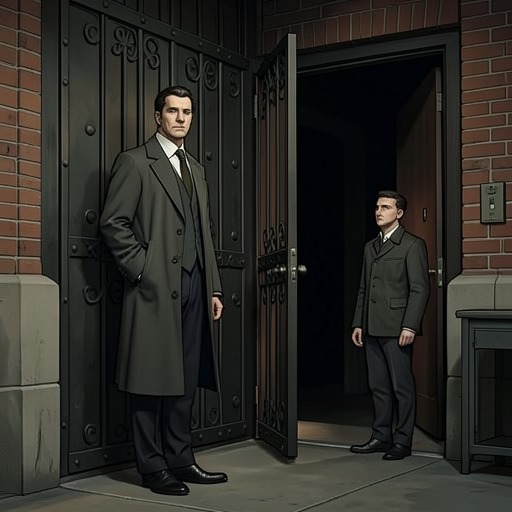
Martin Bormann—Angelus Thomsen
The Zone of InterestMartin Bormann—Angelus Thomsen is a relationship of intimacy without equality: Bormann addresses his nephew with easy familiarity, draws on his help, and commands access to political power, while Thomsen serves him and discovers that the older man possesses a secret bound to Paul Doll and Dieter Kruger. Their exchanges at the family home in Pullach turn an ordinary request for assistance into a disclosure about complicity in murder, one that complicates the boundary between family loyalty and political crime.
Family Familiarity and Unequal Power
At the old family home in Pullach, Bormann’s importance is announced before he appears. He is the Director of the Party Chancellery, described as the mastermind of the Wilhelmstrasse, and is travelling from the mountain retreat at the Obersalzberg to join the family. The war is turning against Germany, and the future of National Socialism is in question; Bormann nevertheless arrives occupied with the accumulation of mail he sorts and stacks on the hall table. Political authority and domestic routine share the same space.
His manner with Thomsen is informal, teasing, and practical. He calls him nephew, jokes about his memory for the female staff on the Security Service’s third floor, and asks him to carry some of the mail. The familiarity does not erase the difference between them: Bormann can summon Thomsen into service with a joke, while Thomsen responds by asking how he may oblige. Their exchange makes kinship a working relationship, one in which personal access and deference coexist.
Bormann also needles Thomsen about a young woman whom he wants traced. Thomsen explains that he has spent several days going through files at the Gestapa, ostensibly on behalf of a female friend, and says that he is anxious to return to Buna but remains at Bormann’s service. Bormann’s request places Thomsen’s connections and availability at his disposal; Thomsen’s answer, in turn, presents assistance to his uncle as an established obligation. The scene shows their closeness through favors and banter, not through an explicit declaration of affection.
Kruger and the Shared Secret
When Bormann asks whom Thomsen is trying to find, Thomsen gives only the vague answer that it is a Communist. Bormann immediately names Dieter Kruger. Thomsen is sharply surprised, but tries to continue languidly, asking why the name amuses his uncle. The quick identification changes the character of the conversation: Bormann knows that Thomsen’s search touches a history he himself has reason to conceal.
Bormann explains that, in early November, he received a teletype from the Commandant concerning Kruger and has not yet replied. He calls his connection to Paul Doll a sacred bond, then identifies its foundation as complicity in murder. The disclosure reaches back to early 1923, when Doll’s paramilitary unit identified a supposed traitor in its ranks in Parchim. Bormann says he was innocent of the killing itself but had passed on permission for a beating. Doll and his men stayed too long in a pub and then went too far in the woods. Bormann served a year; Doll was sentenced to ten and served five. Bormann suggests that Doll partly took the fall for him.
That history makes Bormann’s knowledge of the present more than political gossip. He has received an official communication about Kruger, yet his old bond with Doll complicates what he will do with it. Asked what he intends to tell the Commandant, Bormann proposes the formula that Kruger was shot while trying to escape, then acknowledges that the words merely mean Kruger is dead. Thomsen’s question about whether Kruger is dead exposes the gap between a bureaucratic report and the truth it might be concealing.
A Favor Reversed into a Confession
The balance of the visit shifts as Bormann admits that he is tempted to tell Thomsen the whole story because he believes his nephew would appreciate its supposed moral beauty. He claims that fewer than half a dozen men in the Reich know what actually happened to Kruger, and says he will sleep on it before deciding what to do. The promise is not a resolution: Bormann controls the information, while Thomsen can only ask questions and wait for his uncle’s decision.
Bormann’s confession is also delivered amid crude, mocking familiarity. He connects Doll’s interest in Kruger to Hannah Doll, suggesting that Doll is concerned because Kruger had been with her first; he then makes a sexual remark about Thomsen’s relationship with Hannah. The taunt shows how readily Bormann folds intimate knowledge into family teasing. It also places Thomsen’s private life beside the older political secret, without establishing that the two men share the same understanding or purpose.
The conversation therefore reverses the initial arrangement of favors. Thomsen has been helping Bormann trace a woman, but Bormann’s knowledge of Kruger makes him the one who can provide something Thomsen urgently wants. His offer to disclose the story remains conditional, and the uncertainty over Kruger’s fate is left unresolved in this exchange. Kinship opens the door to the secret; it does not guarantee that Thomsen will receive the whole truth.
Wartime and Postwar Limits
The surrounding narrative places this family intimacy inside a regime whose agencies press people toward incompatible ends. Thomsen describes the Economic Administration Head Office as demanding more labour for the munitions industries, while another authority presses for the disposal of evacuees. The immediate pressures on his work at Buna differ from Bormann’s political position, but the family scene shows how private favors and official power meet in the same wartime world. Bormann’s importance gives his silence about Kruger weight beyond a private family confidence.
The relationship has no narrated reconciliation or final exchange. Years later, Bormann’s fate is reported as having been verified: wounded by a Russian artillery shell while trying to flee Berlin in the early hours of May 1, 1945, he took cyanide. This ending supplies a stark limit to the power and practical protection his position once suggested. It does not settle what he would have told Thomsen about Kruger. Their defining connection remains the combination of nephewly service, political asymmetry, and a murderous secret that Bormann could choose to reveal—or keep.