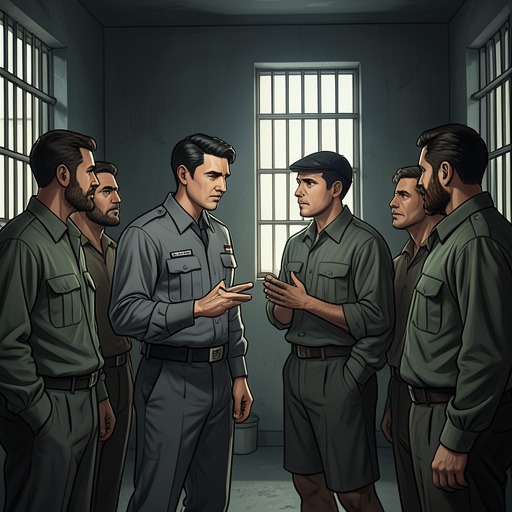
Michael Off
The Zone of InterestMichael Off is an SS agent whose few appearances make him part of the machinery of interrogation rather than a fully developed figure with a private history. The book shows him taking turns in the abuse of prisoners, and, in the case of Roland Bullard, being reprimanded for ineffective violence even as the prisoner lies gravely injured. Off’s scenes expose a system in which cruelty is organized, assessed, and directed, not merely inflicted in uncontrolled outbursts.
Identity and Place in the Organization
Off is addressed as Agent Off and appears in the company of camp officials and interrogators. The available episodes do not establish his personal background, rank beyond that designation, or private motives. Instead, they identify him through his work: he is assigned a role in questioning prisoners and is present in the spaces where their confinement and physical abuse are administered.
That limited characterization matters. Off is not presented as an isolated perpetrator acting beyond the institution’s reach. His actions occur amid instructions, successive interrogations, and oversight by officials such as Fritz Mobius. The narrative gives him little interiority, but places his conduct within an organization capable of allocating tasks and controlling what may be disclosed.
The Jenkins Interrogation
In a confidential discussion about Jenkins, an English NCO held in the crouch-box, Fritz reports that Off will take a turn after another interrogator, before Professor Entress uses a scalpel. The sequence sets out a progression of coercion: Jenkins is confined, questioning is planned in shifts, and physical abuse is treated as one stage in a procedure. Off is named as an expected participant rather than as someone who might independently decide whether the prisoner will be harmed.
The secrecy surrounding the case is as revealing as the planned violence. Fritz orders that it not be mentioned to IG Farben, Suitbert Seedig, Rupprecht Strunck, or Wolfram Prufer, and specifically tells Paul Doll not to disclose it to Prufer. Off’s assigned role thus belongs to an operation whose participants distinguish between those who may know and those who must be kept uninformed. The passage supplies no account of what Off ultimately did to Jenkins; it establishes the planned assignment and the institutional effort to conceal the case.
Bullard in the Crouch-Box
Off appears more directly in the interrogation of Roland Bullard. When the bolts are drawn back, Off is half asleep on a stool, with a pencil in his mouth, while Bullard lies on his side in the dirt. Bullard’s head is described as badly damaged. The contrast between Off’s drowsy posture and the prisoner’s condition makes the scene’s violence feel routine: the agent is at rest in the same confined space where a prisoner has been subjected to prolonged abuse.
Fritz Mobius rebukes Off for continuing to kick Bullard. He points out that Bullard has spent seventy-two hours in the crouch-box and has already undergone two examinations with a probe, so another kick will not make him see the light. The reprimand does not object to the preceding torture or call for Bullard’s release. It treats Off’s conduct as ineffective, criticizing its method and result. In this episode, violence is not opposed so much as managed according to the interrogator’s calculation of what might still work.
Mobius then orders Off to go to Kalifornia and bring back Sara, while asking whether Bullard can still see. Bullard’s eyes are gone; Mobius turns his attention to the prisoner’s ability to hear. Mobius, not Off, fires his Luger into the straw mattress. The distinction is important: Off is assigned the next action, while Mobius directs the interrogation and demonstrates his own authority over its terms. Bullard’s injuries have not ended the process; the officials adapt their approach to the senses the prisoner retains.
Night Shift and Controlled Violence
In another account of a night beneath the Political Department, Off takes over as the shift changes at midnight and remains until dawn. The narrator reports that Off continues with the same kind of treatment Paul Doll had used: slaps to the face and a punch to the stomach. The blows are described as part of the night’s repeated abuse, though the narrator suspects the interrogators have been told not to leave visible marks. That restriction does not prevent violence; it shapes how violence is administered and what evidence it may leave.
The scene also places Off among several men whose shouting fills the night. Fritz Mobius, Doll, and Off all yell, while the prisoner is kept under their control. Off’s shift therefore extends the coercion across hours and personnel: the interrogator changes, but the prisoner remains subject to the same process. The narrator’s uncertainty about the instruction not to mark him leaves the order’s source unspecified, but the suspected restraint underscores that even the appearance of bodily harm is subject to management.
Narrative Significance and Limits
Off’s appearances connect individual acts of abuse to a larger structure of delegated responsibility. He is assigned to Jenkins, found beside the mutilated Bullard, reprimanded for the bluntness of his violence, and later takes part in a night-long sequence of physical abuse. These episodes show different aspects of the same role: planned participation, routine presence, correction by a superior, and continued action within an interrogation system.
The book provides no independent account of Off’s intentions and does not state his eventual fate. Nor does it say that he personally caused every injury suffered by the prisoners in these scenes. What it does show is enough to establish that he participates in their coercive treatment and operates under the direction of other officials. His sparse characterization is itself significant: the narrative presents him less as an individuated psychological portrait than as one working agent in a hierarchy where violence is scheduled, concealed, evaluated, and repeated.