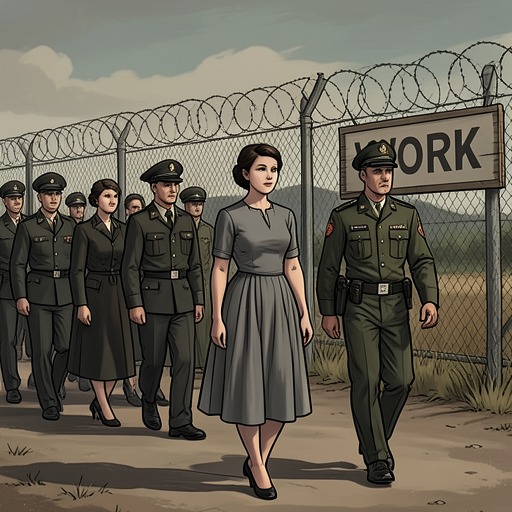
Miriam Luxemburg
The Zone of InterestMiriam Luxemburg is a Polish-German Jewish prisoner doctor whose medical work at the SS-Hygienic Institute becomes the target of Paul Doll’s coercion. Summoned to prepare for a clandestine procedure on Alisz Seisser, she is offered cigarettes for her brother and pressed to undertake an act she says she does not know how to perform. The scene presents her not as a free agent within a medical institution, but as a skilled and vulnerable prisoner forced to negotiate among survival, professional knowledge, and the danger Doll can impose.
Identity and Work
Miriam has been imprisoned for two years and works as one of several prisoner doctors conducting bacteriological research and experimental-sera work at the SS-Hygienic Institute. The work is performed under close supervision. The narrator distinguishes the institute from the indigent hospice and holding area called the Ka Be, and from Block 10, which he describes as a site of castrations and hysterectomies. To him, the SS-Hygienic Institute bears persuasive outward resemblance to a medical establishment; Miriam’s role there places her inside a system where medical practice and coercive authority occupy the same space.
Her Polish-German identity is accompanied by an uncertain family story: her mother is said to have been a niece of Rosa Luxemburg. The account marks this as reported rather than verified, and gives no further detail about Miriam’s response to the connection. It does, however, place a politically charged name beside the prisoner doctor’s own constrained existence, without turning that association into a biography the narrative does not supply.
The narrator estimates Miriam to be about thirty, though she looks closer to fifty. He attributes the visible aging of women in the camp generally to lack of food, but says that hunger alone does not account for her condition: her hair has become mould-like and her lips are turned outward. He also notes that she has some flesh and appears tolerably clean. These details are filtered through his inspecting gaze. They register the bodily effects of imprisonment while exposing how readily he converts a person’s appearance into an assessment.
The Assignment for Alisz Seisser
Paul Doll first meets Miriam for an introductory conversation, then arranges a second meeting in a quiet stockroom in the MAB. He tells her that, for security reasons, the procedure must happen around midnight, and asks what she will need. Miriam requests clean towels and plenty of boiling water. Doll assumes she will use a pill or preparation; she corrects him, specifying dilation and curettage. Her concise correction establishes that she understands the procedure more accurately than he does.
Doll then introduces uncertainty into the arrangement, saying that the directive might change and that orders from Berlin may be modified. His phrasing leaves Miriam to prepare for an intervention whose authorization he presents as unsettled. The practical arrangements are specific, but the terms are not secure: the procedure is to take place at night, the necessary equipment must be brought, and the decision may still be altered by an authority outside the room.
Doll initially offers six bread rations. Miriam rejects that offer with hauteur. He then gives her two sleeves of Davidoffs and promises two more, amounting to 800 cigarettes. He knows she intends to use this capital to help her brother, who is struggling in a penal Kommando in the uranium mines beyond Fürstengrube. The exchange is not simply a payment for medical skill: the promised cigarettes are made valuable through a family member’s desperate circumstances, giving Doll leverage over Miriam while presenting his demand as a transaction.
Pressure and Refusal
Doll’s request turns from the procedure on Alisz to lethal injections. He names sodium evipan or phenol and calls a cardiac injection simple. He invokes Miriam’s experience of selections, accusing her of having separated prisoners and disposed of live births. The accusation is Doll’s, delivered as a means of pressing her; it does not establish what Miriam personally did or what choices were available to her in those situations.
Miriam answers that she has sometimes been asked to perform such selections, but denies knowing how to give the injection Doll wants. When he insists that it is easy, she replies, “It’s easy. All right, sir. You do it.” The answer both marks the limit she asserts and throws Doll’s demand back at him: if the act is as straightforward as he says, he can perform it himself. The scene does not show him accepting that challenge. Instead, he retreats to the possibility that the original decision will stand and returns to the practical question of boiling water.
The Procedure’s Preparation
Later, as the night advances and the hotplate’s cauldron of water begins to bubble, Miriam brings a substantial amount of equipment. She unfolds a portable stand resembling a miniature operating table and arranges the instruments on blue cloth: a syringe, speculum, clamp, and a long wooden stick ending in a sharp, crenellated metal loop. The narrator judges their quality superior to the gardener’s kitbag sometimes used by SS medical staff. The orderly display makes her technical preparation tangible, even as the surrounding circumstances deny the scene the security and autonomy associated with ordinary medical care.
The account stops at preparation. It establishes that Miriam has been summoned, has negotiated for supplies and cigarettes, has specified the procedure, and has brought the equipment; it does not establish what she ultimately does to Alisz or how the encounter concludes. That unresolved endpoint matters to her portrayal. Miriam’s knowledge is visible in the precise procedure and instruments, while the conditions governing their use remain in Paul Doll’s hands.
Narrative Significance
Miriam’s scene exposes the contradiction between the language of medicine and the camp’s coercive practices without making her a symbol detached from her circumstances. She is a prisoner doctor with laboratory duties, a brother in forced penal labor, a precise grasp of the requested procedure, and a clear refusal to claim competence at a lethal injection. Doll turns her professional position and family need into instruments of pressure; she responds by correcting his medical assumptions, rejecting the initial offer, and refusing to carry out an injection she says she cannot perform.
The scene is also tightly limited by its narrator. Paul Doll describes Miriam’s body, recounts what she says, and controls the setting and terms of the transaction. His own language reduces the threatened violence to an easy jab, while her answer restores the practical and moral burden to the person issuing the order. Her brief challenge does not free her from the arrangement, and the evidence gives no outcome that would justify claiming otherwise. What remains is the stark image of Miriam laying out instruments with professional care in a room where neither the orders nor the meaning of medical aid are secure.