Nazi Germany (the Third Reich)
The Zone of InterestNazi Germany (the Third Reich) is presented as both a political project sustained by claims of popular assent and a system whose competing institutions turned people into labor, obstacles, or targets for destruction. The novel sets the regime’s promise of a thousand-year order against the realities of mass death, industrial exploitation, bombing, and postwar denial. Its decisive contradiction is not simply that the state fails to keep its promises: the same administrative machinery that claims to preserve the nation helps make annihilation possible.
Political Promise and Manufactured Consent
The regime’s self-understanding rests on a story of national destiny. It imagines its thousand-year Reich as a renewal on the scale of the empire begun by Charlemagne and ended by Napoleon, and treats political difficulty as a temporary rough stretch before the project resumes its course. The rhetoric is confident enough to call the goal accomplished even while acknowledging that modifications and a more centrist head of state may eventually be needed. The gap between this assured language and the approaching collapse lends the boast a bitter irony.
That political confidence is buttressed by election figures presented as proof of a deep affinity between the people and National Socialism. The Nazi Party’s 37.5 percent in the July 1932 election is identified as the highest vote for a single party in Weimar history; the narrator then cites 88 percent in the November 1933 plebiscitary acclamation and just over 99 percent in April 1938. The sequence is made to signify popular confirmation, but the account’s triumphant interpretation also exposes how statistics can be enlisted as a story of consent. Votes and acclamations become evidence in the regime’s own case for its legitimacy and durability.
Bureaucratic Conflict and the Escalation of Killing
The state does not operate as a single, frictionless will. Paul Doll describes pressure from the Economic Administration Head Office to enlarge the labor force for the munitions industries, while the Reich Central Security Department presses for the disposal of evacuees, treating Jews as a supposed internal danger. A proposal to make able-bodied mothers work in a boot factory at Chełmek brings the conflict into sharp relief: an office can recommend exploiting their labor, but someone must face the practical and human consequences of separating them from their children. Doll’s complaint is directed at officials who formulate policy without having to stand at the arrival ramp.
The novel also traces an increasingly explicit authorization of mass murder. In the account offered to Angelus Thomsen, the decisive document is dated July 31, 1941: a letter drafted by Eichmann and Heydrich, sent to Goring, and returned with his signature. Its practical meaning is described as authority to begin a total solution after manpower has been assembled in the east. At first, officials may still have imagined forcing Jews into cold, barren territory beyond the Urals or in the Arctic Circle, where death would come by exposure and deprivation. That possibility recedes as annexations add three million Jews and officials in occupied Poland compete to find an answer to the numbers under their control. By August or September, the account marks a moral and operational escalation: killing extends beyond Jewish men, already being murdered, to women and children.
Professor Peters rejects the idea that the regime’s murderous intent depended on its most conspicuously modern machinery. Gas chambers and crematories accelerate killing, economize on resources, and spare the nerves of the killers, but he regards them as secondary to the prior decision to kill. Bullets and pyres, he argues, would have served the same purpose. He cites the Einsatzgruppen’s murder of well over a million people by bullets as evidence that industrial facilities were not the source of the will to destroy. The distinction is essential to the novel’s account: technology changes the speed and administration of murder, not the underlying readiness to carry it out.
Forced Labor and the Accounting of Human Beings
At Buna-Werke, the system’s competing priorities become a dispute over the usefulness and replacement of prisoners. Suitbert Seedig explains that prisoners rise at three in the morning, face a ninety-minute march to the factory, work until six in the evening, return at eight, and carry their casualties. They are exhausted before their labor begins. He asks how any work can be obtained from them under those conditions, while Frithuric Burckl says IG Farben will pay for a proposed arrangement. Burckl also offers to provide food independently of the camp administration in the hope of avoiding typhus. The discussion treats sickness and exhaustion as operational problems, but never displaces the prisoners’ exposure to death.
The scale of attrition is stated plainly: Seedig reports that prisoners are still dying at a rate of one thousand a week. Burckl proposes a modest increase in rations of 20 percent, arguing that the extra food would give them more strength and make them last longer. His phrasing reveals the limit of the proposed improvement: nourishment is considered partly as a way to prolong a worker’s capacity for exploitation. The argument is sharpened by a calorie comparison. An adult needs 2,500 calories a day at complete rest; the account gives 300 for some Polish ghettos, eight hundred in the Stammlager, and eleven hundred at Buna, even for penal labor. A heavy worker on eleven hundred calories is said to lose about three kilograms a week. Burckl calls for an incentive, while Thomsen points out that the prisoners know they have been brought there to die.
A letter from Bayer makes the underlying valuation still more brutal. It reports that 150 women arrived in good condition but all died during experiments that produced no conclusive results, and requests another group of the same number at the same price. In the same Buna-Werke setting, company designers and engineers move through a landscape of wounded, unconscious, and dead prisoners with leather-bound notebooks and retractable yellow measuring tapes. Their careful technical work contrasts with the bodies underfoot. Meanwhile, the camp’s physical consequences escape its boundaries: at the Old Town civic centre, local representatives complain that the water is undrinkable even after boiling; the water table has been breached, fermenting matter has entered the water, and the smell is expected to worsen. Industrial and administrative order coexists with a spreading material disorder that cannot be managed away by official reassurances.
Defeat and the Return of War
For a time, Berlin appears comparatively untouched while other German cities and the Ruhrgebiet have already suffered bombing. Raids in late 1940 and early 1941 taper off, and there are none in 1942, but the expectation of a coming attack persists. After the Day of the Luftwaffe, the first multi-squadron bombardment arrives on the night of March 1–2. Sirens wake the narrator, who goes in a dressing gown to a drinks party in the wine cellars of Hotel Eden. Its levity lasts for ninety minutes before the approaching bombing seems like a stumbling giant, each impact a prehistoric thunderclap; then the attack veers east and passes on.
The figures that follow strip away any sense that the capital has remained insulated: hundreds are dead, thousands injured, perhaps a hundred thousand homeless, and a million faces are described as gaunt and horrified. Broken glass covers the ground beneath a sulphur-yellow, fume-laden sky. The war is said to be coming home to the place where it began, toward the Wilhelmstrasse. Defeat also alters the language and gestures of authority. After the disasters in Africa and at Tunisgrad, the sarcastic nickname Grofaz circulates for the leader. Straight-arm salutes give way to ordinary greetings, and the novel describes the spell as broken and the regime’s ten-year Walpurgisnacht as nearing its end. Yet the prospect is not immediate relief: Peters predicts that the leader will persist until Berlin resembles Stalingrad, unless the resistance manages to kill him.
Aftermath and the Failure of Reformation
The novel’s postwar perspective refuses to treat defeat as an automatic moral transformation. In the later period, the narrator’s American colleagues joke that the claim of having known nothing has become Germany’s new national anthem. Germans are expected to emerge reformed after the war of annihilation and the Endlösung, and the narrator includes himself among the reformed. Yet he describes a failure to construct a self-sufficient inner life and sees this as a wider national failure, made worse by the temptation to relieve it by joining another organization. His image of the perpetrator’s divided self in the camp changes after the war: there he felt doubled, as if another self existed alongside him; afterward he feels halved.
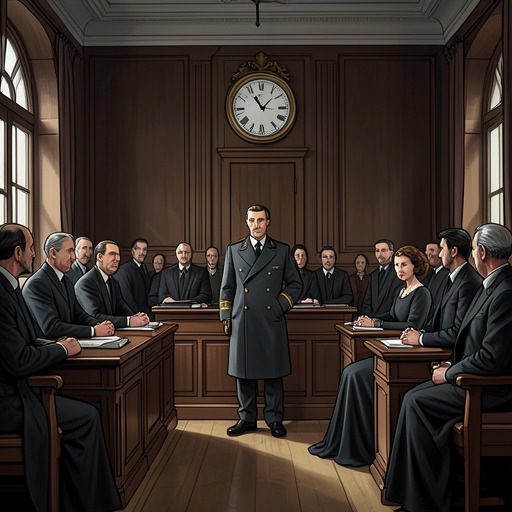
The material record undercuts the regime’s promises of productive strength as well as its claims to political permanence. Thirteen IG Farben executives and managers are convicted at Nuremberg in July 1948, excluding Frithuric Burckl. Seedig receives an eight-year sentence for slavery and mass murder, and Rupprecht Strunck, recalled from early retirement, receives seven years for plunder and spoliation, slavery, and mass murder. Not a kilogram of synthetic rubber or a millilitre of synthetic fuel is ever produced at Buna-Werke. The institution has consumed lives without delivering the industrial output used to justify that consumption. In this account, Nazi Germany’s collapse leaves behind not only ruined cities and prosecutions, but also the unresolved divide between public claims of renewal and the inward life of people who participated in, benefited from, or survived its crimes.