Nazi Germany's increasingly apparent defeat
The Zone of InterestNazi Germany's increasingly apparent defeat is presented as a fact recognized in private long before it can be admitted in public. The contrast sharpens as Boris Eltz interprets the military evidence with clarity, while Paul Doll reaches for propaganda and turns doubt into a punishable offense. Around them, institutional demands for labor and deportation continue, and the regime's violence intensifies. Defeat in the novel is therefore not a single revelation or battlefield reversal: it is a growing rupture between what officials can see, what they are willing to say, and what they continue to do.
Recognition Before Admission
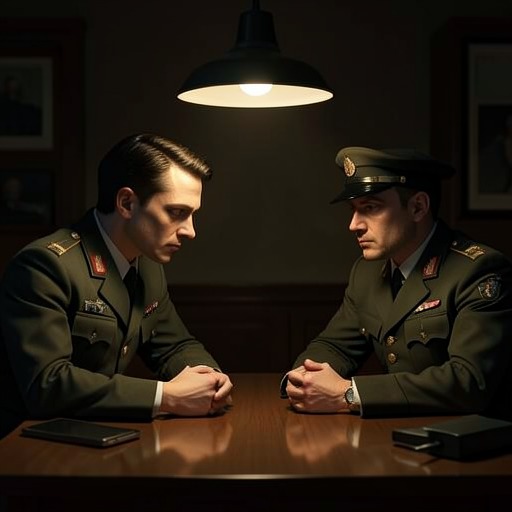
Boris tells Angelus Thomsen that the war is lost, first insisting that he means more than the fate of the Sixth Army. The claim is not an abstract pessimism: Boris points to the encirclement of Friedrich Paulus's troops, frozen and starving on the Volga, while Erich von Manstein's relief force has yet to engage Georgy Zhukov. His assessment makes the approaching disaster at Stalingrad part of a wider strategic collapse rather than an isolated crisis.
Boris locates the decision that made defeat likely in the war's expansion. By December 1941, Germany was fighting the Soviet Union while also confronting the United States and the British Empire. Thomsen replies that there is no second front yet, that the Allies might fall out with Moscow, and that Germany is developing new weapons. Boris counters that the enemy has scientists too, including German scientists, and argues that killing millions would not make Russia conquerable. His numerical picture—five million killed, five million taken prisoner, and thirty million starved, with 125 million still remaining—is part of his argument about the scale and futility of the undertaking, not a detached statistical account.
His reasoning moves beyond territory and armies. Even the destruction of Leningrad and Moscow, he argues, would leave a vast insurgency, while Siberia alone is larger than eight Europes. The decisive distinction, for Boris, is between an older cabinet war against a weakened regime and a war of pillage and murder. In this conflict the Red Army is only the vanguard: the population itself will fight. He recalls that, until October and the advance on Kiev, he thought mass killing might accomplish the impossible. His image of night winning registers the point at which he had mistaken murder's apparent momentum for victory.
The Battlefront and the Public Story
The military situation becomes harder to disguise when news arrives that Zhukov has mauled Manstein and driven him into retreat fifty kilometres to the west. Doll, already physically distressed, has been reading concealed newsprint in his boots; he drinks warm water from a rusting faucet and vomits in the urinal before the news is voiced. Yet when all eyes turn to him as Kommandant, he performs confidence, predicting that Paulus will prevent the Sixth Army from being encircled. Mobius cuts through the performance: Paulus is already surrounded, the Romanians have been broken through, and the German forces are trapped.
Official broadcasting offers Doll a different war. His Volksempfänger, tuned to the National Socialist station, describes a heroic stand in the Caucasus and compares the Sixth Army to the Spartans at Thermopylae. The comparison itself prompts Doll to wonder whether the Spartans were all killed, but it does not free him from the story the broadcast supplies. Later, the radio describes the last fighters at Stalingrad raising their hands to sing national anthems, and calls their sacrifice an example to Germany. A newspaper editorial likewise declares that they died so Germany might live; Joseph Goebbels's Sportpalast speech culminates in a call for total war, amplified by prolonged applause.
Mobius supplies the fact that the language of sacrifice conceals: the soldiers surrendered. Doll's response is incredulity, not comprehension. Mobius gives the scale as he understands it—150,000 dead and 100,000 captive—and asks what the enemy will do with the prisoners. The correction exposes how propaganda converts capitulation into heroic death, while Doll's need for the heroic version makes the correction feel almost impossible to accept.
Defeat as a Crisis of Loyalty
The war's loss also changes the meaning of private speech. When Hannah asks why Doll is radiant after hearing that Kruger is dead, Doll answers that the war is lost. The admission is immediately followed by accusation: he tells Hannah that she has committed a crime by doubting victory, and invokes the supreme penalty. The reversal is stark. A truth he has just acknowledged becomes, when spoken by someone else, an offense against the regime. His reaction shows that recognition has not become moral or political dissent; instead, he tries to restore authority by criminalizing the recognition itself.
The same fracture appears in Doll's workplace. He describes himself as caught between the Economic Administration Head Office, which presses him to increase labor for the munitions industries, and the Reich Central Security Department, which demands the removal of evacuees. A teletype proposes working able-bodied mothers to exhaustion in the boot factory at Chełmek. Doll objects that those issuing the order have not considered what it means to separate mothers from their children at the ramp. His objection registers a practical conflict inside the machinery of persecution: the demand to exploit labor collides with the demand to deport people. It does not amount to opposition to the regime's antisemitic premises, which Doll repeats even while describing the contradiction.
Military Failure and the Will to Kill
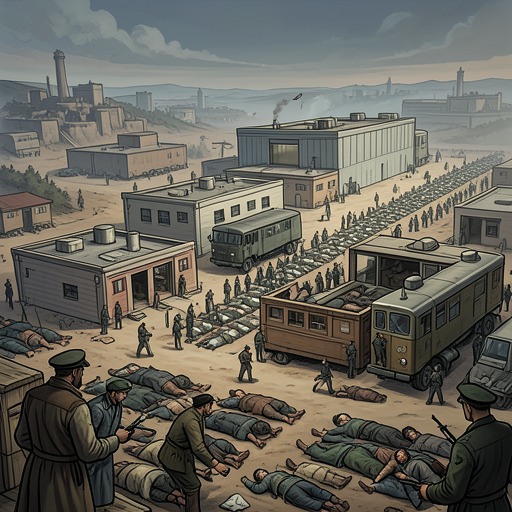
A later conversation gives the campaign of mass murder a chronology and a bureaucratic setting. Thomsen describes the crime without a name as beginning with the authorization dated July 31, 1941, drafted by Adolf Eichmann and Reinhard Heydrich and signed by Hermann Göring after its return. In his account, the original possibility still included deporting Jews to a cold, barren region beyond the Urals and the Arctic Circle after a quick victory over Russia. As that territorial solution receded and officials in Poland faced the additional millions brought under German control, pressure mounted for another answer. The decisive escalation was the extension of killing from Jewish men to women and children.
Professor Entress challenges the idea that the industrial apparatus of extermination was the source of the crime. Gas chambers and crematoria, he argues, made killing faster, more economical, and less psychologically difficult for the killers; bullets and pyres could also have carried the policy through. He cites the Einsatzgruppen's killing of well over a million people by shooting as evidence that the means could change without changing the will. Set beside the military reversals, this argument prevents defeat from functioning as a moral reckoning. The regime can lose its strategic wager and still pursue annihilation with purpose.
The Meaning of an Apparent Defeat
The novel distinguishes among military knowledge, propaganda, and political intention. Boris can infer the likely outcome from the war's scale and alliances; Mobius can report encirclement and surrender; the radio can recast disaster as sacrifice; and Doll can hear the truth while punishing another person for voicing it. These are not simply competing versions of one event. They show how the regime's public language attempts to preserve obedience after its claims have become untenable.
The growing visibility of defeat therefore exposes no automatic collapse of the system's violence. Its agencies continue to argue over labor, deportation, and the treatment of prisoners, while the exterminatory policy proceeds through authorization, local pressure, and changing methods. The contrast is central: Germany's military prospects narrow, but the willingness to kill does not. Defeat becomes apparent first as knowledge that cannot be safely spoken, then as a public fact disguised by ceremony, and finally as a measure of how little military failure by itself can undo the regime's crimes.