Nazi policy to exterminate Europe’s Jews
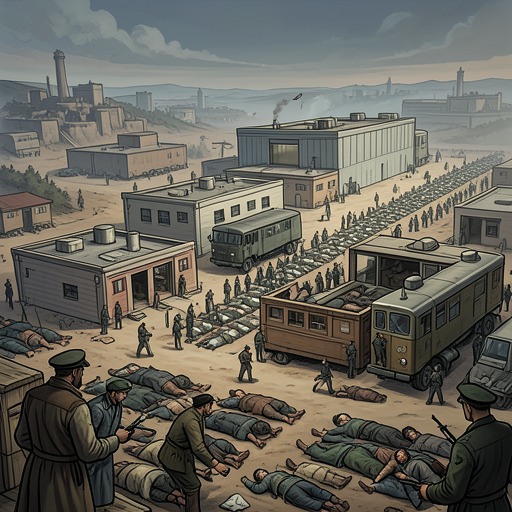
The Zone of InterestNazi policy to exterminate Europe’s Jews emerges as both a project authorized at the highest level and a process accelerated through the machinery of competing institutions. The account traces a shift from euphemistic plans for deportation to the deliberate killing of women and children, while insisting that gas chambers and crematoria facilitated murder rather than made it possible.
Authorization and the Wannsee Conference
The novel’s discussion of the Wannsee Conference challenges the idea that its participants originated the extermination policy. Paul Doll describes the meeting’s stated purpose in the language of evacuation to territories in the east, but argues that the participants merely ratified a decision made months earlier at a more senior level. He identifies Heydrich, Lange, Eichmann, and Gestapo official Muller among those present, presenting the gathering not as the decisive point of invention but as an administrative stage in a policy already under way.
The account later gives that earlier authorization a date. In Konrad Peters’s explanation to Angelus Thomsen, the crime without a name begins, provisionally, on July 31, 1941, when a letter drafted by Eichmann and Heydrich was sent to Goring and returned with his signature. Peters describes it as conveying Hitler’s wish for a total solution and granting authority to begin. The emphasis falls on a chain of authorization: a leader’s expressed wish, an official document, and the signature that turns it into permission to act.
Bureaucratic Agreement and Expanding Scope
At a discussion of the conference, Angelus Thomsen describes its purpose as testing whether administrators would resist the application of the regime’s racial policy across Europe. He says there was no resistance. The projected scope, as he gives it, includes Spain, England, Portugal, and Ireland, with ten or perhaps twelve million people involved. His account makes bureaucratic acquiescence part of the policy’s reach: its ambition is continental, and the resistance that might have impeded it does not materialize in the discussion.
Peters’s retrospective account adds a different pressure. The regime may initially have contemplated sending Jews to remote, barren regions after an expected quick victory over Russia. But, in his description, that territorial solution receded as the war continued and authorities in Poland faced the added burden of three million Jews brought within the regime’s control through annexation. Competing officials pressed for further action. Peters locates a decisive escalation in the move from killing men, which had already been occurring for months, to killing women and children as well. This account makes the policy’s development neither a simple one-step decision nor an accident: central authority, failed plans for removal, and pressure among officials converge in widening the targets of murder.
Labour, Deportation, and Institutional Conflict
A glimpse of Paul Doll’s private administrative calculations exposes another conflict within the system. He sees the Economic Administration Head Office pressing him to increase the labour force for the munitions industries, while the Reich Central Security Department demands the disposal of as many evacuees as possible. He understands the two demands as incompatible, especially when officials propose working able-bodied mothers to exhaustion in a boot factory at Chełmek. His imagined answer is that the officials making the proposal should try separating the mothers from their children at the ramp themselves.
The passage does not present Doll’s complaint as opposition to persecution: his own thinking repeats the regime’s characterization of Jews as a security threat. Instead, it reveals how labour extraction and deportation could pull administrative priorities in different directions, and how decisions made at a distance depended on coercive encounters with families. Bureaucratic friction here concerns how to exploit and remove people, not whether they should be persecuted.
Means of Killing and the Policy’s Logic
Peters distinguishes the industrial form of mass murder from its underlying purpose. Gas chambers and crematoria, he argues, sped up killing, reduced costs, and spared the nerves of the killers; they were not indispensable to the outcome. He points to the Einsatzgruppen’s murder of well over a million people by bullets and insists that bullets and pyres could have carried the killing further. In his stark formulation, the perpetrators already possessed the will to kill millions of women and children.
That distinction gives the account its bleakest implication: technology changes the speed and organization of murder, not the intention that drives it. Read alongside the July 1941 authorization, the lack of resistance at Wannsee, and the pressure to broaden the killings, Peters’s argument connects policy at the centre with the methods used in its execution. Industrial killing is presented not as the origin of the crime but as a means of making an already authorized project more rapid and administratively manageable.