November 9
The Zone of InterestNovember 9 gathers several histories into one of the novel’s sharpest displays of political memory. Paul Doll proposes an open-air ceremony for the date and recasts it as a Reich memorial day, using it to link a distorted story of national injury with the Nazi movement’s own origin myth. The scene’s bitter force lies in the contrast between his solemn staging and the violence, corruption, and disintegrating world that surround it. Elsewhere, November 9 belongs to a broader inquiry into how people reveal themselves under National Socialism—and how memory contests the stories perpetrators tell about their actions.
The Planned Commemoration
Paul Doll raises the idea of marking November 9 while speaking with Wolfram Prufer at night. He wants a proper ceremony and a rousing speech, but rejects the church in the Old Town in favour of an open-air site. He invokes the Old Fighters, insisting that their deeds took place in the open. Prufer objects that they are in eastern Poland, far from Munich, and suggests the church; Doll brushes the objection aside. Snow, tarpaulins, and the orchestra stand, he says, will make the occasion bracing and stiffen morale. The proposal turns a date into a public performance, planned not simply as remembrance but as an exercise in collective resolve.
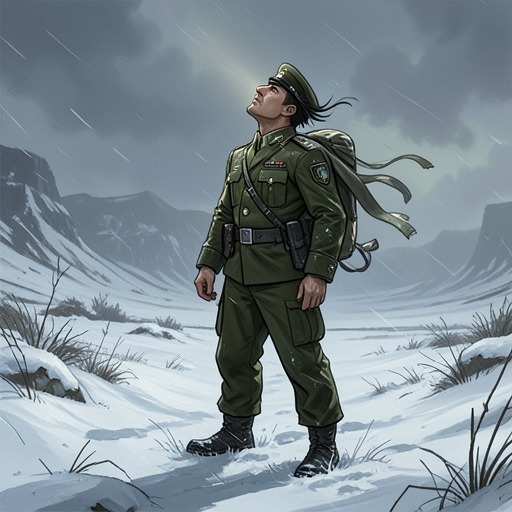
The ceremony takes place in severe cold: the temperature is minus fourteen Celsius, and snow falls brown with residue from the pyre and smokestacks. Paul Doll advances slowly between the two halves of the standing audience and climbs onto a low stage. Fourteen wreaths lean against fourteen supposed urns, which are actually tar-blackened flowerpots, their contents weakly flickering and fuming. In this setting, the repeated fourteen is at once part of the ceremony’s staging and a number that will recur in Doll’s account of the failed putsch. His solemn apparatus does not lift the scene out of the camp’s material reality; smoke, ash, cold, and the pyre remain in view.
Doll is not wholly sober, though he has drunk with enough care to stop his teeth chattering and deepen his voice. He produces a large glass of colourless liquid and opens his speech by invoking a darkening sky and the Reich Day of Mourning. The grand delivery, the displayed drink, and the stage-managed setting make his commemoration theatrical. Yet its authority is unstable from the outset: the speaker is visibly drunk, the urns are improvised flowerpots, and the audience stands in the bitter weather of the camp.
Three Histories Recast as One
Doll presents November 9 as a day of threefold importance. He begins with 1918, claiming that Jewish profiteers auctioned Germany to financial interests in Wall Street, the Bank of England, and the Bourse. This is not neutral history but an antisemitic conspiracy narrative: it makes national defeat the result of a fabricated Jewish betrayal. The novel shows how the date can be made to carry a political accusation by repeatedly joining distinct events under the same commemorative heading.
For 1938, Doll refers to the murder of the German ambassador in Paris by Herschel Grynszpan, then describes Kristallnacht as a spontaneous German response to years of provocation and a simple quest for justice. His formulation converts organized persecution into popular self-defence. By placing this claim inside a memorial speech, the novel shows commemoration functioning as an alibi: the violence is renamed, and responsibility is displaced onto its victims.
Doll announces that he wants to speak about November 9, 1923. His account turns the failed Beer Hall Putsch into a scene of heroic sacrifice, describing its participants as brothers and warrior-poets and presenting their advance as a march animated by courage and feeling. The narrative cuts against that elevation with a deflationary inventory: about nineteen hundred assorted people, in ill-fitting brown uniforms, each paid two billion marks—then worth three or four dollars—gathered in and around the Bürgerbräukeller in Munich. The gap between this detail and Doll’s lyricized version makes the speech’s method legible. It transforms a ragged political failure into a founding legend, and the fourteen wreaths and flowerpot urns echo the fourteen dead that his version makes central.
The Date Against the Record of Violence
The novel sets Doll’s retrospective mythology beside accounts of persecution that refuse to be contained by a ceremonial story. In a conversation in the Tiergarten, Angelus Thomsen describes a letter dated July 31, 1941, drafted by Eichmann and Heydrich and signed by Göring, as an authorization to begin a total solution. He recounts how an imagined territorial expulsion beyond the Urals and into the Arctic receded as pressure mounted among officials in occupied Poland. By August or September, he says, the decisive extension was killing women and children as well as men. This account belongs to a different time and conversation from Doll’s speech, but it sharpens the novel’s contrast: public myth turns violence into honour, whereas the account of policy reveals decisions, escalation, and human consequences.
Thomsen’s conversation with Professor Entress also challenges the idea that the machinery of killing defines the crime. Gas chambers and crematoria, Entress argues, accelerated the process, economized effort, and spared the killers’ nerves; bullets and pyres could have achieved the same end. He points to the Einsatzgruppen’s mass shootings as evidence of the will to kill beyond any one technology. Set against Doll’s ceremonial handling of November 9, this argument shifts attention from the symbols perpetrators choose to the intentions and acts those symbols conceal.
The narrative also shows the competing institutional pressures inside the regime. At home, Thomsen thinks of himself as caught between the Economic Administration Head Office’s demand to expand labour for the armaments industries and pressure to dispose of evacuees. He rejects, in thought, a proposal to work able-bodied mothers to exhaustion in a boot factory, because separating them from their children at the ramp would make the human cost undeniable. Elsewhere, the sensory consequences of the camp’s violence breach administrative distance: poisoned water is described as undrinkable even after boiling, while the smell worsens on a drive past tanks of benzene. These episodes do not form part of the November 9 ceremony, but they give the novel’s surrounding world a material record against which Doll’s controlled language of honour and mourning can be measured.
Memory, Witness, and the Novel’s Frame
November 9 is therefore more than the date of a single ceremony. The novel returns to the problem of who gets to describe violence and what happens when public memory is shaped by the perpetrators. Against Doll’s speech, it places the buried testimony of Josef, a Czech Jew from Brno. Written in Yiddish in black ink across eight pages, the document had been hidden in a child’s galosh beneath the hedge bordering Doll’s garden. The Sonderkommando prisoners debate whether to exhume it and read it; their decision makes testimony an act of deliberate recovery, not a monument supplied by those in power.
The novel’s later reflection extends that conflict beyond the camp. In its postwar section centred on Hannah, the narrator says that National Socialism forced victims, perpetrators, collaborators, witnesses, conspirators, and even minor obstructors to discover—or reveal—who they were. The phrase zone of interest names this exposure of character under pressure. November 9, as Doll stages it, tries to settle the meaning of the past by turning grievance and defeat into a consoling national ritual. The novel instead keeps the date open to contradiction: the ceremony’s borrowed heroism stands beside buried testimony, institutional decisions, bodily consequences, and the recognition that official remembrance can disguise rather than resolve responsibility.