Paul Doll
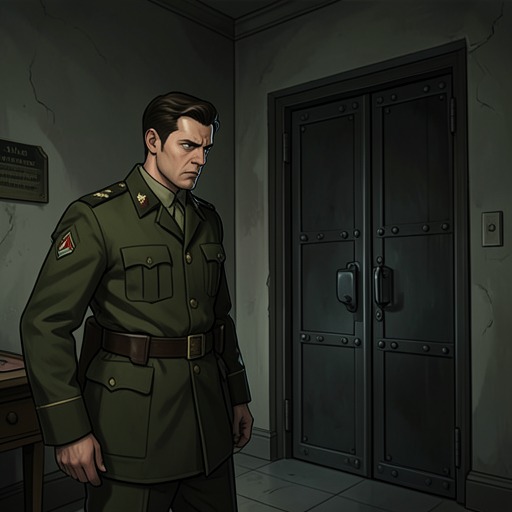
The Zone of InterestPaul Doll is a concentration-camp commandant who makes normality his most persistent defense against the evidence of his own conduct. He administers orders, rationalizes mass violence as service to Germany, and treats his private grievances as injuries of comparable weight; yet his own account repeatedly lets the consequences of his actions break through that self-protective story. His career ends in capture, trial, and execution, while his final statement acknowledges grave sin against humanity.
Identity and Background
Doll presents himself as an experienced official, a decorated veteran, and a man entitled to ordinary domestic and sexual satisfaction. He invokes his two Iron Crosses, awarded in the second and first classes, as proof of his virility, and describes himself as twenty-nine when he married Hannah. That confidence sits uneasily beside his account of their marriage: they wed at Christmas in 1928, and a week after returning to the vicinity of Rosenheim, Hannah’s pregnancy was confirmed at six weeks. Doll says he had attributed her earlier lack of response to medical reasons, then blamed her supposed frigidity on her former relationship with Dieter Kruger. He invokes a reading of Tolstoy to justify abstaining from sex during pregnancy and lactation, presenting the restriction as principle rather than acknowledging the strain in their relationship.
His insistence on ordinary manhood becomes a refrain. He declares, “I am a normal man with normal needs,” then repeats that he is completely normal and names himself in the third person: “Paul Doll is completely normal.” The repeated assertion does not settle the question; it draws attention to how urgently he needs it settled. His narrative moves between first-person complaint, official rhetoric, and self-address, revealing a speaker who tries to control the meaning of events even as his own details undermine his account.
Command and the Camp
As commandant, Doll has authority over camp policy and personnel, but he repeatedly frames decisions as demands imposed from above or as necessities of national purpose. In a discussion about prisoners’ strength and endurance, he rejects the prospect of pampering and insists that the camp is not a sanatorium. He presents himself as aligned with the Reichsführer-SS and treats practical considerations as subordinate to a political objective. The language of discipline turns deprivation into an administrative virtue.
His handling of orders shows how he both exercises authority and invokes its chain of command. When Wolfram Prufer says an order cannot be carried out, Doll replies that it comes from Gruppenführer Horst Blobel and therefore from the Reichsführer-SS. At the Spring Meadow, he watches the field where bodies are being burned and insists that he feels no false sentimentality. He explains that any impulse toward human kindness must yield to Germany and its leader, and concludes that under the new order deeds have positive or negative outcomes rather than being judged as right or wrong. This is not mere compliance: Doll states the principle that makes the violence acceptable to him, while presenting that principle as a political necessity.
The camp’s procedures also expose his participation in deception. A delegation of doctors, including Professor Zulz and Professor Entress, confronts him with the claim that he has become worse at deceiving transports; Zulz says that Doll no longer deceives them and that scenes have become very unpleasant nearly every time. The complaint indicates a change in Doll’s conduct: the reception process depends on misleading deportees, but he is no longer maintaining that deception successfully. His later attention to a report identifying a coordinator on the floor shows him engaged in official scrutiny of camp operations, even as the wider record makes clear that administration and mass violence are inseparable in his post.
Doll also tries to manage antisemitism as a question of technique. He says he banned Der Stürmer from the camp because its lurid depictions of Jewish sexuality damage the cause of antisemitism, which he believes should rest on charts, statistics, and supposedly scientific evidence. He recalls that a display of the newspaper at Dachau provoked violence among prisoners, then supplies conspiratorial claims about Jewish prisoners, bribes, and the newspaper’s editor. The episode shows no rejection of persecution: Doll objects to an ineffective form of propaganda and argues for a more systematic one.
Hannah, Alisz, and Domestic Power
Doll’s account of family life repeatedly casts him as the wronged party. After an incident on the ramp leaves him with a splitting headache, he notes that Hannah offers no solicitude, although she can see that he is shaken. He interprets her response as proof that she considers her hardships greater than his own. Even amid the consequences of his work, his attention returns to the affront of not receiving sympathy.
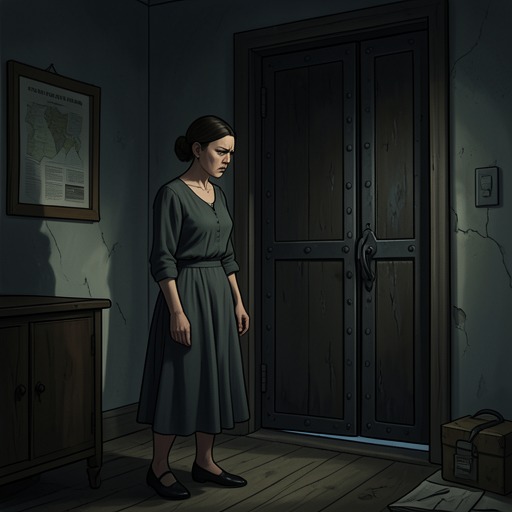
His insecurity about Hannah intensifies into fear. He writes plainly, “I am afraid of Hannah,” describing a hollow sensation in his solar plexus when they are alone. He interprets her changed appearance after the December concert as deliberate sexual display and reads calculation into her eyes. These descriptions belong to Doll’s resentful perspective, not to an objective account of Hannah’s motives. When he concludes that she and Angelus Thomsen are lovers, he imagines himself betrayed and dwells on their sexual relationship, while acknowledging that he is not supposed to know. His suspicion makes Hannah’s independence and intimacy with another man appear to him as a threat to his authority as husband and commandant.
That authority is challenged explicitly when Doll is warned that his position is hanging by a thread. Hannah, the warning says, responds with pleasure to bad news; Doll is told that if matters do not change, the matter will be reported to Prinz Albrecht Strasse, and asked whether he can control his wife. The exchange joins domestic discipline to institutional power: Hannah’s conduct is treated as a professional liability for Doll, and he is expected to govern her as part of governing the camp.
Doll’s relationship with Alisz Seisser offers another version of his self-exculpation. He calls her Sunday visits and the meals she brings a family tradition, and describes their sexual relationship as necessary to preserving his dignity and self-respect. He presents her gratitude and affection as a counterweight to the misery of his home, turning his exploitation of a vulnerable woman into a story about his own emotional need. When Alisz faces an abortion, he tells her to celebrate a clean termination over gin in a scalding bath, then threatens to slap her if she cannot pull herself together. Miriam Luxemburg arrives with a portable stand and instruments, including a syringe, speculum, clamp, and a wooden stick with a sharp metal loop. Doll’s breezy language and impatience stand in sharp contrast to the seriousness of the procedure and Alisz’s distress.
Self-Justification and Moral Breakdown
Doll’s reasoning is most exposed when the camp’s violence becomes impossible to conceal even from himself. After watching the Spring Meadow, he claims that kindness to Jews would be cruelty to Germans and that moral categories have passed away. Yet elsewhere he reflects on killing old women and little boys while other men display conspicuous courage. His admiration for an officer facing Polish prisoners is mixed with envy: Doll recognizes the disparity between his own bureaucratic role and another man’s visible brutality, but his reflection does not become a rejection of the system he serves.
A drunk Doll tells a member of the Sonderkommando that he is afraid to die but not afraid to kill, and says he sees murder in the man’s mouth. The speech turns the threat of violence back on its speaker: Doll identifies the capacity to kill as a useful trait in the prisoner, while his own command makes clear that he possesses and uses the same capacity. His language of usefulness cannot erase the unequal power between them.
On the Reich Day of Mourning, Doll wakes in the Officers’ Club after the patriotic luncheon has degenerated into a scene of wreckage. He asks why the work smells so bad, why the guards become brutishly drunk on the ramp, why the meadow churns, and why snow turns brown. He asks why conception and pregnancy promise death for both mother and child, and why the dead are treated as a problem of numbers. These questions are not an account of repentance; they register a crisis in the terms he has used to make the camp bearable to himself. When he worries about a prisoner headcount, Prufer reminds him that the total need only tally and that prisoners do not have to be alive. Doll accepts the correction. The moment compresses the camp’s bureaucratic logic into a grotesque administrative reassurance: even the living status of prisoners is irrelevant so long as the figures agree.
Doll’s power over prisoners also takes the form of personal coercion. In the sepulchral space beneath Crematory IV, he instructs a Sonderkommando prisoner to practise drawing a concealed weapon and stabbing a sack. He then says that Shulamith Zachariasz will be taken at noon on May 1 unless he countermandes the order by telephone that morning. Doll makes her survival conditional on the prisoner killing Doll’s own wife. The threat is presented as elegant and simple, a calculated use of one person’s life to compel violence against another. It joins the camp’s machinery of death to Doll’s private life, making intimate attachment another instrument of command.
Removal, Trial, and Ending
Doll’s institutional career changes but does not end with the first demotion. In June 1943 he is moved sideways into a clerical post at the Inspectorate of Concentration Camps in Berlin, which is being bombed nightly and then by day as well. In May 1944 he is reinstalled as commandant. The movement between office work and command does not alter the responsibility attached to his authority; the record places him within the administrative structure before returning him to its direct leadership.
He is captured in March 1946, tried at Nuremberg, and delivered to the Polish authorities. In his final statement, Doll writes, “In the solitude of my cell I have come to the bitter realisation that I have sinned gravely against humanity.” He is hanged outside Bunker 11 in Kat Zet I on April 16, 1947. That acknowledgment stands against the novel’s accumulated record of his claims to normality, his appeals to orders and national necessity, and his treatment of human beings as entries in a tally. His ending does not undo those acts; it gives their evasion a final, stark counterstatement.