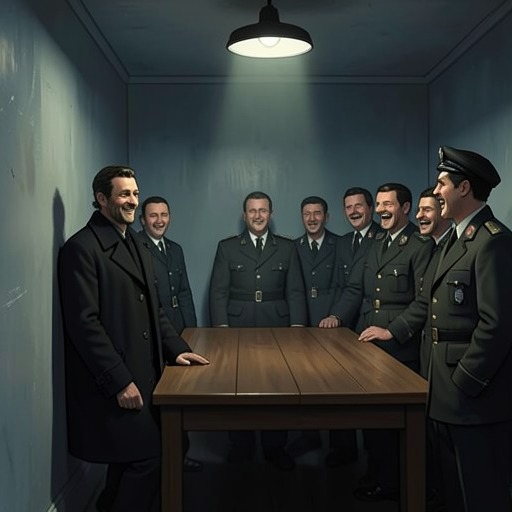
Paul Doll’s Mental Breakdown and Madness
The Zone of InterestPaul Doll’s mental breakdown unfolds as a conflict between the “normal” man he claims to be and the world of organized killing he administers. His language repeatedly converts violence into political duty, yet bodily disturbance, private questioning, and others’ judgments expose a mind that cannot fully contain what its public justifications demand. The novel’s portrait of madness is therefore not a simple loss of ideology: Doll can regain confidence in murder even as his capacity for self-recognition appears to fracture.
The Normal Man and His Political Creed
Doll’s insistence on normality is clearest when he gazes across Spring Meadow, where the sounds of burning bodies reach him from beyond the mound. He declares himself free of false sentimentality and says that, when tempted by human weakness, he thinks of Germany and the trust placed in him by its leader. His reasoning turns kindness to Jews into cruelty toward Germans, then dismisses right and wrong as concepts that have passed away. The calm, declarative logic does not dispel the horror of the scene; it shows how Doll makes ideological obedience serve as a substitute for moral judgment.
The same defense appears in his response to a proposal about improving prisoners’ physical strength. Doll insists that the camp must not become a place of pampering, aligning himself with the Reichsführer-SS and rejecting any suggestion of leniency. His short, emphatic commands make severity sound like discipline rather than a choice. The gap between his self-description as ordinary and his readiness to treat human suffering as an administrative concern gives his claim of normality its disturbing force.
His account of Der Stürmer offers another revealing contradiction. Doll says he banned the publication in the camp because its lurid depictions of Jewish men supposedly harmed antisemitism by replacing scientific evidence with sensational cartoons. He presents this as a more effective policy, not a rejection of persecution: his objection is that crude propaganda may weaken the cause it serves. Even his apparent criticism of antisemitic excess remains inside the logic of persecution, exposing how readily he mistakes tactical calculation for sound judgment.
Bodily Symptoms and Private Doubt
After a failed exchange with a woman who refuses to tell him what he wants to know and says she will keep her promise to the girls, Doll withdraws to his private quarters. That night he wakes with his chin, lips, and cheeks completely numb, comparing the sensation to novocaine and to a dead limb. He imagines that even a kiss would be unfelt. The passage records a precise bodily disturbance rather than offering a diagnosis; its placement after the rebuff makes the numb face an unsettling counterpoint to Doll’s pursuit of control and intimacy.
Elsewhere, while reflecting on Dieter Kruger and the political history of the German left, Doll asks himself why he feels like a sick bird unable to rise. The image briefly gives bodily form to a helplessness that his official language suppresses. His resentment of Kruger is complicated by the recognition that Kruger was capable of courage, a quality Doll cannot simply dismiss. The moment does not amount to a stable moral awakening, but it shows that judgment and self-questioning have not disappeared altogether.
The novel places Doll’s distress within a broader landscape of violence. Boris Eltz recalls hearing that psychiatric patients in Königsberg were killed to clear beds for men who had broken down after killing women and children in Poland and Russia. This account does not identify Doll as one of those men, but it makes explicit the regime’s circuit of violence: perpetrators are damaged by killing, and the state answers that damage with further killing. Doll’s own condition belongs to a world in which atrocity is at once an act of policy and a source of psychic ruin.
Public Recognition and Renewed Conviction
At a reception after a performance, Hannah Doll tells Doll that he is now completely mad. Her judgment is brief, delivered while he is visibly disordered and turns back toward the group. It gives an outside voice to what Doll’s own narration only intermittently admits. The episode does not establish a clinical diagnosis; it shows that his condition has become legible to someone who knows him, and that his public disarray can no longer be concealed by official authority.
After Germany’s defeat in the east, a bewildered lull settles over the camp for five or six days. The prisoners and staff confront the scale of the gamble on victory and the fact that crimes authorized by the German state remain crimes elsewhere. But the pause does not become lasting recognition. Selections continue on the ramp, in the infirmary, in the blocks, at roll call, and even at the gate, sometimes twice daily for work details. Against that persistence of violence, Doll appears less slovenly and less visibly drunk or hungover; his speech becomes more confident and flowery. The narrator reads the change as a renewed commitment to murder: Doll has again convinced himself that killing all the Jews is right. His madness is thus not presented as a steady collapse into incapacity. It can coexist with renewed composure and an intensified ability to rationalize atrocity.
The Night Log and the Attempt to Shut Out Thought
A later recollection returns to November 9, the Reich Day of Mourning. Doll wakes in the Officers’ Club after the commemorative luncheon has ended, amid toppled bottles, discarded napkins, cigarette ends, and the remains of a drunken banquet. The scene’s wreckage frames a belated reckoning: he asks why the work smells so foul, why those on the ramp become brutally drunk, why the meadow was made to churn and spit, and why conception and pregnancy promise death for mother and child. He also asks why the snow is made brown. These questions gather physical consequences—stench, intoxication, killing, death, and contaminated snow—against the abstractions through which the camp’s violence is administered.
The same inward inquiry turns the regime’s language of obedience against itself. Doll reflects on the camp placard proclaiming that loyalty and honour are one, then notices that the German word for ideal obedience contains a word for corpse. The image implicates both the murdered and those who obey: the dead are in the crematoria and pits, but obedience has made the living resemble them. This is a rare point at which his rhetoric exposes the moral cost it was designed to conceal.
Doll’s response is not to act on these questions or to sustain their implications. He decides that they must never recur and that he must shut down a zone of his mind. The resolve to suppress thought is a crucial part of his breakdown: awareness briefly surfaces, but he treats awareness itself as the threat. The ending leaves him neither restored nor simply unable to function. He remains capable of carrying out his role and recommitting himself to murder, while recognizing enough to know that his own questions must be forcibly silenced.