Poland
The Zone of InterestPoland in the novel is a camp landscape where state violence is carried out against prisoners and where efforts to preserve testimony persist under threat. Its significance emerges especially at Bunker 3, where Polish Home Army prisoners are assembled and told they will be shot, and in the nearby world of Paul Doll’s garden, where Josef’s buried account waits to be recovered.
Camp geography and the prisoners
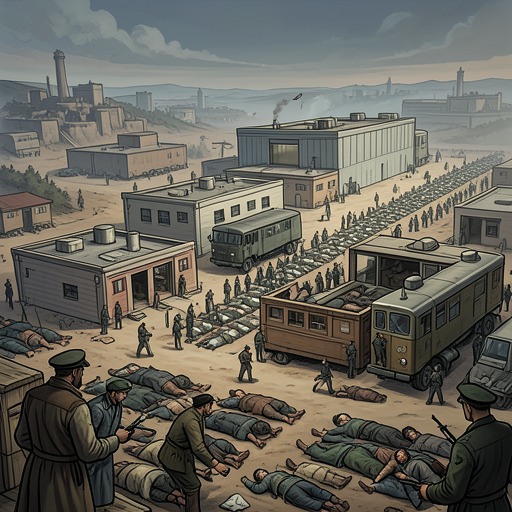
The country is evoked through the camp’s sites and routines rather than through a broad description of Polish territory. At Bunker 3, Angelus Thomsen arrives in its windowless basement, where officials have gathered before the Polish prisoners are brought in. The scene makes the geography institutional and immediate: a basement, a yard, armed guards, and an assembly of men whose lives are subject to decisions made by their captors.
The prisoners are members of the Polish Home Army. Their appearance unsettles the expectations of the camp authorities: they are numerous, physically powerful, and carry themselves with the bearing of soldiers. Thomsen’s fleeting admiration for their fighting spirit sits uneasily beside his role within the system holding them captive. Poland here is not merely a national designation; it is the home and political allegiance that the prisoners’ captors use to identify them, while also threatening their families to compel their compliance.
Bunker 3 and the execution
The prisoners are told that they will be shot that afternoon. Their captors explain that the men have been withholding information from their centre because it does not understand the camp’s military value. The threat extends beyond the prisoners themselves: the authorities invoke parish registers and warn that their relatives may be deported and killed. The episode exposes how hostage-taking and collective punishment are used to control resistance.
The execution does not proceed without opposition. A small group barricades itself in the yard and chooses to fight; the barricade is quickly overrun. The remaining 291 men are shot between 17:10 and 17:45. Afterward, the officer who reports that the operation went smoothly calls it exemplary, a cool administrative judgment set against the killing it describes. Bunker 3 thus concentrates the gap between bureaucratic composure and the physical reality of mass execution.
Buried testimony and the work of remembering
The Polish camp setting also holds a record of violence concealed for later discovery. Josef, a Czech Jew from Brno, writes an eight-page testimony in Yiddish and hides it inside a child’s galosh beneath the hedgerow bordering Doll’s garden. After debate and a vote, the Sonderkommando prisoners decide to exhume the manuscript temporarily and read it. The document’s concealment turns the garden’s edge into both a hiding place and a fragile archive.
The reading does not offer simple mastery over what happened. As the narrator begins to recite the account of a five-year-old girl, he stops and says that the story may be mixed up. The hesitation matters: the act of bearing witness depends on a damaged, difficult-to-order record, not on a seamless account. In Poland, the manuscript and the execution at Bunker 3 give remembrance two sharply different forms: one concealed and recovered, the other carried out openly by the camp authorities.
Violence, spectacle, and the landscape
The camp grounds also frame public Nazi ritual. At the Farben Kat Zet, a sick kite hangs above an oak near the scaffold and the Appellplatz, a recurring image associated with the commandant’s world. The bird’s suspended presence gives the setting a visual counterpoint to the camp’s claims of order: a living creature appears unable, or unwilling, to move on.
At a November 9 memorial ceremony, Paul Doll speaks beneath a darkening sky, invoking the dates 1918, 1938, and 1923 while presenting Nazi history as a story of injury and national grievance. The ceremony’s rhetoric attempts to turn the perpetrators’ political mythology into public remembrance. Read beside Josef’s hidden testimony and the shooting of the Polish prisoners, it shows how Poland’s camp landscape is made to hold both the violence itself and competing efforts to define what that violence means.